
Packaging Guides
Wholesale Mylar Bags: Bulk Buying Guide, Pricing, and How to Choose a Supplier (2026)
Humizair by Cubit
April 14, 2026
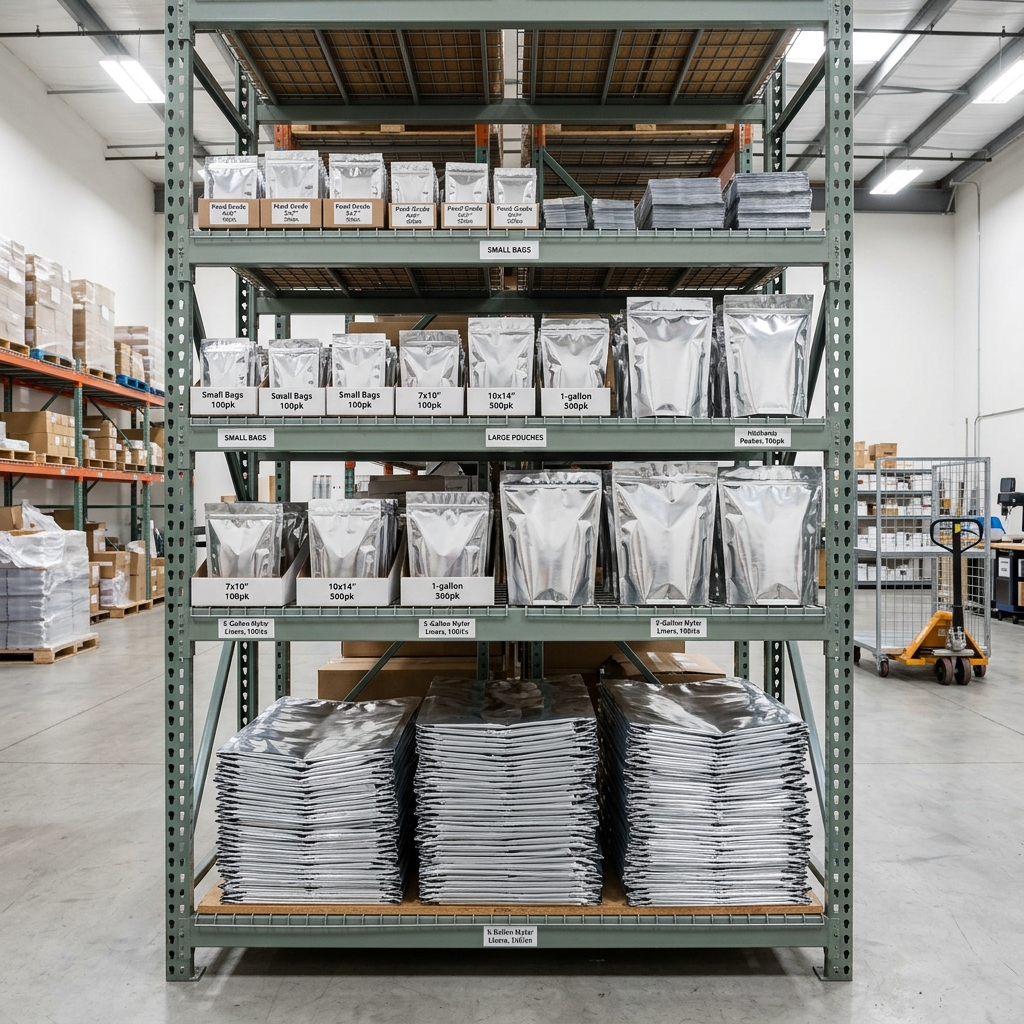
Whether you are a prepper buying 5-gallon bucket liners in bulk, a small food brand packaging your first product line, or an established company sourcing 50,000 custom-printed pouches per month — buying mylar bags wholesale is one of those decisions that seems straightforward until you start comparing options and realize the market is full of confusing specs, unclear pricing, and wildly inconsistent quality.
This guide cuts through the noise with concrete pricing data, specification benchmarks, and a clear framework for evaluating suppliers.
Before comparing prices, you need to speak the same language as your supplier. Here are the specifications that actually matter:
One mil equals one-thousandth of an inch (0.001"). Mylar bag thickness is measured as the total thickness of all laminated layers combined.
| Thickness | Common Use | Wholesale Price Range (per bag) |
|---|---|---|
| 2–3 mil | Samples, sachets, short-term storage | $0.03–$0.08 |
| 3.5–4 mil | Retail food, coffee, snacks (1–2 year shelf life) | $0.05–$0.12 |
| 5 mil | Long-term food storage (5–15 years) | $0.08–$0.18 |
| 7–7.5 mil | Premium long-term storage (20–30 years) | $0.12–$0.25 |
Quotable fact: The difference between a 3.5 mil and 7 mil mylar bag is approximately $0.07–$0.13 per unit — but the difference in oxygen transmission rate is 4–6x, meaning the thicker bag provides dramatically better long-term protection per dollar spent.
Quality mylar bags are not a single material — they are multi-layer laminates. The most common structures:
| Structure | Layers | Performance | Cost |
|---|---|---|---|
| PET/PE | 2 layers | Basic barrier, metalized | $ |
| PET/AL/PE | 3 layers (with aluminum foil) | Excellent barrier | $$ |
| PET/VMPET/PE | 3 layers (vacuum metalized) | Very good barrier, more flexible | $$ |
| PET/AL/NY/PE | 4 layers (with nylon for puncture resistance) | Premium barrier + strength | $$$ |
For food storage applications, PET/AL/PE (with true aluminum foil) provides the highest barrier performance. For retail packaging where flexibility and print quality matter, PET/VMPET/PE is often the better choice.
| Style | Best For | Selfstanding? |
|---|---|---|
| Flat pouch | Samples, sachets, small quantities | No |
| Stand-up pouch (SUP) | Retail, food, consumer products | Yes |
| Side-gusseted bag | Coffee, bulk items, industrial | Partially |
| Flat-bottom (box pouch) | Premium retail, gift items | Yes (wide base) |
| Bucket liner | 5-gallon food storage | No (goes inside bucket) |
Pricing for wholesale mylar bags depends on five main variables:
| Quantity Range | Price Impact | Typical Per-Unit Savings |
|---|---|---|
| 500–1,000 | Base price | — |
| 1,000–5,000 | 10–15% below base | $0.01–$0.03 saved |
| 5,000–10,000 | 20–30% below base | $0.03–$0.06 saved |
| 10,000–50,000 | 35–50% below base | $0.05–$0.10 saved |
| 50,000+ | 50–65% below base | $0.08–$0.15 saved |
Larger bags use more material. A rough rule of thumb: doubling the bag surface area increases material cost by approximately 60–70% (not 100%, because fixed costs like zipper and seal remain similar).
| Feature | Additional Cost Per Bag |
|---|---|
| Resealable zipper | +$0.01–$0.03 |
| Tear notch | +$0.005–$0.01 |
| Hang hole | +$0.005–$0.01 |
| Degassing valve | +$0.02–$0.05 |
| Child-resistant zipper | +$0.05–$0.15 |
| Clear window | +$0.01–$0.03 |
| Euro/round hang slot | +$0.01–$0.02 |
| Print Method | Per-Unit Cost | Best For | Setup Cost |
|---|---|---|---|
| No print (stock) | $0.00 | Storage, repackaging | None |
| Hot stamp (1–2 colors) | +$0.02–$0.05 | Simple logos | $50–$200 |
| Digital (full color) | +$0.15–$0.45 | Short runs, photo-quality | None–$50 |
| Flexographic | +$0.08–$0.20 | Mid-range runs | $300–$1,000 |
| Rotogravure | +$0.05–$0.15 | High-volume, best quality | $800–$2,500 |
As shown in the thickness table above, going from 3.5 mil to 7 mil roughly doubles the material cost component.
To give you concrete numbers, here are representative wholesale prices for common mylar bag orders in 2026:
| Bag Description | Qty: 1,000 | Qty: 5,000 | Qty: 25,000 |
|---|---|---|---|
| 1-gallon flat pouch, 5 mil, plain | $0.12 | $0.09 | $0.06 |
| 12 oz stand-up pouch, 4 mil, zipper, plain | $0.10 | $0.08 | $0.05 |
| 12 oz SUP, 4 mil, zipper, custom digital print | $0.45 | $0.35 | — |
| 12 oz SUP, 4 mil, zipper, custom gravure print | — | — | $0.18 |
| 5-gallon bucket liner, 7 mil, plain | $0.22 | $0.17 | $0.12 |
| 3.5g CR pouch, 5 mil, custom digital print | $0.55 | $0.42 | — |
Prices are estimates based on 2026 market averages and will vary by supplier, material source, and shipping location.
Not all suppliers are equal. Here is a checklist for vetting potential partners:
Before contacting suppliers, know your answers to:
Get quotes from at least two suppliers for comparison. Provide identical specifications to each to ensure apples-to-apples pricing.
Order samples of the specific bag type and size you plan to purchase. Check for:
Confirm pricing, lead time, shipping terms, and payment schedule in writing before proceeding. For first orders, many suppliers require 50% deposit with balance due before shipping.
When your order arrives, inspect a random sample of 1–2% of the total quantity. Check dimensions, thickness, seal integrity, print quality (if applicable), and correct bag count.
For stock (unprinted) mylar bags, many suppliers sell by the case with no formal MOQ — typically 100–500 bags per case. For custom-printed bags, the minimum order quantity depends on the printing method: digital printing starts at 500–1,000 bags, flexographic at 3,000–5,000, and rotogravure (gravure) at 10,000–25,000 bags. Cubit Packaging offers custom-printed mylar bags starting at 500 units.
Measure the dimensions of your product (length, width, height for 3D items, or weight for granular products), then add 1–2 inches to the width and 3–4 inches to the height for headspace and sealing clearance. For food products, most suppliers publish a fill-weight chart showing how many ounces or grams each bag size accommodates. When in doubt, order sample bags in two sizes and test with your actual product.
International suppliers (primarily from China) often offer lower per-unit prices, but the total landed cost must include: ocean freight ($0.02–$0.05/bag for small orders), customs duties (typically 3–6% for flexible packaging), import brokerage fees, and lead times of 6–12 weeks. For orders above 50,000 units, overseas sourcing can be 20–40% cheaper. For orders below 10,000 units, domestic suppliers are usually more cost-effective when you factor in shipping, communication efficiency, and sample turnaround times.
At minimum, food-grade mylar bags must comply with FDA 21 CFR (Code of Federal Regulations) for food-contact materials. Additional certifications that enhance credibility and open market access include: BRC (British Retail Consortium) for food safety management, ISO 9001 for quality management systems, and SGS or Intertek third-party testing reports confirming material composition and contamination levels. For organic products, verify that the packaging materials are free of prohibited substances under USDA NOP (National Organic Program) guidelines.
Yes. Digital printing technology has made short-run custom packaging accessible for small businesses and startups. Many manufacturers — including Cubit Packaging — offer full-color custom-printed mylar bags starting at just 500 units. The per-unit cost is higher than high-volume gravure printing, but the elimination of plate charges and setup fees makes the total project cost much lower for small orders. A typical 500-unit order of custom 12 oz stand-up pouches costs approximately $225–$400 total.
Ready to source wholesale mylar bags for your business? Cubit Packaging offers competitive wholesale pricing, no minimum for stock bags, 500-unit minimum for custom printing, and dedicated account support from quote to delivery. Get your wholesale quote →
Design your packaging free in 60s
Try the free AI packaging design toolReady to Order Custom Mylar Bags?
Custom printed mylar bags from 500 units. Food-grade, smell-proof, child-resistant options. Free design support + 3D mockup.