
Compliance
Food Grade Mylar Bags: FDA Compliance, Certifications & How to Verify Food Safety (2026)
Humizair by Cubit
April 14, 2026
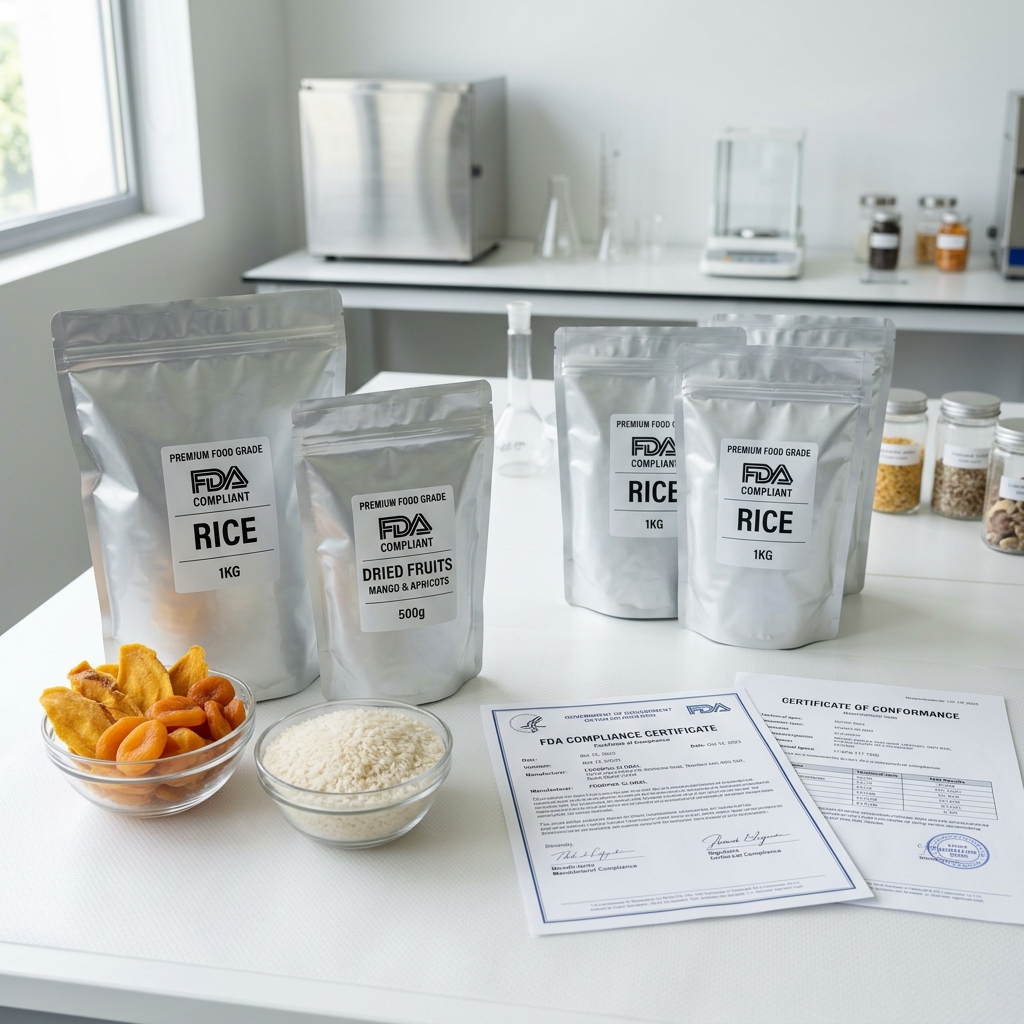
The term "food grade" gets thrown around so casually in the packaging industry that it has almost lost meaning. Amazon listings, Alibaba suppliers, and even some established brands will stamp "food grade" on their mylar bags without providing any documentation, testing data, or regulatory reference to back up the claim.
If you are packaging food for commercial sale, storing food long-term for your family, or sourcing bags for a food brand, you need to understand what "food grade" actually means in a regulatory context — and how to verify it before you trust your product (or your health) to a supplier's marketing copy.
In the United States, food-grade packaging is regulated primarily by the U.S. Food and Drug Administration (FDA) through the Federal Food, Drug, and Cosmetic Act (FD&C Act). The key regulatory framework is:
These sections of the Code of Federal Regulations specify which materials, additives, coatings, adhesives, and components are safe for use in food-contact applications. The critical parts for mylar bags are:
| CFR Section | What It Covers | Relevance to Mylar Bags |
|---|---|---|
| 21 CFR 174 | Indirect food additives: general | Overall regulatory framework |
| 21 CFR 175 | Indirect food additives: adhesives and coatings | Laminating adhesives between mylar layers |
| 21 CFR 176 | Indirect food additives: paper and paperboard | Applies to kraft-paper exterior bags only |
| 21 CFR 177.1520 | Olefin polymers | Polyethylene (PE) inner sealant layer |
| 21 CFR 177.1630 | Polyethylene terephthalate (PET) | The mylar (BoPET) film layer itself |
| 21 CFR 178 | Indirect food additives: adjuvants, production aids | Inks, solvents, processing aids |
Quotable definition: A food-grade mylar bag is a flexible pouch where every material layer — the BoPET film, aluminum coating, laminating adhesive, inner sealant, printing inks, and any coatings — individually complies with the applicable sections of FDA 21 CFR Parts 174–178 for the bag's intended use conditions (food type, temperature, and duration of contact).
The FDA does not test or "approve" individual finished packaging products. The responsibility falls on the manufacturer to ensure that all materials used in their packaging meet the applicable FDA regulations. When a mylar bag supplier says their bags are "FDA compliant," they are certifying that:
This distinction matters because there is no FDA database where you can look up whether a specific bag model is "approved."
A Letter of Guarantee (also called a Letter of Compliance or Continuing Guarantee) is a legal document from the manufacturer or supplier stating that their product complies with the applicable FDA regulations. It typically includes:
Any reputable supplier will provide this on request. If a supplier refuses or claims they "don't have" compliance documentation, treat it as a major red flag.
For commercial food packaging, particularly for products stored at elevated temperatures or containing acidic, fatty, or alcoholic foods, you may need migration test reports. These tests measure whether any substances from the packaging material transfer (migrate) into the food at unsafe levels.
Common migration tests:
| Test | What It Measures | When Required |
|---|---|---|
| Overall migration | Total amount of any substance that migrates into food or food simulants | General food contact compliance |
| Specific migration | Migration of specific known substances (e.g., a particular plasticizer) | When specific chemical concerns exist |
| Sensory testing | Whether the packaging imparts any taste, odor, or color to food | Quality assurance (not regulatory requirement) |
Migration testing is usually performed by accredited third-party labs like SGS, Intertek, Bureau Veritas, or TÜV.
Beyond basic FDA material compliance, these certifications indicate a higher level of quality control:
| Certification | What It Means | Who Issues It |
|---|---|---|
| BRC Packaging | British Retail Consortium food safety management standard for packaging manufacturers | BRC Global Standards |
| ISO 9001 | Quality management system certification (processes, not products) | Various accredited registrars |
| ISO 22000 | Food safety management system (integrates HACCP principles) | Various accredited registrars |
| SQF | Safe Quality Food certification — recognized by GFSI | SQFI (Food Marketing Institute) |
| SGS Tested | Products tested by SGS labs for specific regulatory compliance | SGS Global |
Yes. Standard mylar bags made from PET (polyethylene terephthalate) and PE (polyethylene) do not contain BPA (Bisphenol A). BPA is a chemical building block used in the production of polycarbonate plastics and epoxy resins — completely different chemistry from the polyester and polyethylene used in mylar bags.
The confusion often arises because:
Quotable fact: The PET polymer used in mylar bags is synthesized from ethylene glycol and terephthalic acid — a chemical pathway that does not involve BPA at any stage. The U.S. FDA has confirmed that PET does not contain BPA and is safe for food contact under normal conditions of use.
PFAS (per- and polyfluoroalkyl substances, sometimes called "forever chemicals") are a more legitimate concern in the packaging world. PFAS compounds have been used as grease-resistant coatings in some food packaging, particularly:
Standard mylar bags (PET/AL/PE structure) do not typically contain PFAS because their grease resistance comes from the inherent properties of the PET and PE layers, not from applied chemical coatings. However, some specialty mylar bags with added grease barriers or coatings could contain PFAS compounds.
To protect your brand:
Food-grade printing inks used on mylar bags must comply with FDA 21 CFR 178 and should be:
For custom-printed bags, verify that your supplier uses food-grade, low-migration inks and that printing is always on the outer layer of the laminate structure.
Use this checklist when evaluating any mylar bag supplier for food packaging:
Watch for these warning signs when evaluating suppliers:
| Red Flag | What It Suggests |
|---|---|
| ❌ "FDA approved" language | FDA does not approve packaging — suggests lack of regulatory knowledge |
| ❌ No documentation available | May not have actually tested materials for food contact compliance |
| ❌ Unusually low prices | Possible use of non-food-grade materials, recycled content, or inferior adhesives |
| ❌ Strong chemical odor inside bags | Possible solvent residue from adhesives or substandard manufacturing practices |
| ❌ "Food grade" claim with no CFR references | Generic claim without regulatory specificity |
| ❌ Refuses to provide samples | Cannot verify quality before committing to an order |
If your product carries USDA Organic certification, your packaging must not contain substances that could contaminate the product and compromise its organic status. This means:
If your mylar bags are manufactured on equipment that also produces bags for common allergen-containing products (nuts, dairy, soy, wheat), cross-contamination protocols should be in place. Request documentation of allergen management procedures, especially for bags intended for allergen-free food brands.
Food-grade mylar (PET/PE) is one of the most chemically inert packaging materials available. Under normal conditions of use — room temperature storage of dry goods — there is no measurable migration of harmful substances from the bag into the food. Migration risk increases at higher temperatures and with fatty or acidic foods, which is why FDA compliance is specified for particular conditions of use. If you are storing dry staples (rice, beans, flour, pasta) at room temperature, food-grade mylar is considered exceptionally safe.
No. Mylar (BoPET) is used across many industries — electronics, aerospace, industrial insulation — and these applications do not require food-grade materials, adhesives, or manufacturing conditions. Industrial-grade mylar may contain non-food-safe adhesives, coatings, or processing residues. Always purchase bags specifically manufactured and documented as food-grade for any food-contact application.
In practice, these terms are used interchangeably, but technically: "food-grade" typically refers to material compliance (the materials meet FDA 21 CFR requirements), while "food-safe" is a broader claim that the bag is safe for food contact under specific conditions. A bag can be made from food-grade materials but still not be food-safe if, for example, the manufacturing facility has contamination issues or the bag has been stored improperly before use.
Mylar bags themselves do not have a meaningful expiration date when stored properly (cool, dry, away from UV light). The BoPET film and PE sealant layers are stable for decades. However, the laminating adhesive that bonds the layers together can theoretically degrade over very long periods (10+ years in extreme conditions). For practical purposes, unused food-grade mylar bags stored in a clean, dry environment have a usable life of 5–10+ years with no degradation in performance.
Some are, some are not — and it is difficult to verify without documentation. When purchasing from marketplace sellers, always request a Letter of Guarantee or compliance documentation before using the bags for food. Reputable sellers will provide this information. Avoid sellers who list bags as "food grade" in the product title but do not reference any specific regulatory standard or provide supporting documentation. For commercial food brands, sourcing directly from a verified packaging manufacturer is strongly recommended over marketplace purchases.
Your food deserves packaging you can verify. Cubit Packaging provides full FDA compliance documentation — Letter of Guarantee, material specifications, and migration testing data — with every food-grade mylar bag order. Get verified food-grade packaging →
Expand your knowledge of mylar bag specifications and sourcing:
All Cubit mylar bags use FDA-compliant food contact materials (21 CFR compliant PET, aluminum foil, PE) — custom printed from $0.05/unit with child-resistant, ziplock, and heat-seal options.
Design your packaging free in 60s
Try the free AI packaging design toolReady to Order Custom Mylar Bags?
Custom printed mylar bags from 500 units. Food-grade, smell-proof, child-resistant options. Free design support + 3D mockup.