
Packaging Guides
Types of Mylar Bags: Every Style, Size & Feature Compared (2026 Guide)
Humizair by Cubit
April 14, 2026
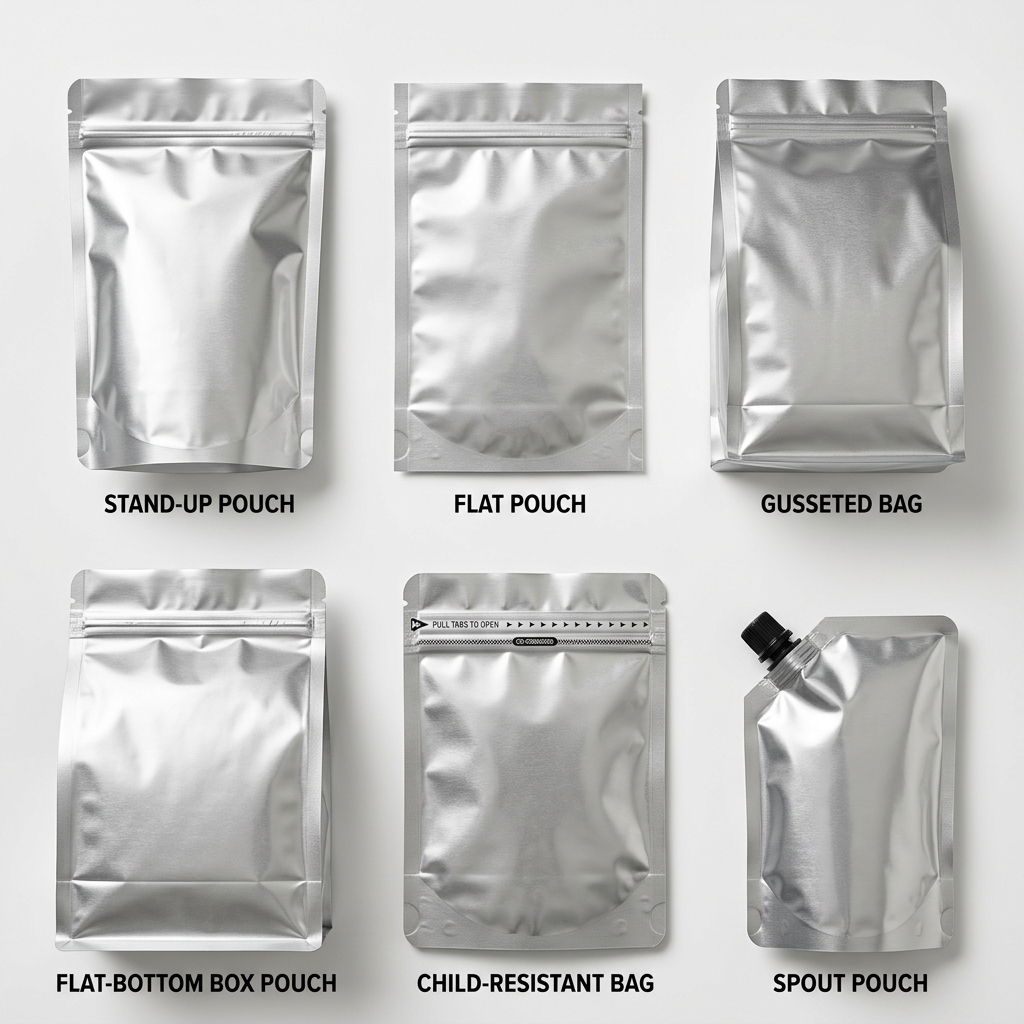
Walk into any grocery store, pet supply shop, or dispensary, and the packaging you see is dominated by mylar bags — in dozens of shapes, sizes, and configurations. But "mylar bag" is about as specific as saying "box." There are flat pouches, stand-up pouches, gusseted bags, flat-bottom bags, bucket liners, spout pouches, child-resistant bags, vacuum-compatible bags, and more.
Choosing the wrong type wastes money. Choosing the right one protects your product, elevates your brand, and satisfies regulatory requirements. This guide breaks down every common mylar bag format with honest comparisons.
The simplest mylar bag format — a flat, sealed pouch with no gussets, no bottom structure, and no standing capability.
Construction: Two sheets of mylar laminate heat-sealed on three sides (or four sides for a fully enclosed design).
| Specification | Details |
|---|---|
| Self-standing | ❌ No |
| Typical sizes | 2" × 3" to 12" × 18" |
| Cost per unit | $0.03–$0.15 (lowest of all formats) |
| Best for | Samples, sachets, spices, single-serve items, long-term food storage |
| Not ideal for | Retail shelf display, heavy products, products requiring resealing |
When to choose flat pouches:
The workhorse of modern flexible packaging. A bottom gusset allows the bag to stand upright on retail shelves, giving it the shelf presence of a rigid container at a fraction of the weight and cost.
Construction: Front panel, back panel, and a W-shaped or K-sealed bottom gusset. Optional resealable zipper at the top.
| Specification | Details |
|---|---|
| Self-standing | ✅ Yes |
| Typical sizes | 4 oz to 5 lb (3" × 5" to 10" × 15") |
| Cost per unit | $0.08–$0.40 |
| Best for | Retail food, coffee, snacks, pet treats, supplements, cannabis |
| Not ideal for | Bulk storage (5+ gallons), liquids without spout fitment |
When to choose stand-up pouches:
Quotable fact: Stand-up pouches account for more than 60% of the global flexible packaging market by volume, with annual growth of 5.8% projected through 2028 (Smithers Pira, The Future of Flexible Packaging to 2028).
A rectangular bag with inward-folding gussets on the left and right sides, creating a wider profile when filled while maintaining a compact footprint when empty.
| Specification | Details |
|---|---|
| Self-standing | Partially (sits on its bottom, but less stable than SUP) |
| Typical sizes | 8 oz to 5 lb |
| Cost per unit | $0.10–$0.35 |
| Best for | Coffee, tea, flour, granola, pet food |
| Not ideal for | Small portions, products needing wide-mouth opening |
When to choose side-gusseted bags:
A premium format that combines the convenience of a flexible pouch with the stability and shelf presence of a box. The flat bottom creates a wide, stable base.
| Specification | Details |
|---|---|
| Self-standing | ✅ Yes (widest, most stable base) |
| Typical sizes | 4 oz to 2 lb |
| Cost per unit | $0.15–$0.55 |
| Best for | Premium coffee, specialty food, luxury snacks, gift items |
| Not ideal for | Budget-sensitive products, bulk storage |
When to choose flat-bottom pouches:
Similar to flat pouches but specifically sized for single-serve applications — sugar packets, seasoning sachets, supplement powders, and sample packs.
| Specification | Details |
|---|---|
| Self-standing | ❌ No |
| Typical sizes | 1" × 3" to 4" × 6" (very small format) |
| Cost per unit | $0.02–$0.08 |
| Best for | Single-serve supplements, condiments, samples, travel sizes |
| Not ideal for | Anything larger than ~2 oz, retail shelf display |
Large-format flat pouches specifically designed to line food-grade 5-gallon buckets for long-term food storage.
| Specification | Details |
|---|---|
| Self-standing | ❌ No (goes inside a bucket) |
| Typical sizes | 18" × 28" to 20" × 30" (5-gallon capacity) |
| Typical thickness | 5–7.5 mil (heavier than retail bags) |
| Cost per unit | $0.15–$0.30 |
| Best for | Bulk food storage (rice, beans, wheat, oats), emergency preparedness |
| Not ideal for | Retail display, small quantities, branded packaging |
When to choose bucket liners:
Mylar pouches with integrated child-resistant closure mechanisms, designed to meet CPSC testing requirements (16 CFR § 1700.20). These are not optional for cannabis, many CBD products, and certain pharmaceutical items.
| Specification | Details |
|---|---|
| Self-standing | ✅ Yes (most CR bags are stand-up format) |
| Typical sizes | 3.5" × 5" to 6" × 9" |
| Cost per unit | $0.25–$0.80 (premium over standard due to CR mechanism) |
| Best for | Cannabis flower, edibles, CBD products, pharmaceuticals |
| Not ideal for | Food products not requiring CR, budget-sensitive products |
CR Mechanism Options:
| Mechanism | How It Works | Difficulty Rating |
|---|---|---|
| Press-and-slide zipper | Requires simultaneous pressing and sliding to open | ★★★★ |
| Tear-notch + CR reclose | Initial tear opening, CR zipper for subsequent use | ★★★★ |
| Button-lock | Push-button release mechanism | ★★★★★ |
| Pinch-and-pull | Requires pinching and pulling in specific sequence | ★★★★ |
Flexible pouches with an integrated plastic spout and cap for liquids and semi-liquids. The mylar laminate body provides barrier protection while the spout enables controlled pouring.
| Specification | Details |
|---|---|
| Self-standing | ✅ Yes (bottom gusset + spout at top) |
| Typical sizes | 4 oz to 64 oz |
| Cost per unit | $0.30–$0.80 |
| Best for | Cold brew coffee, sauces, baby food, liquid supplements, detergent |
| Not ideal for | Dry goods, products requiring wide-mouth access |
| Feature | Flat | SUP | Gusseted | Flat-Bottom | Sachet | Bucket Liner | CR Bag | Spout |
|---|---|---|---|---|---|---|---|---|
| Self-standing | ❌ | ✅ | ⚠️ | ✅ | ❌ | ❌ | ✅ | ✅ |
| Resealable zipper | Optional | ✅ | Optional | ✅ | ❌ | ❌ | ✅ (CR) | Cap |
| Retail shelf appeal | ★★ | ★★★★ | ★★★ | ★★★★★ | ★★ | ★ | ★★★★ | ★★★★ |
| Print surface area | ★★★ | ★★★★ | ★★★ | ★★★★★ | ★★ | ★ | ★★★★ | ★★★ |
| Cost efficiency | ★★★★★ | ★★★ | ★★★ | ★★ | ★★★★★ | ★★★★ | ★★ | ★★ |
| Liquid compatible | ❌ | ⚠️ | ❌ | ❌ | ❌ | ❌ | ❌ | ✅ |
| Child-resistant | ❌ | ❌ | ❌ | ❌ | ❌ | ❌ | ✅ | ❌ |
| Long-term storage | ✅ | ✅ | ✅ | ✅ | ❌ | ✅ | ✅ | ⚠️ |
Ask yourself these four questions in order:
Question 1: What is your product?
| Product Type | Recommended Bag Types |
|---|---|
| Dry food (rice, beans, flour) | Flat pouch, SUP, bucket liner |
| Snacks (chips, nuts, trail mix) | SUP, flat-bottom |
| Coffee | SUP with valve, side-gusseted with valve, flat-bottom with valve |
| Cannabis / CBD | CR bag (mandatory) |
| Liquids | Spout pouch |
| Supplements / powders | SUP, sachet/stick pack |
| Pet food / treats | SUP, side-gusseted |
| Samples / single-serve | Flat pouch, sachet |
Question 2: Where will it be displayed or stored?
| Environment | Best Formats |
|---|---|
| Retail shelf (standing) | SUP, flat-bottom, CR bag |
| Hanging on peg hook | Flat pouch or SUP with hang hole |
| Inside a bucket or bin | Flat pouch, bucket liner |
| Mailed to customer (DTC) | SUP, flat pouch |
| Dispensary shelf | CR bag |
Question 3: Any regulatory requirements?
| Regulation | Required Format |
|---|---|
| Cannabis/CBD (most states) | Child-resistant bag |
| Pharmaceutical (CPSC) | Child-resistant packaging |
| FDA food contact | Any food-grade format |
| Organic certification | PFAS-free materials |
Question 4: What is your budget?
| Budget Priority | Recommended Path |
|---|---|
| Lowest possible cost | Flat pouches, stock (unprinted) |
| Balanced cost and presentation | Stand-up pouches, digital print |
| Premium brand positioning | Flat-bottom pouches, gravure print, soft-touch finish |
Every mylar bag type (except bucket liners and basic sachets) can include these add-on features:
| Feature | Description | Added Cost |
|---|---|---|
| Resealable zipper | Press-to-close zipper for consumer resealing | +$0.01–$0.03 |
| Tear notch | Pre-cut notch for easy opening | +$0.005–$0.01 |
| Hang hole | Round or euro-slot hole for peg display | +$0.005–$0.01 |
| Degassing valve | One-way valve for CO₂ release (coffee, fermented foods) | +$0.02–$0.05 |
| Clear window | Transparent panel for product visibility | +$0.01–$0.03 |
| Rounded corners | Aesthetic upgrade, reduces snagging | +$0.005 |
| Laser scoring | Easy-peel or easy-tear feature | +$0.01–$0.02 |
| Matte or soft-touch finish | Premium tactile feel | +$0.02–$0.05 |
| Industry | Primary Format | Secondary Format | Key Feature |
|---|---|---|---|
| Coffee roasters | Side-gusseted or SUP | Flat-bottom (premium) | Degassing valve |
| Snack brands | Stand-up pouch | Flat-bottom (premium) | Resealable zipper |
| Emergency prepping | Bucket liner | Flat pouch | 7 mil thickness |
| Cannabis | CR bag | — | CPSC-tested CR mechanism |
| Pet food | Side-gusseted or SUP | — | Heavy-duty bottom gusset |
| Supplements | Stand-up pouch | Sachet (samples) | Zipper + tamper-evident |
| Sauces / liquids | Spout pouch | — | Spout fitment |
| Sample / trial | Flat pouch or sachet | — | Lowest cost per unit |
The stand-up pouch (SUP) is the most popular mylar bag format globally, accounting for over 60% of the flexible packaging market by volume. Its combination of self-standing shelf presence, resealable zipper option, excellent print surface, and moderate cost makes it the default choice for most retail food, coffee, snack, and supplement brands. The format was originally invented by French engineer Louis Doyen in 1962 and has become the industry standard for good reason.
No. Flat pouches lack the bottom gusset structure that allows stand-up pouches to remain upright on a shelf. If you fill a flat pouch and try to stand it up, it will fall over immediately. If you need shelf-standing capability, you must use a stand-up pouch, flat-bottom pouch, or side-gusseted bag. Flat pouches are designed for lying flat — in drawers, bins, buckets, or mailed envelopes.
For long-term food storage (10–30 years), flat pouches in 5–7 mil thickness are the most common choice because they offer the best cost-per-ounce ratio and fit efficiently inside 5-gallon buckets. Dedicated bucket liners (18" × 28" to 20" × 30") are specifically sized for this application. Stand-up pouches also work well for smaller quantities (1–2 lb portions) that you want to access individually without opening a large bag.
In most states with cannabis or CBD regulations, yes — child-resistant packaging is required for ingestible CBD products including gummies, tinctures, and capsules. Even in states without explicit CBD packaging laws, using CR packaging is considered a best practice for liability protection. CR mylar bags must meet the CPSC 16 CFR § 1700.20 testing standard, which requires that fewer than 20% of tested children (ages 42–51 months) can open the package within 5 minutes.
Spout pouches offer significant advantages over rigid bottles: they weigh 75–85% less (reducing shipping costs), use 60–70% less material, and lie flat when empty for efficient shipping and storage. The trade-off is that they have a shorter shelf life than glass bottles (12–18 months vs. 24+ months for glass) and cannot be pressurized. For cold brew coffee, sauces, baby food, and liquid supplements, spout pouches provide an excellent balance of barrier performance, cost, and sustainability.
Not sure which mylar bag type is right for your product? Cubit Packaging offers all 8 formats with custom sizing, printing, and feature options — from 500 units. Tell us about your product and we will recommend the right bag →
Dive deeper into specific mylar formats and applications:
Cubit offers custom printed mylar bags from $0.05/unit — smell-proof, food-grade barrier pouches with child-resistant, ziplock, and heat-seal options. 500 unit MOQ.
Design your packaging free in 60s
Try the free AI packaging design toolReady to Order Custom Mylar Bags?
Custom printed mylar bags from 500 units. Food-grade, smell-proof, child-resistant options. Free design support + 3D mockup.