
Industry Guides
Coffee Mylar Bags: Custom Packaging Guide for Roasters & Brands (2026)
Humizair by Cubit
April 14, 2026
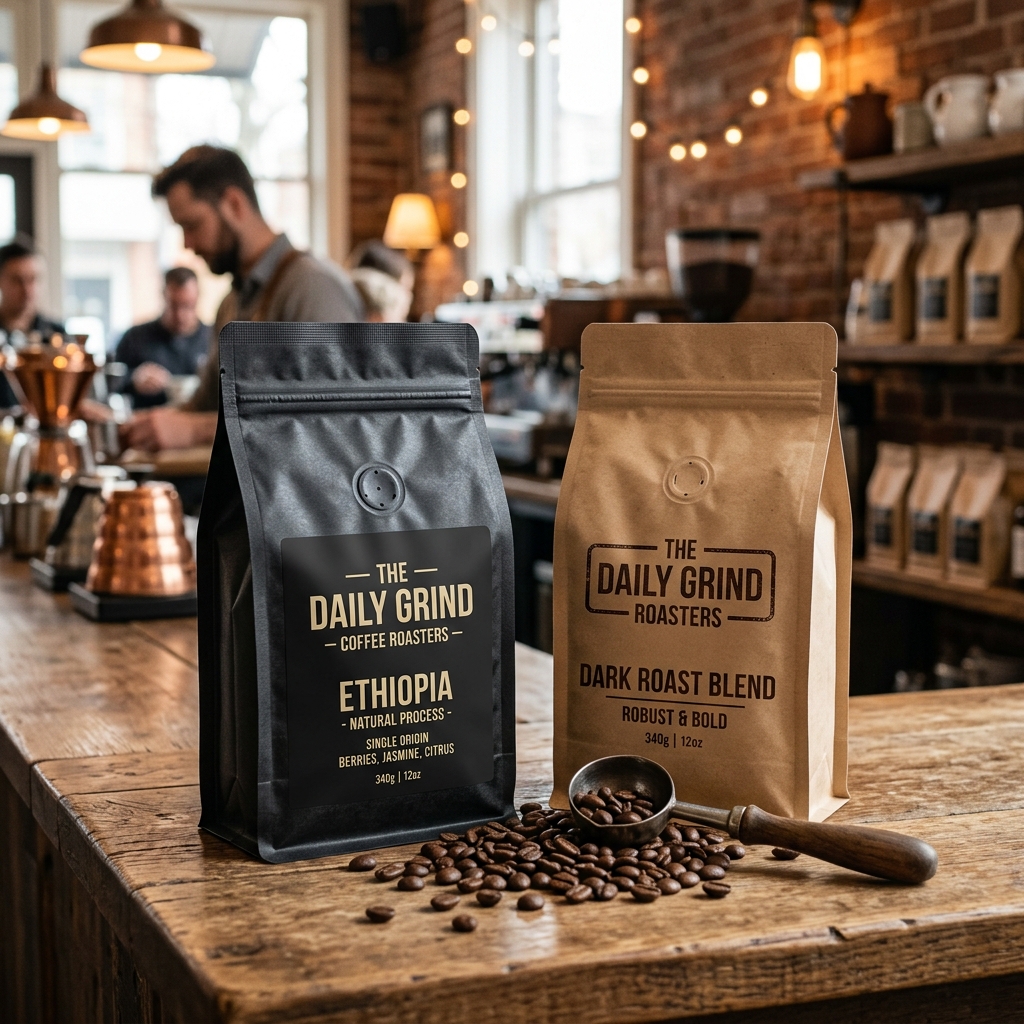
If you are a coffee roaster, you already know the uncomfortable truth: you can source the finest single-origin beans from Yirgacheffe, nail a perfect medium roast, and sell it to a customer who will not open the bag for three weeks. At that point, the packaging becomes the entire experience — and cheap packaging can turn a $22/lb specialty coffee into something indistinguishable from a $6 supermarket bag.
Mylar bags (specifically, multi-layer laminated pouches with BoPET + aluminum + PE layers) have become the packaging standard for specialty and commercial coffee alike. This guide covers everything you need to know: material science, valve technology, sizing, custom printing, and how to order at scale.
Oxygen — Causes oxidation of aromatic compounds and lipids, producing stale, cardboard-like flavors. Freshly roasted coffee has over 1,000 volatile aroma compounds that begin degrading immediately on contact with oxygen (Illy & Viani, Espresso Coffee: The Science of Quality, 2005).
Moisture — Coffee beans are hygroscopic with an ideal moisture content of 11–12%. Excess moisture leads to mold growth and accelerates staling. Below 8% moisture, beans become brittle and produce harsh, flat brews.
Light — UV and visible light catalyze the breakdown of chlorogenic acids and lipids, the compounds responsible for body and sweetness.
| Barrier Property | Paper Bag | Standard Poly Bag | Mylar Coffee Bag |
|---|---|---|---|
| Oxygen Transmission Rate | 5,000+ cc/m²/day | 150–400 cc/m²/day | 0.5–2.0 cc/m²/day |
| Moisture Vapor Transmission | Very high | 8–15 g/m²/day | 0.01–0.05 g/m²/day |
| UV Light Block | 0% | 10–20% | 99%+ |
| Typical Shelf Life | 1–2 weeks | 1–2 months | 6–12 months |
Quotable fact: Switching from paper bags to mylar pouches extends roasted whole-bean coffee freshness from approximately 14 days to 6–12 months — a 15–25x improvement in shelf life at a per-unit cost increase of only $0.10–$0.30.
Freshly roasted coffee releases significant amounts of carbon dioxide — up to 10 liters of CO₂ per kilogram of beans in the first 72 hours post-roast. If you seal freshly roasted beans in an airtight bag without a valve, one of two things happens:
A one-way degassing valve solves this by allowing CO₂ to escape while preventing external oxygen from entering. The valve is a simple pressure-activated diaphragm — when internal pressure exceeds ambient pressure, the valve opens; otherwise, it stays sealed.
| Format | Typical Sizes | Best For | Shelf Appeal |
|---|---|---|---|
| Stand-up pouch with zip | 8 oz, 12 oz, 16 oz, 2 lb | Retail / DTC subscription | ⭐⭐⭐⭐⭐ |
| Flat-bottom (box pouch) | 12 oz, 16 oz, 2 lb | Premium retail / gift | ⭐⭐⭐⭐⭐ |
| Side-gusseted bag | 1 lb, 2 lb, 5 lb | Wholesale / café supply | ⭐⭐⭐ |
| Flat pouch (pillow bag) | 2 oz, 4 oz sample sizes | Sampling / subscription | ⭐⭐⭐ |
The 12 oz stand-up pouch with a resealable zipper is the single most popular format in the North American specialty coffee market, accounting for an estimated 45% of all retail coffee bag sales (Specialty Coffee Association market report, 2025).
Custom-printed coffee bags transform your packaging from generic to brand-building. Here is what is available:
Based on packaging design research and specialty coffee market trends:
| Bag Size | Whole Bean Capacity | Ground Coffee Capacity | Common Use |
|---|---|---|---|
| 4 oz (quarter pound) | 110–115 g | 100–110 g | Sample packs, subscription add-ons |
| 8 oz (half pound) | 225–230 g | 210–220 g | Single-origin tasters |
| 12 oz (three-quarter pound) | 340 g | 320–330 g | Retail standard (most popular) |
| 16 oz (one pound) | 454 g | 430–440 g | Classic retail / café supply |
| 2 lb | 907 g | 860–880 g | Café and wholesale |
| 5 lb | 2,268 g | 2,150–2,200 g | Bulk / commercial accounts |
The main variables affecting per-unit cost:
The coffee industry is increasingly focused on sustainable packaging. Options for eco-conscious roasters include:
Whole bean coffee sealed in a quality mylar bag with a one-way degassing valve retains peak freshness for 6–12 months from the roast date. Ground coffee has a shorter peak window of 3–6 months due to the dramatically increased surface area exposed to any residual oxygen. For comparison, coffee in paper bags loses peak freshness within 1–2 weeks.
Pre-ground coffee off-gasses much less CO₂ than whole beans because the grinding process releases most of the trapped gas. For ground coffee that will be sealed 48+ hours after grinding, a degassing valve is optional — though it provides a margin of safety and consumers associate it with freshness quality.
For retail coffee (6–12 month shelf life), a total pouch thickness of 4–5 mil (combining all laminate layers) is standard. The critical factor is the aluminum layer thickness, not total material thickness. Look for bags with a minimum 7-micron aluminum foil layer or 12-micron metalized PET layer for optimal oxygen barrier performance.
Liquid products require different packaging considerations. Standard mylar stand-up pouches are not designed for liquids. However, spout pouches with mylar lamination are available for cold brew concentrate — they include a pour-spout fitment and are designed to hold liquids without leaking. Contact your packaging supplier for liquid-compatible options.
Look for bags manufactured to FDA 21 CFR (food contact material) standards with SGS or Intertek testing certification. For organic coffee, your packaging should be free of chemical contaminants that could compromise organic certification. Additional certifications to consider: BRC for food safety, ISO 9001 for quality management, and FSC for paper-component sourcing.
Your coffee deserves packaging as exceptional as the beans inside. Cubit Packaging offers custom mylar coffee bags with degassing valves, resealable zippers, and premium printing — available from 500 units. Design your custom coffee bag →
Cubit offers custom printed mylar bags from $0.05/unit — smell-proof, food-grade barrier pouches with child-resistant, ziplock, and heat-seal options. 500 unit MOQ.
📖 Read the complete guide: What Are Mylar Bags? The Complete Guide for 2026 — Everything you need to know about mylar bag types, materials, thickness, food safety, and more.
Order custom coffee mylar bags. Custom Mylar Bags with Degassing Valve → — printed with your brand, one-way valve, resealable zip. Browse all mylar bags →
Design your packaging free in 60s
Try the free AI packaging design toolReady to Order Custom Mylar Bags?
Custom printed mylar bags from 500 units. Food-grade, smell-proof, child-resistant options. Free design support + 3D mockup.