
Packaging Science
What Is Mylar Made Of? BoPET Material Science, Manufacturing & Properties Explained
Humizair by Cubit
April 14, 2026
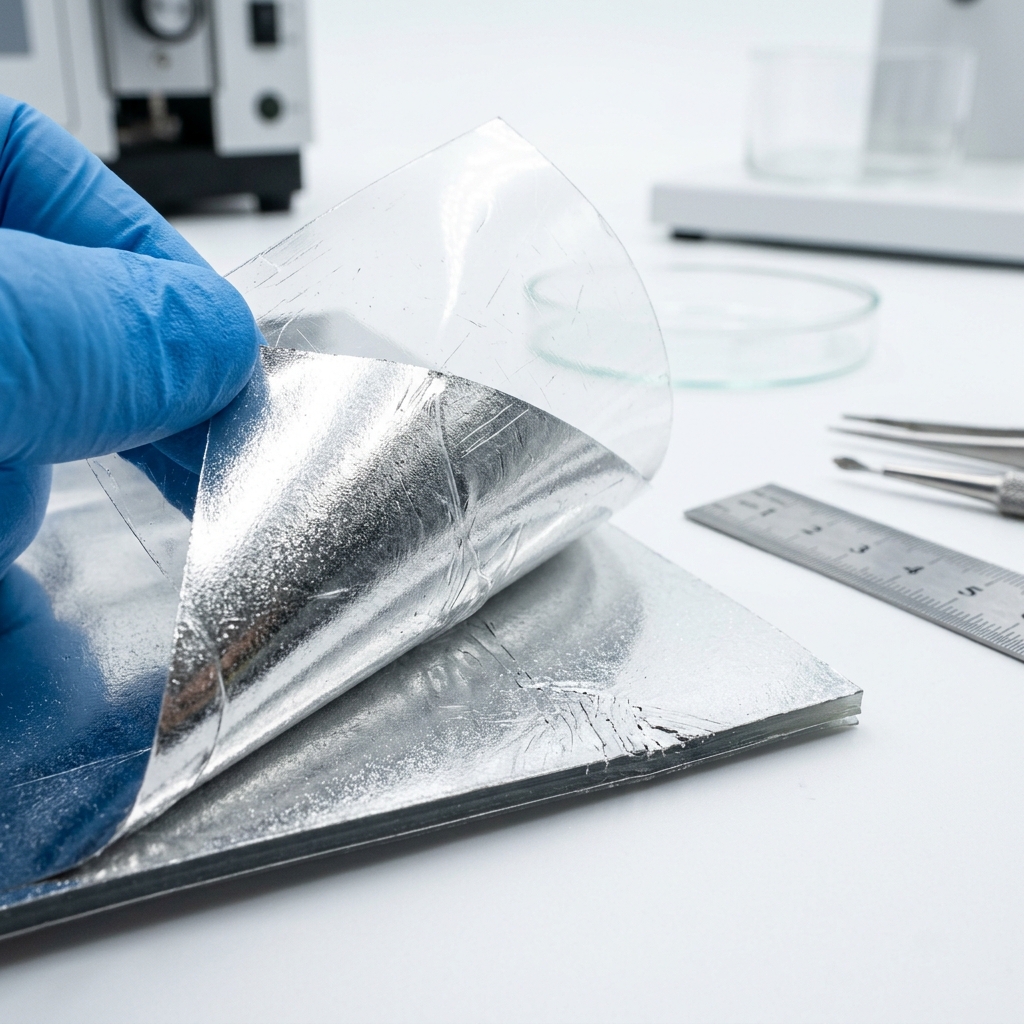
If you have ever searched "what is mylar?" you have probably encountered one of two types of answers: a one-sentence dictionary definition ("Mylar is a polyester film") or a 500-word product page trying to sell you bags. Neither actually explains what mylar is at a material level, why it works so well for packaging, or how the manufacturing process creates its unique properties.
This article is the explanation that should exist — written for people who want to understand the science, not just the marketing.
Mylar is a registered trademark (originally owned by DuPont Teijin Films, now Celanese Corporation) for a type of plastic film made from biaxially-oriented polyethylene terephthalate, abbreviated as BoPET.
In plain language: it is a polyester film that has been stretched in two directions during manufacturing to make it exceptionally strong, dimensionally stable, and resistant to gases and moisture.
Quotable definition: Mylar is biaxially-oriented polyethylene terephthalate (BoPET) — a thermoplastic polyester film stretched in two perpendicular directions during manufacturing to align its polymer chains, resulting in a material with high tensile strength (up to 31,000 psi), excellent gas barrier properties, and thermal stability up to 150°C (302°F).
Mylar starts as PET — the exact same polymer family used to make plastic water bottles, polyester clothing fiber, and food clamshell containers. PET is synthesized through a polycondensation reaction between two chemical building blocks:
When these two monomers react under heat and vacuum, they form long polymer chains with repeating ester linkages — hence the name "polyester." The resulting PET resin is a semi-crystalline thermoplastic with a melting point of approximately 260°C (500°F) and a glass transition temperature of about 75°C (167°F).
PET has several inherent advantages for film applications:
| Property | PET Value | Why It Matters |
|---|---|---|
| Tensile strength | 55–75 MPa (before orientation) | Good baseline mechanical strength |
| Clarity | 89–92% light transmittance | Excellent optical quality |
| Chemical resistance | Resistant to acids, alcohols, greases | Food-safe and durable |
| Moisture absorption | < 0.4% | Low moisture pickup |
| FDA status | Generally Recognized as Safe (GRAS) | Approved for food contact |
But raw, unoriented PET film is mediocre. It is the biaxial orientation process that transforms it into the high-performance material we call mylar.
The conversion of PET resin into BoPET film involves four critical stages:
PET resin pellets are dried (to below 50 ppm moisture content — critical to prevent hydrolytic degradation), then fed into a single-screw or twin-screw extruder where they are melted at 270–290°C. The molten polymer is pushed through a flat die (a precisely machined slot) to form a thick sheet, typically 600–800 microns.
This thick, molten sheet is immediately cast onto a chill drum — a large, highly polished, water-cooled rotating cylinder. The rapid cooling (quenching) prevents the polymer chains from crystallizing, producing an amorphous (non-crystalline) sheet. This amorphous state is essential for the next step: you cannot effectively stretch crystalline PET.
The amorphous sheet is reheated to just above its glass transition temperature (approximately 80–100°C) and then stretched lengthwise — in the direction the film is traveling through the production line — using a series of rollers running at progressively faster speeds.
Typical MD stretch ratio: 3.0–3.5x the original length.
This stretching aligns the polymer chains in the machine direction, dramatically increasing tensile strength in that axis.
The MD-stretched film then enters a stenter frame — a machine that grips the film edges with a series of clips mounted on two diverging rails. As the clips travel forward, the rails spread apart, stretching the film sideways (perpendicular to the machine direction) at temperatures of 90–120°C.
Typical TD stretch ratio: 3.0–4.0x the original width.
This second stretching aligns polymer chains in the transverse direction as well, creating a biaxially-oriented structure where the molecular chains are organized in a balanced, two-dimensional lattice.
Key insight: The biaxial orientation is what separates mylar from ordinary plastic wrap. By aligning polymer chains in two perpendicular directions, the film gains strength in all directions (isotropic properties) rather than being strong in only one axis.
The biaxially-stretched film passes through a heat-setting zone at temperatures between 160–220°C. This thermal treatment:
After heat setting, the film is cooled, edge-trimmed, and wound onto large master rolls for further processing.
The transformation is dramatic:
| Property | Unoriented PET | BoPET (Mylar) | Improvement |
|---|---|---|---|
| Tensile strength | 55–75 MPa | 190–220 MPa | 3–4x |
| Elongation at break | 300–400% | 70–130% | (stiffer, tougher) |
| Oxygen transmission rate | 80–120 cc/m²/day | 30–50 cc/m²/day | 50–60% reduction |
| Moisture vapor transmission | 15–20 g/m²/day | 7–10 g/m²/day | ~50% reduction |
| Haze | 2–5% | < 1.5% | Clearer |
| Thermal stability | Up to 100°C | Up to 150°C | +50°C |
| Dimensional stability | ±2% | ±0.1% | 20x more stable |
No. This is one of the most common misconceptions. Mylar is a plastic (polyester film), not a metal. The confusion arises because most packaging-grade mylar bags have a thin layer of aluminum applied to the surface through a process called vacuum metallization.
The BoPET film is placed inside a vacuum chamber (pressure reduced to approximately 10⁻⁴ mbar). Aluminum pellets are heated until they evaporate, and the aluminum vapor condenses onto the surface of the BoPET film in a uniform layer.
The aluminum coating is extraordinarily thin — typically 0.5–2.0 microns (500–2,000 nanometers), compared to the 12–250 micron thickness of the BoPET film itself. Despite being thinner than a human hair, this microscopic aluminum layer:
Some premium mylar bags use laminated aluminum foil (6–12 microns thick) instead of vacuum-deposited aluminum. This is 5–20x thicker than metallized coatings and provides even better barrier properties:
| Barrier Type | O₂ Transmission (cc/m²/day) | MVTR (g/m²/day) | Cost |
|---|---|---|---|
| Plain BoPET | 30–50 | 7–10 | $ |
| Vacuum metallized BoPET | 0.5–2.0 | 0.3–0.8 | $$ |
| Aluminum foil laminate | < 0.1 | < 0.05 | $$$ |
For packaging applications, BoPET film is almost always laminated (bonded) with other materials to create a multi-layer structure. Each layer serves a specific function:
| Structure | Layers | Outer → Inner | Applications |
|---|---|---|---|
| PET/PE | 2 | Polyester (print surface) → Polyethylene (heat-seal layer) | Basic packaging, sachets |
| PET/VMPET/PE | 3 | Polyester → Vacuum Metallized PET → Polyethylene | Snack bags, coffee bags, pet food |
| PET/AL/PE | 3 | Polyester → Aluminum foil → Polyethylene | Long-term food storage, pharmaceuticals |
| PET/AL/NY/PE | 4 | Polyester → Aluminum foil → Nylon → Polyethylene | Premium food storage, military MREs |
When a mylar bag is described as "5 mil" or "7 mil," that measurement refers to the total thickness of all laminated layers combined, not just the mylar (BoPET) film alone.
A typical 5 mil (127 micron) PET/AL/PE mylar bag might break down as:
| Layer | Material | Thickness | Percentage |
|---|---|---|---|
| Outer | BoPET | 12 µm | 9.4% |
| Barrier | Aluminum foil | 7 µm | 5.5% |
| Sealant | LDPE | 100 µm | 78.7% |
| Adhesive | Laminating adhesive | 8 µm | 6.3% |
| Total | 127 µm (5 mil) | 100% |
Important: A thicker bag is not always a better-performing bag if the extra thickness is all polyethylene (sealant layer) rather than being distributed to the barrier layers. When comparing bags, ask about the aluminum layer thickness specifically, not just the total mil rating.
While packaging is the most visible consumer application, BoPET/Mylar is used across dozens of industries:
Technically, Mylar is a brand name for BoPET — similar to how "Band-Aid" is a brand name for adhesive bandages. All Mylar is BoPET, but not all BoPET is Mylar. In everyday usage, the packaging industry uses "mylar" as a generic term for any BoPET-based packaging film, regardless of manufacturer. Other BoPET brand names include Hostaphan (Mitsubishi), Lumirror (Toray), and Melinex (Teijin DuPont).
Plastic wrap (cling film) is typically made from PVC (polyvinyl chloride) or LDPE (low-density polyethylene) — completely different polymers from the PET used in mylar. Plastic wrap is designed to stick and stretch but offers minimal barrier protection. Mylar (BoPET) is a rigid, dimensionally stable film engineered for high-barrier performance. The oxygen transmission rate of plastic wrap is approximately 3,000–8,000 cc/m²/day, compared to 0.5–2.0 cc/m²/day for metallized mylar — a difference of 1,500–16,000x.
Plain BoPET film is technically recyclable under resin code #1 (PET), the same stream as water bottles. However, multi-layer laminated mylar bags (PET/AL/PE) are generally not recyclable through standard municipal recycling programs because the bonded layers cannot be easily separated. Some specialty recyclers accept clean, sorted flexible film packaging. The packaging industry is developing mono-material alternatives (all-PET or all-PE structures) that maintain barrier properties while being fully recyclable.
Standard BoPET film has a continuous use temperature of up to 150°C (302°F) and a melting point of approximately 254°C (489°F). However, this applies to the BoPET layer only — the polyethylene sealant layer in most mylar bags softens at 120–130°C (248–266°F), which is why heat sealing works. Mylar bags should not be placed in a conventional oven, but they are safe for boiling water (100°C) and warm storage environments. For cooking applications, specialized oven-safe BoPET films (rated to 220°C) are available.
The biaxial orientation process gives BoPET a distinctive "crinkly" feel — it is stiffer, more dimensionally stable, and produces a characteristic sound when crumpled compared to the soft, stretchy feel of polyethylene bags. This stiffness comes from the oriented, semi-crystalline molecular structure. The metallized or foil-laminated versions feel even more rigid because the metal layer adds additional structural integrity to the film.
Understanding mylar at a material level helps you make better packaging decisions. Cubit Packaging manufactures custom mylar bags in all standard structures — from basic PET/PE to premium PET/AL/NY/PE — in thicknesses from 3 mil to 8 mil. Discuss your specifications with our team →
Now that you understand the material, apply that knowledge:
Design your packaging free in 60s
Try the free AI packaging design toolReady to Order Custom Mylar Bags?
Custom printed mylar bags from 500 units. Food-grade, smell-proof, child-resistant options. Free design support + 3D mockup.