
Mylar Bags for Freeze-Dried Food: Storage Guide, Shelf Life & Best Practices (2026)
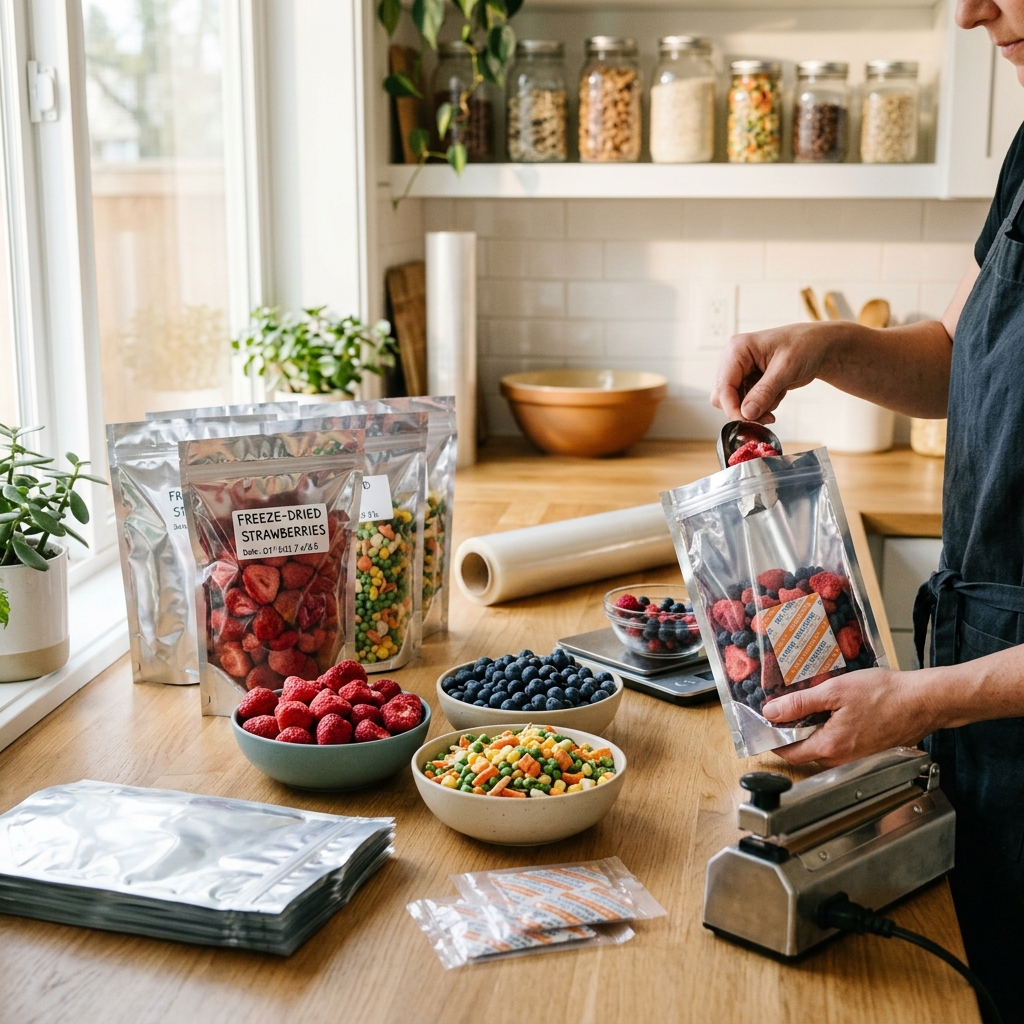
Key Takeaways
- Freeze-dried food stored in mylar bags with oxygen absorbers can last 25–30 years when sealed and stored correctly.
- Use 5–7.5 mil mylar bags — never thinner than 5 mil for long-term freeze-dried storage.
- Always add oxygen absorbers: 300–500 cc per gallon bag of freeze-dried food.
- Store below 70°F in a dark, dry location for maximum longevity.
- Never store freeze-dried food that isn't fully dry — residual moisture is the #1 cause of spoilage.
Freeze-dried food has become a staple of emergency preparedness, backpacking, and long-term food storage — and for good reason. The freeze-drying process (lyophilization) removes approximately 98–99% of moisture from food while preserving its original shape, color, and up to 97% of its nutritional value, according to research from the International Journal of Food Properties (Ciurzyńska & Lenart, 2011).
But here is the thing most people get wrong: freeze-dried food is incredibly hygroscopic. It acts like a sponge, aggressively pulling moisture and oxygen from the surrounding air. Without proper packaging, your $40 can of freeze-dried strawberries will degrade within months, not decades.
That is where mylar bags come in.
Why Mylar Bags Are the Gold Standard for Freeze-Dried Food
Mylar (biaxially-oriented polyethylene terephthalate) provides a triple barrier against the three enemies of freeze-dried food:
- Oxygen — Mylar's aluminum layer creates an oxygen transmission rate (OTR) as low as 0.5 cc/m²/day at 5 mil thickness, compared to 150+ cc/m²/day for standard polyethylene bags.
- Moisture — The moisture vapor transmission rate (MVTR) of quality mylar is below 0.02 g/m²/day, effectively locking out humidity.
- Light — The metalized layer blocks 99.9% of UV and visible light, preventing photodegradation of vitamins A, C, and B-complex.
Quotable fact: A 7 mil mylar bag with a proper heat seal provides a more reliable oxygen barrier than commercial #10 cans, at roughly one-fifth the cost per unit of stored food.
Choosing the Right Mylar Bag Thickness
| Thickness | Puncture Resistance | OTR Performance | Best For | Long-Term Viable? |
|---|---|---|---|---|
| 3.5 mil | Low | Moderate | Short-term (< 1 year) | ❌ No |
| 5 mil | Good | High | Medium-term (5–15 years) | ✅ Minimum |
| 7–7.5 mil | Excellent | Very high | Long-term (20–30 years) | ✅ Ideal |
The industry benchmark for long-term freeze-dried food storage in 2026 is 5 mil minimum, with 7–7.5 mil as the premium standard. The extra thickness provides meaningful puncture resistance — important because a single pinhole can compromise decades of storage.
Avoid Bags With Windows
Transparent windows in mylar bags may look appealing for retail display, but they defeat the entire purpose of light-blocking protection. For food meant to last decades, opaque, fully-metalized bags are non-negotiable.
Oxygen Absorbers: Sizing for Freeze-Dried Food
Freeze-dried food is inherently "fluffy" — it contains significantly more air space between pieces than dense foods like rice or wheat. This means you need larger oxygen absorbers than you might expect.
| Bag Size | Recommended OA Size | Notes |
|---|---|---|
| 1 Quart | 200–300 cc | Small portions, snack-sized |
| ½ Gallon | 300–500 cc | Individual meal portions |
| 1 Gallon | 500–1,000 cc | Standard storage size |
| 5 Gallon | 2,500–3,000 cc | Bulk storage in bucket liners |
Important: You cannot over-absorb. If you are unsure, always round up to the next size. An excess absorber simply stops reacting once all available oxygen is consumed.
Step-by-Step: Packing Freeze-Dried Food in Mylar
Step 1 — Verify the Food Is Fully Dry
This is the single most critical step. Freeze-dried food should feel crispy, crunchy, and snap when broken. If any pieces feel spongy, leathery, or cool to the touch, they still contain moisture and will spoil even in a perfectly sealed bag.
Test a sample by placing a few pieces in a sealed ziplock bag for 15 minutes. If condensation appears on the inside of the bag, the food needs more drying time.
Step 2 — Pre-Label the Bag
Write the contents, date, weight, and oxygen absorber size on the bag with a permanent marker before filling. Include any relevant prep instructions (e.g., "add 1 cup boiling water, wait 10 minutes").
Step 3 — Fill and Add Absorbers
Pour the freeze-dried food into the bag, leaving 3–4 inches of headspace. Drop the appropriate oxygen absorber packet(s) on top. Work quickly once you open the master absorber package — they begin absorbing ambient oxygen immediately.
Step 4 — Seal With a Heat Sealer
Use an impulse heat sealer for the most consistent results. Alternatives include:
- Clothes iron on wool/silk setting — press firmly for 3–5 seconds across the full width
- Hair straightener / flat iron — effective for smaller bags, but difficult to get a straight seal on larger bags
Run the sealer across the bag in one smooth pass. Inspect the seal for any gaps, wrinkles, or trapped food particles.
Step 5 — Secondary Packaging
Place your sealed mylar bags inside food-grade 5-gallon buckets with gamma-seal lids. This protects against:
- Rodent gnawing
- Accidental punctures from stacking
- Additional light exposure
- Physical impact during storage or transport
Step 6 — Confirm the Seal (24–48 Hours)
After 1–2 days, check each bag. It should feel firm and compressed against the food — almost vacuum-packed in appearance. If the bag remains puffy or loose, the seal is compromised. Cut it open, add fresh absorbers, and reseal.
Shelf Life Expectations
When properly packed in 7 mil mylar with oxygen absorbers and stored below 70°F:
| Food Type | Expected Shelf Life |
|---|---|
| Freeze-dried fruits | 25–30 years |
| Freeze-dried vegetables | 25–30 years |
| Freeze-dried meats | 15–25 years |
| Freeze-dried dairy | 15–20 years |
| Freeze-dried complete meals | 20–25 years |
Key factor: Temperature has the single greatest impact on shelf life. Storage at 90°F can reduce expected life by 50% or more. Every 10°F increase roughly halves the storage life.
Foods You Should NOT Freeze-Dry for Long-Term Mylar Storage
Not all foods survive the freeze-drying and long-term storage process well:
- High-fat foods (nuts, avocado, butter) — Fats go rancid even without oxygen over long periods
- High-sugar jams and syrups — May not fully freeze-dry; residual moisture causes spoilage
- Carbonated beverages — Obviously not suitable
- Chocolate — Fat bloom occurs over time regardless of packaging
Storage Environment Best Practices
| Factor | Ideal Condition | Why It Matters |
|---|---|---|
| Temperature | Below 70°F (21°C) | Chemical degradation accelerates with heat |
| Light | Complete darkness | UV degrades vitamins and causes off-flavors |
| Humidity | Below 15% RH | Even sealed mylar cannot protect against extreme humidity indefinitely |
| Elevation | Ground level or above | Basements may have moisture issues |
| Pest protection | Buckets with lids | Rodents can chew through mylar |
Frequently Asked Questions
How long does freeze-dried food last in mylar bags?
When stored in 5–7 mil mylar bags with properly sized oxygen absorbers at temperatures below 70°F, freeze-dried fruits and vegetables can last 25–30 years. Freeze-dried meats and dairy have slightly shorter shelf lives of 15–25 years due to residual fat content. The key variables are bag thickness, oxygen absorber sizing, seal integrity, and storage temperature.
Can I freeze-dry food at home and store it in mylar bags?
Yes. Home freeze dryers from brands like Harvest Right have made home freeze-drying accessible. The same mylar bag and oxygen absorber principles apply to home-processed food. The critical requirement is ensuring the food is completely dry before sealing — typically 24–36 hours in a home freeze dryer, depending on the food type and batch thickness.
Do I need a vacuum sealer for mylar bags?
No, a vacuum sealer is not required. The oxygen absorber removes the residual oxygen inside the sealed bag, achieving an even lower oxygen environment than most home vacuum sealers. However, pressing out excess air before heat-sealing reduces the workload on the absorber and results in a more compact package.
What is the difference between mylar bags and Foodsaver bags for freeze-dried food?
Standard Foodsaver (vacuum sealer) bags are made of polyethylene and nylon — materials with much higher oxygen and moisture transmission rates than mylar. They are suitable for short-to-medium-term freezer storage (1–3 years) but not for room-temperature long-term storage. Mylar bags with their aluminum barrier layer provide 50–100x better oxygen protection for decades-long shelf life.
Should I freeze my freeze-dried food before packing in mylar?
Freezing for 48 hours before packing can kill any insect eggs that may be present, especially in grains and legumes. However, for commercially processed freeze-dried food that has already been through quality control, this step is generally unnecessary. If you are freeze-drying garden produce at home, a 48-hour freeze as a precaution is reasonable.
Freeze-dried food is an investment — protect it with packaging that matches its longevity. Cubit Packaging manufactures food-grade mylar bags in custom sizes and thicknesses, with options for branded printing and child-resistant closures. Request a free quote →
Related Storage & Preparation Guides
- Mylar Bags and Oxygen Absorbers — Complete oxygen absorber sizing and usage guide for food storage.
- How to Seal Mylar Bags — Step-by-step sealing techniques for airtight long-term storage.
- Mylar Bag Thickness Guide — Why 5–7.5 mil is the standard for long-term freeze-dried storage.
- How Long Do Mylar Bags Last? — The science behind 25–30 year shelf life claims.
- Food Grade Mylar Bags — Verify food-safety certification before storing food.
Shop Storage-Grade Mylar Bags
- Flat Mylar Bags — Ideal for bucket liners and bulk food storage
- Custom Mylar Bags — Custom sizing for your freeze-dried products
- Mylar Bags — Full product catalog
Need Custom Mylar Bags for Freeze-Dried Food?
FDA food-grade mylar bags optimized for long-term food storage. Triple-layer barrier, heat-seal ready. From $0.05/unit, 500 MOQ.
Browse Custom Mylar Bags →