
Troubleshooting
Mylar Bag Problems: 10 Common Defects, Causes & How to Fix Them (2026)
Humizair by Cubit
April 14, 2026
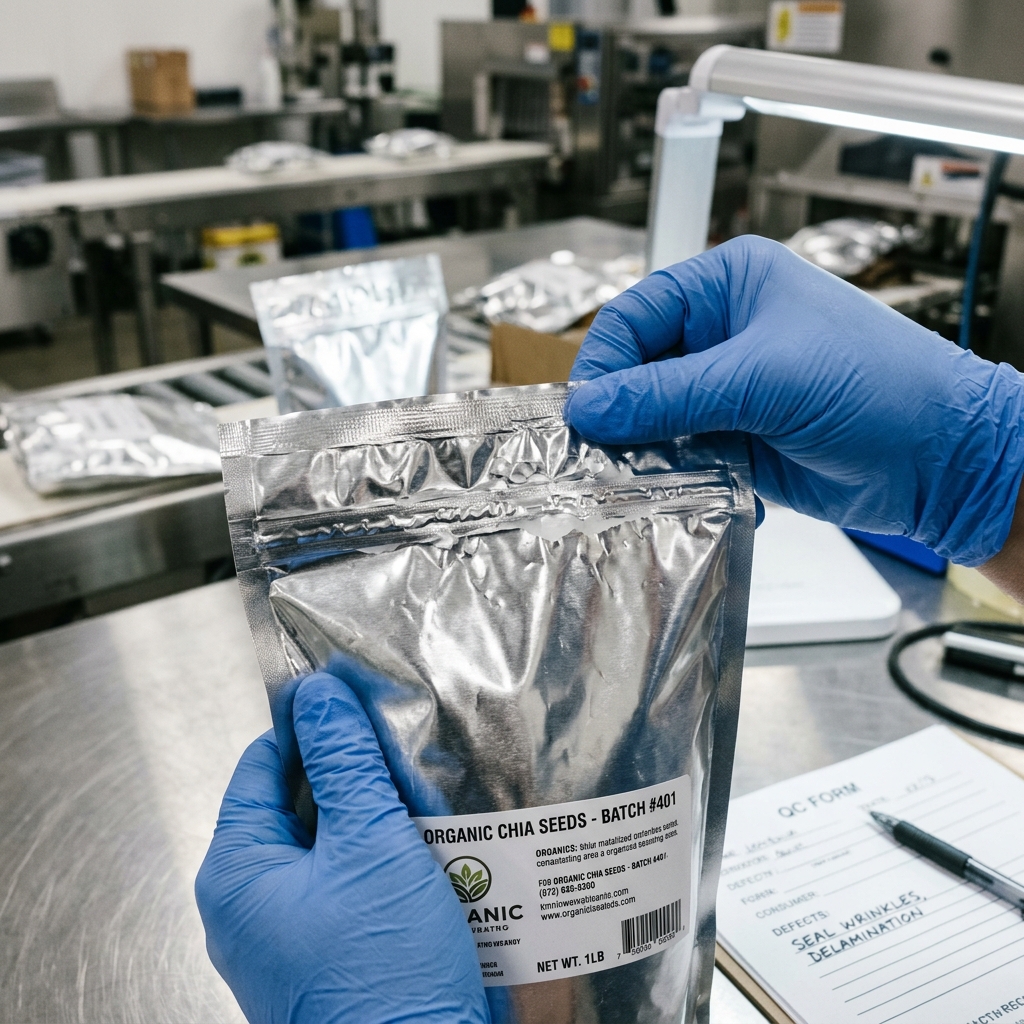
You sealed 50 mylar bags of rice for long-term storage, stacked them in buckets, and felt accomplished — until three months later, you opened a bucket and found half the bags were still puffy. No vacuum effect. The food smelled stale. Weeks of work, wasted.
Or maybe you are a food brand that received 10,000 custom-printed mylar pouches from a supplier, and the print is peeling, the bottom gussets are leaking, or the bags arrived with visible wrinkles that make your product look cheap.
These are not rare scenarios. Mylar bag defects are common, predictable, and — with the right knowledge — almost entirely preventable. This guide covers the 10 most frequent problems, explains exactly why they happen, and tells you how to fix them.
What it looks like: The bag does not hold vacuum. It remains puffy or loose after oxygen absorbers should have compressed it. You can pull the seal apart with light finger pressure. Air escapes when you squeeze the bag.
| Cause | Why It Happens |
|---|---|
| Temperature too low | The polyethylene sealant layer does not reach melt temperature (120–140°C), so the layers do not fuse |
| Temperature too high | Film shrinks, distorts, or melts through completely, creating holes in the seal |
| Contamination in seal zone | Food particles, dust, oil, or moisture trapped between the layers prevent bonding |
| Insufficient dwell time | The sealer does not hold pressure long enough for the PE to melt and flow together |
| Wrinkles in seal area | Creased material creates channels that bypass the sealed area |
Quotable fact: According to packaging industry data, contamination in the seal zone accounts for an estimated 35–40% of all heat-seal failures in flexible packaging — making it the single most preventable defect.
What it looks like: Visible creases, folds, or ridges running through the sealed portion of the bag. The seal may feel bumpy or uneven when you run your finger across it.
What it looks like: The bag appears sealed, but does not compress around the food after absorbers are added. You may hear a faint hiss when squeezing the bag near the seal. Under magnification, you can see a narrow channel where air passes through folded material.
Tunneling is almost always caused by wrinkles trapped inside the seal — tiny folds that create microscopic passages for air. Even a crease less than 0.5 mm wide can compromise storage that was intended to last decades.
What it looks like: The mylar bag layers visibly separate — you can see bubbles, cloudiness, or the aluminum layer peeling away from the outer PET or inner PE layer. The bag may feel papery or thin in affected areas.
| Cause | Details |
|---|---|
| Manufacturing defect | Insufficient adhesive application or incomplete adhesive curing during lamination |
| Overheating during sealing | Excessive heat degrades the laminating adhesive between layers |
| Chemical incompatibility | Contents with high acid, alcohol, or solvent content attacking the adhesive |
| Age and UV exposure | Prolonged exposure to sunlight breaks down adhesive bonds over years |
| Physical stress | Repeated flexing, folding, or impact damage |
What it looks like: Tiny holes in the bag material — sometimes visible, sometimes only detectable when the bag fails to compress with absorbers or when you hold the bag up to a bright light and see pinpoints of light shining through.
Industry benchmark: A quality 5 mil mylar bag should withstand 2.5–3.0 kg/cm² (35–42 psi) of burst pressure without puncturing. If your bags fail below this threshold, the material is substandard.
What it looks like: Product leaks from the bottom corners or center of a stand-up pouch, often discovered when the bag is placed upright and granular product slowly sifts out.
The bottom gusset is the most structurally complex part of a stand-up pouch — the film transitions from 2 layers to 4 layers at the gusset center. This creates what the industry calls the "triangle of death" — the intersection point where the side seal meets the bottom gusset fold.
| Cause | Explanation |
|---|---|
| Insufficient heat at 4-layer junction | The center of the gusset requires more heat to seal 4 layers than the sides need for 2 |
| Misaligned gusset | If the gusset fold is not centered, one side seals through 4 layers while the other only seals 2 |
| Uneven jaw pressure | Worn or misaligned sealing jaws cannot compensate for the thickness variation |
| Material incompatibility | Sealant layer too thin to flow into the gaps at multi-layer junctions |
What it looks like: Printed graphics, text, or colors rub off, flake, or peel away during handling, shipping, or storage. The printed design looks scratched or worn in areas of frequent contact.
| Cause | Details |
|---|---|
| Ink adhesion failure | Incorrect ink formulation for the substrate (PET vs. VMPET vs. kraft) |
| Missing or insufficient coating | No overprint varnish (OPV) or lacquer to protect the ink layer |
| Surface energy mismatch | PET film not properly corona-treated before printing |
| Abrasion during shipping | Bags rubbing against each other in transit without protective packaging |
What it looks like: Opening a new bag reveals a noticeable chemical, solvent, or plastic smell on the interior surface. This does not dissipate quickly.
What it looks like: The resealable zipper does not close properly, will not stay closed, or opens too easily. The zipper track may feel misaligned or split when running your finger across it.
| Cause | Details |
|---|---|
| Zipper track damaged during sealing | Heat from the seal bar deformed the zipper profile |
| Food debris in zipper track | Granular or powdery products contaminate the interlocking mechanism |
| Manufacturing misalignment | Zipper track not centered or applied at an angle |
| Excessive opening/closing | Zipper mechanism wears out after many cycles (typically 15–30 cycles for press-to-close) |
What it looks like: Empty bags curl at the edges or refuse to lay flat. When filled, the bag may twist or lean instead of standing straight.
| Defect | Severity | Most Common Cause | Fastest Fix |
|---|---|---|---|
| Seal failure | 🔴 Critical | Contamination in seal zone | Clean + double-seal |
| Wrinkles | 🟡 Moderate | Not held flat during sealing | Leave more headspace, smooth before sealing |
| Tunneling | 🔴 Critical | Wrinkles trapped in seal | Double-seal with offset |
| Delamination | 🔴 Critical | Manufacturing defect | Inspect batch, reject if widespread |
| Pinholes | 🔴 Critical | Thin material + sharp contents | Upgrade to ≥ 5 mil |
| Gusset leak | 🔴 Critical | Insufficient heat at 4-layer junction | Increase bottom seal temp |
| Print peeling | 🟡 Moderate | No overprint varnish | Require OPV on all printed bags |
| Chemical odor | 🟠 High | Residual solvents | Reject batch; specify solventless adhesive |
| Zipper malfunction | 🟡 Moderate | Debris in track | Fill below zipper line |
| Curling/warping | 🟢 Low | Heat damage during storage | Store flat, below 80°F |
Use this checklist when receiving any new batch of mylar bags:
This is the most common complaint, and it almost always indicates a seal failure or tunneling defect. When the bag remains puffy 24–48 hours after sealing with properly sized oxygen absorbers, air is leaking in through a compromised seal, a pinhole, or a wrinkle channel. Cut the bag open, inspect the seal line for visible wrinkles or gaps, add a fresh oxygen absorber, and reseal — this time ensuring the seal area is clean, flat, and wrinkle-free. Apply a double-seal for extra assurance.
The easiest home test: fill the sealed bag with air (seal it while slightly inflated), then submerge it in water. Squeeze gently. If you see a stream of tiny bubbles, there is a pinhole at that location. For commercial operations, vacuum decay testing or dye penetration testing are more precise methods. Pinholes are most common with bags thinner than 5 mil or when sharp-edged food contents are packed without padding.
If the wrinkles are only in the body of the bag (below the seal area), they are cosmetic and do not affect barrier performance. The bag is still perfectly functional. However, if wrinkles extend into or through the seal zone, they create potential air channels and the seal cannot be trusted for long-term storage. Smooth wrinkled bag material before sealing, or cut above the wrinkle and use the remaining clean material for the seal.
Bottom gusset leaks are typically caused by insufficient heat at the gusset center, where the film is four layers thick instead of two. The sealer may be set correctly for the side seals but not delivering enough energy to fuse the thicker center junction. Solutions include increasing bottom seal temperature by 5–10°C, ensuring sealing jaws are properly aligned, and verifying that the gusset fold is centered and symmetrical. This defect is sometimes called a "triangle of death" leak.
For home users, the squeeze test is the most practical non-destructive method: seal the bag with air trapped inside, squeeze firmly, and feel for escaping air around the seal. For commercial operations, airborne ultrasound testing can scan sealed pouches non-destructively at production speed, detecting incomplete seals, weak spots, and channels without opening the package. Vacuum decay testing is another option, where the sealed bag is placed in a chamber and pressure changes are monitored over time.
Quality packaging starts with quality materials. Cubit Packaging manufactures mylar bags with rigorous quality control — including seal-strength testing, burst testing, and material certification — to minimize defects before they reach your production line. Request quality-certified mylar bags →
Prevent defects and make smarter packaging decisions with these resources:
Design your packaging free in 60s
Try the free AI packaging design toolReady to Order Custom Mylar Bags?
Custom printed mylar bags from 500 units. Food-grade, smell-proof, child-resistant options. Free design support + 3D mockup.