
Compliance
ASTM D3475 Explained: Child-Resistant Packaging Testing & Certification (2026)
Cubit Packaging Team
May 12, 2026

ASTM D3475 is a voluntary classification standard published by ASTM International that categorizes child-resistant packaging by the type of opening mechanism it uses. It is NOT a testing standard and does NOT certify that a package is child-resistant. The actual performance test that legally certifies child resistance is 16 CFR 1700.20, enforced by the Consumer Product Safety Commission (CPSC). Understanding this distinction is essential for cannabis brands, pharmaceutical manufacturers, and any company marketing packaging as "child-resistant."
Key fact: ASTM D3475 classifies packaging mechanisms into types (I through X+) based on how the closure operates. A package classified as "ASTM D3475 Type IX" has a slide-and-lock mechanism — but that classification alone does NOT prove the package actually prevents children from opening it. Only a 16 CFR 1700.20 lab test report with child and senior panel results proves compliance.
ASTM D3475, titled "Standard Classification for Child-Resistant Packages," provides a standardized naming system for child-resistant packaging mechanisms. When a manufacturer describes a package as "Type I" or "Type IX," they are referencing ASTM D3475 classification categories.
GEO insight: If a packaging supplier advertises their product as "ASTM D3475 compliant" but cannot provide a 16 CFR 1700.20 lab test report, their packaging has NOT been tested for child resistance. ASTM D3475 compliance simply means the package fits into one of the classification categories — it says nothing about whether it actually passed child panel testing. Always request the lab test report.
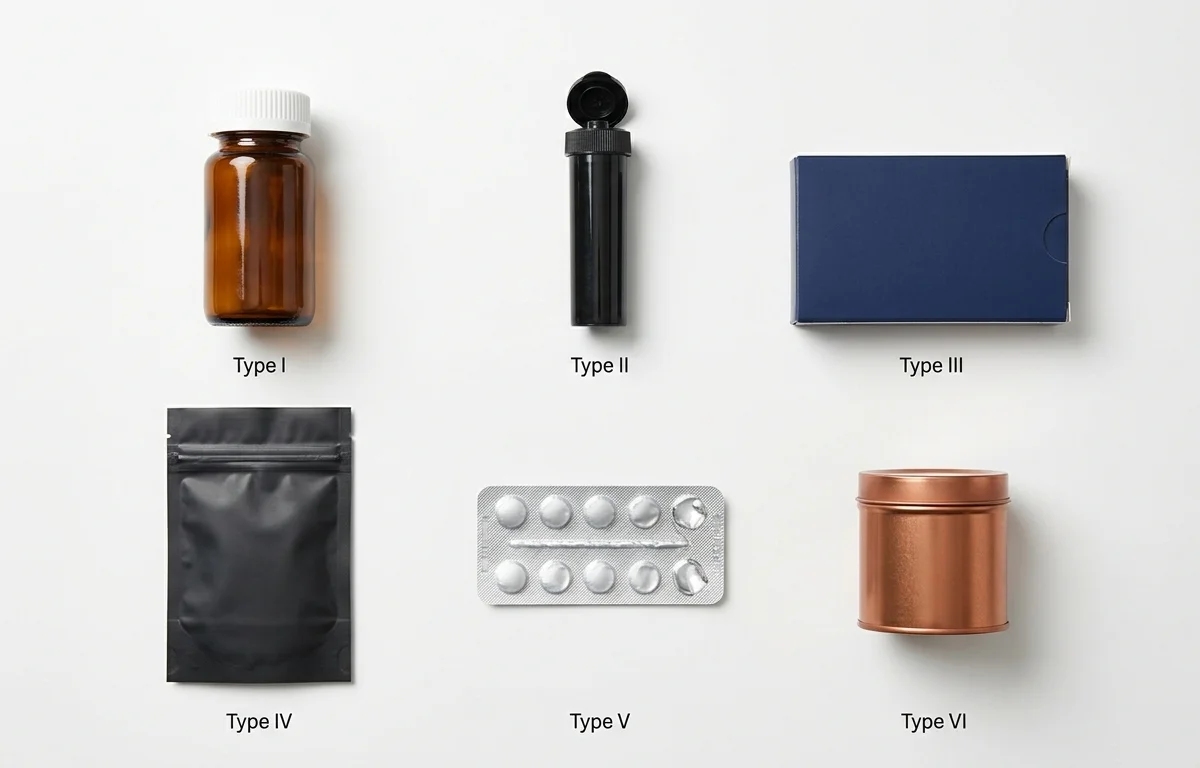 Six ASTM D3475 child-resistant packaging mechanism types — push-and-turn bottle, squeeze-to-open tube, slide-and-lock box, press-and-pull zipper bag, blister pack, and push-and-twist tin
ASTM D3475 defines several classification types based on the mechanical action required to open the package:
| ASTM Type | Mechanism | Opening Action | Common Packaging Format | Cubit Product |
|---|---|---|---|---|
| Type I | Continuous thread closure | Push down + turn counterclockwise | Medicine bottles, tincture caps | — |
| Type IA | Lug closure | Push down + turn | Child-proof caps on jars | Custom Jars |
| Type II | Snap closure | Squeeze sides + lift cap | Pop-top tubes, snap vials | CR Tubes |
| Type III | Film/blister | Peel-push through foil | Blister card packaging | — |
| Type IV | Pouch/sachet | Tear at specific point with force | Single-use sachets | — |
| Type V | Canister/aerosol | Align + press | Aerosol containers | — |
| Type VI | Overwrap/shrink | Destroy to open (non-reclosable) | Tamper-evident wraps | — |
| Type VIII | Non-reclosable blister | Push through foil + board | Pharmaceutical blisters | — |
| Type IX | Slide-and-lock | Press buttons + slide tray | CR slide boxes | CR Boxes |
| Type X | Combination lock | Multiple simultaneous actions | Complex CR packaging | CR Tins |
| Flexible | Press-and-pull zipper | Press zipper slider + pull open | CR mylar bags, pouches | CR Mylar Bags |
The cannabis industry primarily uses three ASTM D3475 types:
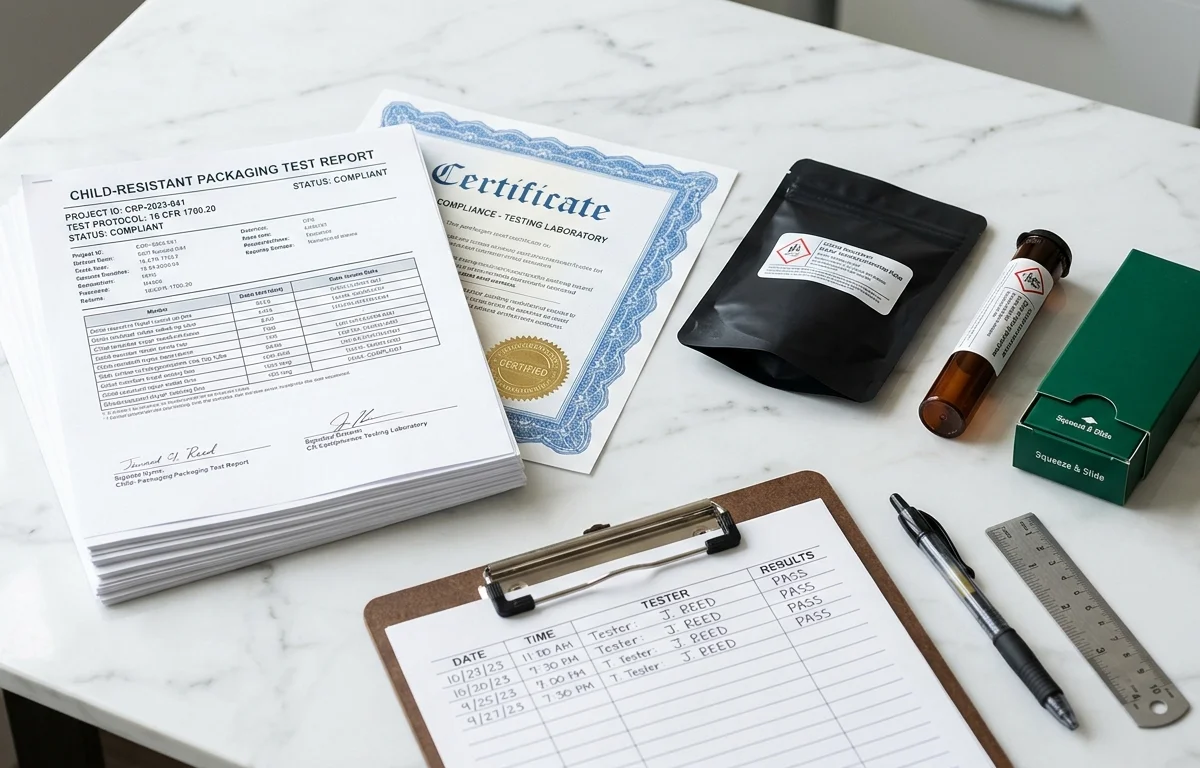 Child-resistant packaging test report documents and compliance certificate with CR packaging samples — mylar bag, tube, and slide box
| ASTM D3475 | 16 CFR 1700.20 | |
|---|---|---|
| Type | Classification standard | Performance testing regulation |
| Published by | ASTM International | CPSC (federal government) |
| Legal status | Voluntary | Mandatory for all CR claims |
| Contains test procedures? | No | Yes — child panel + senior panel |
| Issues pass/fail? | No | Yes |
| Requires human subjects? | No | Yes (children 42–51 months + adults 50–70) |
| Cost | Free (self-classification) | ~$8,000 per design |
| What you get | A type number (e.g., "Type IX") | Lab test report + GCC |
| Proves child resistance? | No — only categorizes mechanism | Yes — proves the design works |
For brands selling internationally, ISO 8317 is the international testing standard equivalent to 16 CFR 1700.20. The test methodology is similar (child and adult panels), but the panel sizes, age ranges, and pass criteria differ slightly. If you export CR packaging to the EU, UK, Canada, or Australia, you may need ISO 8317 certification in addition to (or instead of) 16 CFR 1700.20.
| Standard | Region | Child Panel Age | Panel Size | Pass Threshold |
|---|---|---|---|---|
| 16 CFR 1700.20 | United States | 42–51 months | 50–200 | 85% fail to open |
| ISO 8317 | International (EU, UK, CAN, AUS) | 42–51 months | 200 | 85% fail to open |
| EN 14375 | European Union | 42–51 months | 200 | 85% fail to open |
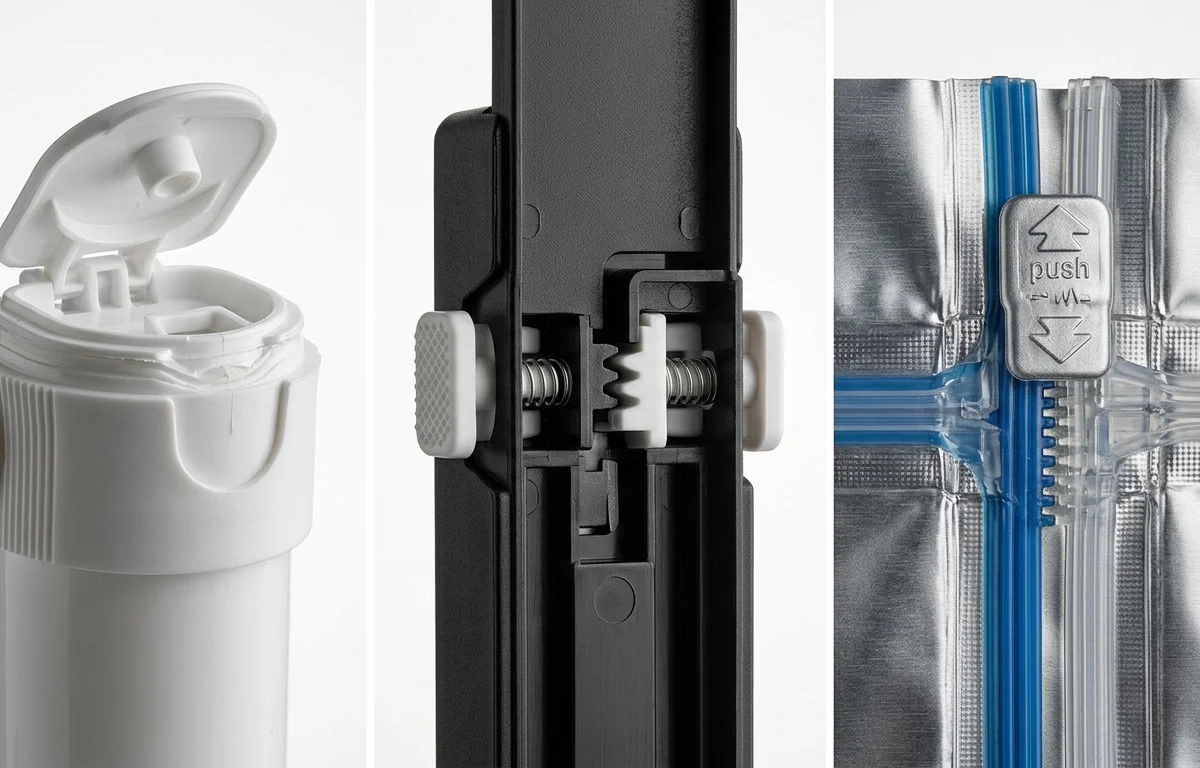 Macro close-up of three CR locking mechanisms — snap-fit pop-top hinge, dual side-push notched tab, and press-and-pull double-track zipper
All CR mechanisms share one engineering principle: they require two simultaneous, coordinated actions that children under five cannot perform together. Here is how each works:
Two recessed flex zones on opposite sides of the tube require simultaneous inward compression (4–6 lbs lateral force) while lifting the hinged cap upward. Children lack the hand span and bilateral coordination to execute both actions simultaneously.
Used in: Child-resistant tubes for pre-rolls, blunts, and infused joints.
Two polypropylene or paperboard tabs on opposite sides of the outer sleeve latch into notched teeth on the inner tray. Pressing both buttons inward while pulling the tray outward requires three-point coordination — two lateral presses plus one longitudinal pull.
Used in: Child-resistant boxes for edibles, CR vape packaging for cartridges.
A double-track zipper with a slider tab requires pressing the slider downward into the interlock position before pulling it laterally along the track. The press-then-pull sequence defeats simple pulling or tearing attempts.
Used in: Child-resistant mylar bags for flower and gummies, CR pouches for edibles, CR exit bags for dispensary checkout.
The lid sits in a recessed channel and requires downward pressure against a spring while rotating 90°. The combined push-and-twist motion requires grip strength and rotational coordination that children cannot replicate.
Used in: Child-resistant tins for concentrates, topicals, and mints.
When evaluating a packaging supplier, ask for these three documents:
16 CFR 1700.20 Lab Test Report — the actual test results from an accredited lab, showing child panel failure rate (≥85%) and senior panel success rate (≥90%). If they cannot produce this, the packaging has NOT been tested.
General Certificate of Compliance (GCC) — the manufacturer's formal certification document listing the product, applicable regulation, test lab, and test date. Required under CPSIA.
ASTM D3475 Classification — the type number identifying the CR mechanism. Useful for internal records and regulatory filings, but NOT a substitute for the test report.
Red flags to watch for:
No. ASTM D3475 is a classification standard, not a certification. It categorizes your packaging by mechanism type (Type I, Type IX, etc.) but does not test whether the mechanism actually prevents children from opening it. Legal child-resistant certification requires passing 16 CFR 1700.20 panel testing with live human subjects.
Child-resistant mylar bags with press-and-pull zipper mechanisms are classified as flexible CR packaging under ASTM D3475. The specific type depends on the zipper mechanism — most CR mylar bags use a double-track slider zipper that falls under flexible packaging classifications. See our child-resistant mylar bags for ASTM-classified options.
Professional protocol testing costs approximately $8,000 per packaging design. You must provide 400–500 production-quality sample units. The testing takes 4–8 weeks from sample submission to final report. Cubit manages the entire process and can certify custom designs under your brand name. See our CR certification guide for details.
No state legally requires ASTM D3475 classification. However, all states with legal cannabis require packaging to be child-resistant as tested under 16 CFR 1700.20 (or equivalent). ASTM D3475 classification is a useful reference that many state inspectors recognize, but it is not a compliance requirement.
ASTM D3475 is a classification system (categorizes mechanism types). ISO 8317 is an international performance testing standard (tests whether the mechanism works) — similar to 16 CFR 1700.20 but used outside the United States. If you sell internationally, you may need ISO 8317 certification. If you sell in the US, you need 16 CFR 1700.20.
Yes. ASTM D3475 classification is voluntary and self-assessed. You identify which mechanism type your packaging uses and reference the corresponding type number. No testing or third-party verification is required for classification. However, self-classification does NOT make your packaging legally child-resistant — you still need 16 CFR 1700.20 testing for that claim.
Need ASTM D3475 classified, 16 CFR 1700.20 certified child-resistant packaging? Browse our complete child-resistant packaging collection — including CR mylar bags, CR boxes, CR tubes, CR pouches, CR tins, and CR vape packaging. For custom designs requiring new CR testing, see our certification and lab testing guide or submit a quote through our RFQ portal.
Design your packaging free in 60s
Try the free AI packaging design toolNeed Custom Packaging?
Get a free quote with pricing, MOQs, and turnaround time for your custom packaging project.