
Technology & Innovation
NFC Tags vs QR Codes for Packaging: Full Comparison
Cubit Packaging Editorial Team
June 8, 2026
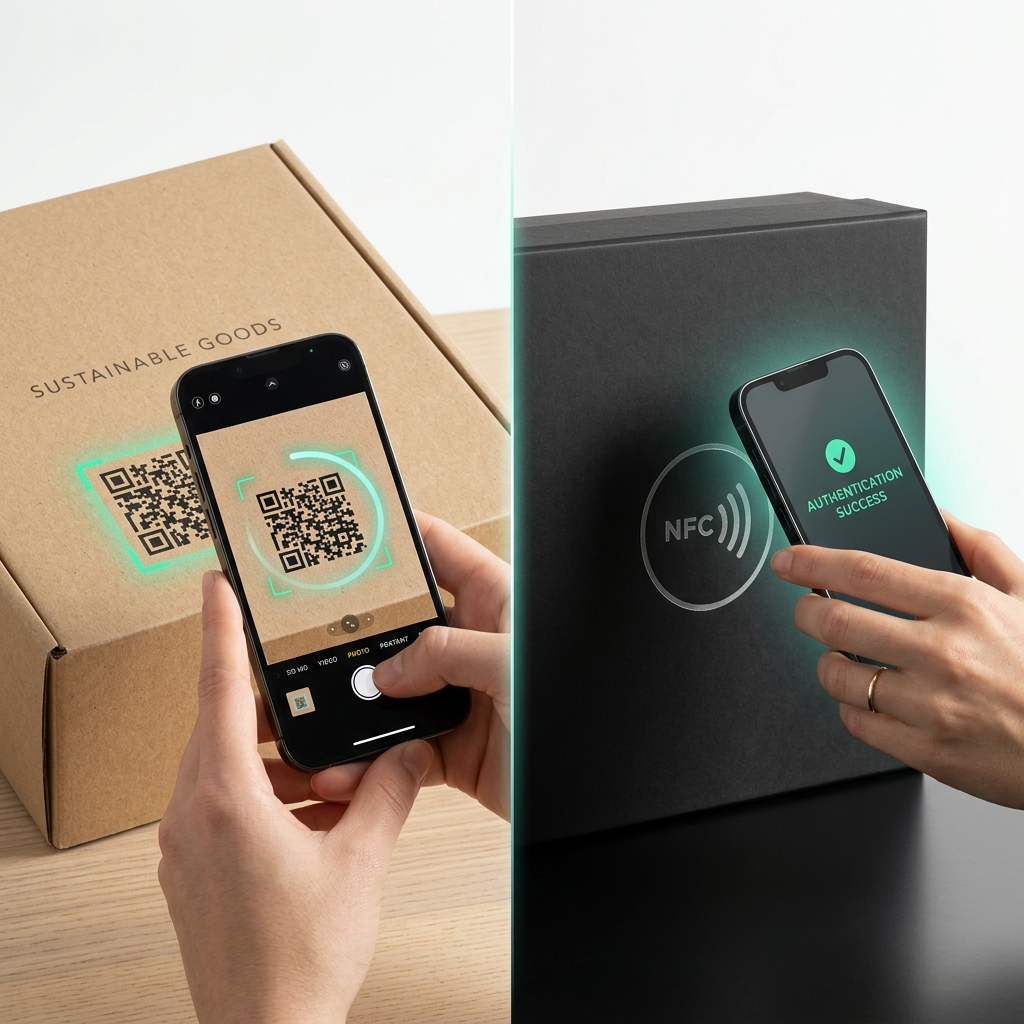
NFC tags and QR codes are the two most widely used technologies for connected packaging, but they serve fundamentally different purposes. QR codes excel at low-cost mass engagement (costing $0.002–$0.05 per unit with a 57% consumer scan rate), while NFC tags provide superior security for authentication (each containing a unique, unclonable chip ID at $0.10–$0.50 per unit). The best strategy is often to use both.
Key Takeaway: Use QR codes for consumer engagement and mass-market products. Use NFC tags for premium authentication and anti-counterfeiting. For maximum impact, deploy both on the same packaging — QR for engagement, NFC for verification.
| Factor | QR Code | NFC Tag | Winner |
|---|---|---|---|
| Cost per unit | $0.002–$0.05 | $0.10–$0.50 | 🏆 QR Code |
| Consumer familiarity | 57% scan rate | ~15% awareness | 🏆 QR Code |
| Security level | Medium (can be copied) | High (unique chip ID) | 🏆 NFC |
| Scan distance | 5–30cm (camera focus) | 1–4cm (physical tap) | 🏆 QR Code |
| Speed of interaction | 1–3 seconds | Instant (<0.5 sec) | 🏆 NFC |
| Data capacity | 4,296 characters | 8KB typical | 🏆 NFC |
| Requires internet | Yes (for URL links) | No (for basic data) | 🏆 NFC |
| Durability | Can scratch/fade | Survives moisture | 🏆 NFC |
| Aesthetics | Visible printed code | Invisible (embedded) | 🏆 NFC |
| Analytics | Dynamic QR only | Yes (via platform) | Tie |
| Smartphone compatibility | All smartphones | Most smartphones (2015+) | 🏆 QR Code |
| Scalability | Unlimited (print-based) | Supply-chain dependent | 🏆 QR Code |
QR (Quick Response) codes are two-dimensional barcodes printed directly onto packaging using standard printing processes. No additional hardware or components are needed — the code is simply part of the printed artwork.
NFC (Near-Field Communication) tags are small electronic chips with an antenna, typically embedded under a label, inside a closure, or between packaging layers. They transmit data wirelessly when a smartphone is held within 1–4cm.
| Volume | QR Code (Dynamic) | NFC Tag (NTAG213) | NFC Tag (NTAG424 DNA) |
|---|---|---|---|
| 1,000 | $0.01 | $0.35 | $0.50 |
| 10,000 | $0.005 | $0.20 | $0.35 |
| 100,000 | $0.003 | $0.12 | $0.25 |
| 1,000,000 | $0.002 | $0.08 | $0.18 |
| Cost Component | QR Code | NFC (NTAG213) | NFC (NTAG424 DNA) |
|---|---|---|---|
| Tags/printing | $300 | $12,000 | $25,000 |
| Platform (annual) | $588 | $1,200 | $2,400 |
| Landing pages | $2,000 | $2,000 | $3,000 |
| Integration | $1,000 | $3,000 | $5,000 |
| Total Year 1 | $3,888 | $18,200 | $35,400 |
| Per unit | $0.039 | $0.182 | $0.354 |
Bottom line: QR codes are 5–10× cheaper than NFC. The cost gap narrows at higher volumes but NFC is always more expensive. The question is whether the additional security and UX justify the premium.
| Security Feature | QR Code | NFC (Basic) | NFC (NTAG424 DNA) |
|---|---|---|---|
| Unique per item | ✅ (if serialized) | ✅ (factory UID) | ✅ (factory UID) |
| Clone-resistant | ❌ (can be photocopied) | ⚠️ (UID can be spoofed) | ✅ (SUN authentication) |
| Tamper detection | ❌ | ❌ | ✅ (tamper loop) |
| Encrypted communication | ❌ | ❌ | ✅ (AES-128) |
| Cloud verification | ✅ (check serial) | ✅ (check UID) | ✅ (cryptographic proof) |
| Offline verification | ❌ | ⚠️ (basic only) | ✅ (on-chip crypto) |
Pros: Consumers know how QR codes work (57% scan rate). No app required. Works from a distance.
Cons: Requires aiming the camera, adequate lighting, and a steady hand. Takes 1–3 seconds. Visible code may not suit minimalist or luxury packaging.
Pros: Instant tap-and-go interaction. No camera needed. Works in any lighting. Invisible integration preserves package aesthetics.
Cons: Consumers may not know where to tap. Some phones have NFC disabled by default. iPhone NFC support requires iOS 13+ for background tag reading.
| Metric | QR Code | NFC Tag |
|---|---|---|
| Awareness | 95% | 45% |
| First-scan success rate | 85% | 72% |
| Repeat engagement | 15% | 35% |
| Average session duration | 45 seconds | 90 seconds |
| Social sharing from scan | 8% | 18% |
Key insight: QR codes drive more first-time interactions, but NFC drives deeper engagement and higher repeat rates. NFC's "tap" gesture feels more premium and intentional than camera scanning.
| Industry | Recommendation | Reasoning |
|---|---|---|
| Mass-market food | QR codes only | Cost-sensitive, high volume, engagement focus |
| Premium food/beverage | QR + NFC | Provenance storytelling + authentication |
| Pharmaceuticals | NFC (NTAG424 DNA) | DSCSA compliance, anti-counterfeit critical |
| Luxury fashion | NFC + QR | Authentication + consumer engagement |
| Cosmetics | QR codes | Tutorial content, ingredient transparency |
| Cannabis | QR codes | Compliance information, lab results |
| Electronics | NFC + QR | Warranty registration + anti-counterfeit |
| Subscription boxes | QR codes | Unboxing content, loyalty, social sharing |
| Spirits/wine | NFC + QR | Origin verification + tasting notes |
The most sophisticated packaging brands deploy both QR codes and NFC tags on the same package, each serving a different purpose:
QR code (visible, on the package exterior)
NFC tag (hidden, under a label or inside a closure)
A premium whisky brand uses a QR code on the back label linking to tasting notes and cocktail recipes (scanned by 35% of buyers). An NFC tag under the bottle cap confirms authenticity and detects if the bottle has been opened (tapped by 12% of buyers, but caught 340 counterfeit bottles in 6 months).
Cubit One supports both QR and NFC on a single packaging order, with unified analytics across both technologies.
Basic NFC tags (NTAG213/215) have UIDs that can theoretically be spoofed by advanced attackers. NTAG424 DNA tags use cryptographic authentication (SUN — Secure Unique NFC) that generates a unique, one-time code for each tap, making cloning mathematically impossible.
NFC tags work through paper, cardboard, plastic, and glass. They have reduced range through metal (use ferrite shields) and may not work when submerged in liquid. For metal packaging, specialized on-metal NFC tags are available at a slight premium.
QR codes have zero environmental impact beyond the ink used to print them. NFC tags contain small amounts of aluminum, copper, and silicon. Some manufacturers now offer biodegradable NFC substrates. From a sustainability perspective, QR codes are clearly superior.
Yes. Many brands start with QR codes and add NFC to premium product lines as they scale. The analytics platforms (including Cubit One) support both technologies, so your data and landing pages transfer seamlessly.
Most NFC tag suppliers have MOQs of 500–1,000 units for standard tags. Custom-shaped or branded NFC tags typically require 5,000–10,000 unit minimums. QR codes have no minimum since they are simply printed.
The choice between NFC tags and QR codes isn't really an either/or decision — it's about matching the right technology to each use case:
Explore Cubit One for integrated QR + NFC smart packaging, or browse our store to start your packaging order today.
Published by Cubit Packaging Editorial Team. Last updated June 2026.
Design your packaging free in 60s
Try the free AI packaging design toolNeed Custom Packaging?
Get a free quote with pricing, MOQs, and turnaround time for your custom packaging project.