
Mylar Bags and Oxygen Absorbers: The Complete Food Storage Guide (2026)
Key Takeaways
- Oxygen absorbers remove residual O₂ inside sealed mylar bags, preventing oxidation, rancidity, and insect growth — extending shelf life to 25–30 years for dry staples.
- Sizing matters: Use 300–500 cc per 1-gallon bag for grains and 2,000–2,500 cc per 5-gallon bucket liner.
- Never reuse absorbers — once exposed to air they begin working immediately and cannot be "recharged."
- Sugar is the exception: Do not use oxygen absorbers with granulated sugar; it will harden into a solid brick.
Storing food for the long haul is part science, part common sense — and if you have ever opened a bag of rice only to find it smells stale or (worse) has tiny weevils crawling through it, you already know the stakes. The combination of mylar bags and oxygen absorbers is the gold standard for long-term dry food preservation, used by preppers, homesteaders, food co-ops, and humanitarian organizations worldwide.
In this guide we will walk through everything: how oxygen absorbers actually work, how to pick the right size, step-by-step packing instructions, and the most common mistakes people make.
What Is an Oxygen Absorber and How Does It Work?
An oxygen absorber (sometimes called an OA or O₂ absorber) is a small sachet filled with iron powder. When exposed to air, the iron undergoes a controlled oxidation reaction — essentially, it rusts. That reaction consumes the oxygen molecules trapped inside your sealed mylar bag, dropping the internal oxygen level from the normal 20.9% down to less than 0.01%.
According to research published by the Journal of Food Engineering, reducing oxygen below 1% inhibits the growth of aerobic bacteria, molds, and insects at every life stage — including eggs that may already be present in bulk grains at the time of purchase (Heather & Hallman, 2008).
Quotable fact: A single 300 cc oxygen absorber can remove all oxygen from roughly 0.95 liters of air — enough for a tightly packed 1-gallon mylar bag of white rice.
Why Pair Them With Mylar?
Mylar (biaxially-oriented polyethylene terephthalate, or BoPET) creates an oxygen barrier with a transmission rate as low as 0.5 cc/m²/day at 5 mil thickness. Standard plastic bags, ziplock bags, and even vacuum-seal bags transmit far more oxygen over time. Without the mylar barrier, an oxygen absorber would exhaust itself fighting the constant influx of outside air within days.
Oxygen Absorber Size Chart
Use this table to match the correct absorber capacity (measured in cubic centimeters, or cc) to your bag size and food density.
| Bag Size | Dense Foods (Rice, Wheat, Beans) | Medium Density (Oats, Lentils) | Light / Fluffy Foods (Pasta, Dehydrated Veggies) |
|---|---|---|---|
| 1 Quart | 100–200 cc | 150–250 cc | 200–300 cc |
| ½ Gallon | 200–300 cc | 250–400 cc | 300–500 cc |
| 1 Gallon | 300–500 cc | 400–700 cc | 500–1,000 cc |
| 5 Gallon | 2,000–2,500 cc | 2,200–2,800 cc | 2,500–3,000 cc |
Pro tip: You cannot "over-absorb." Using extra capacity does no harm — the iron simply stops reacting once all available oxygen is consumed. When in doubt, round up.
Step-by-Step: Packing Mylar Bags With Oxygen Absorbers
Step 1 — Gather Your Materials
You will need:
- Food-grade mylar bags (minimum 5 mil for long-term storage; 7 mil is ideal)
- Oxygen absorbers in the appropriate cc size
- A heat sealer (impulse sealer recommended) or a flat iron / hair straightener
- A permanent marker for labeling
- A clean, dry work surface
Step 2 — Pre-Label Your Bags
Write the contents, date, and absorber size on the outside of the bag before filling. Trying to label a stuffed bag is frustrating and usually results in illegible writing.
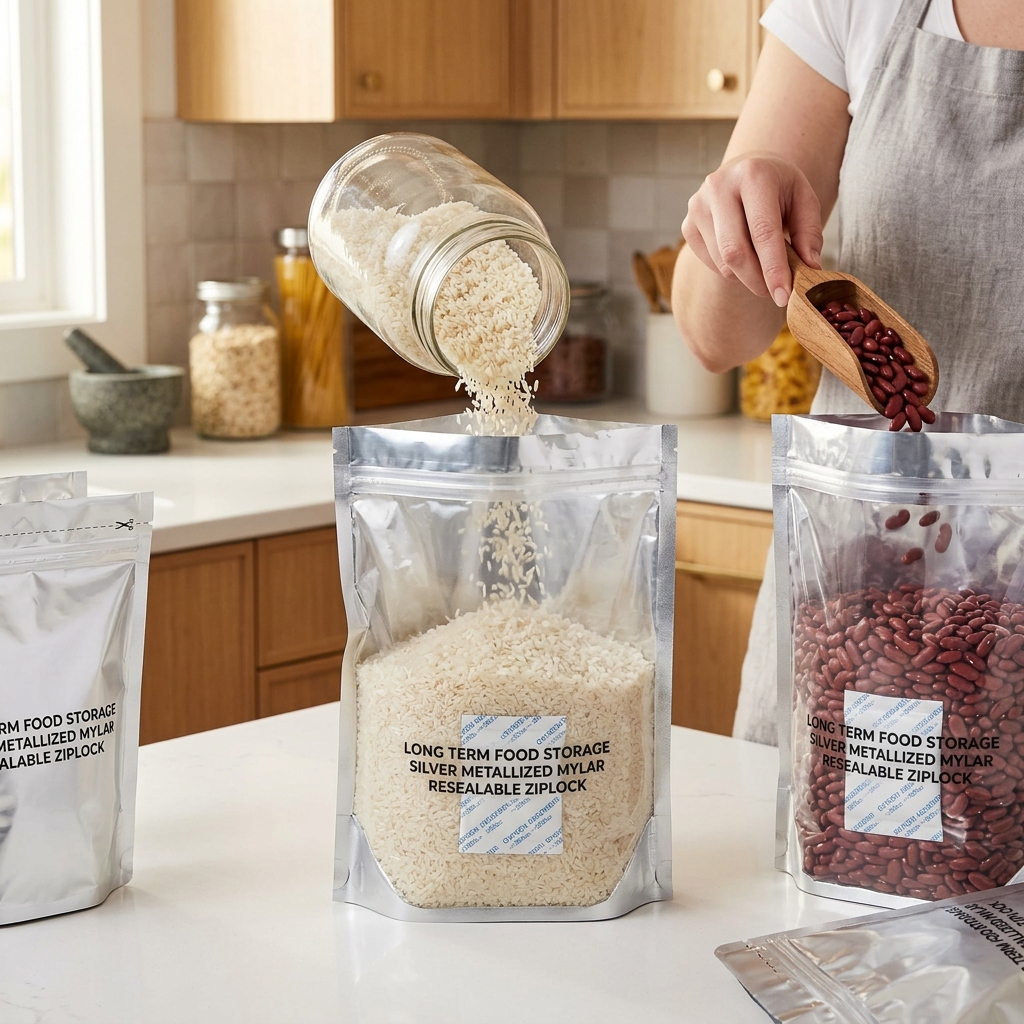
Step 3 — Fill, But Leave Headspace
Pour your dry food into the bag, leaving 3–4 inches of clearance at the top. This space is necessary for a clean, wrinkle-free heat seal.
Step 4 — Add the Oxygen Absorber
Drop the correct number of absorber packets on top of the food. Work quickly — once the master bag of absorbers is opened, they begin absorbing ambient oxygen immediately. Reseal any unused absorbers in a mason jar with a tight lid.
Step 5 — Press Out Air and Seal
Gently squeeze the bag from the bottom upward to push out as much air as possible, then seal the top with your heat sealer. Run the sealer across the full width of the bag in one smooth pass. Inspect the seal line for gaps, wrinkles, or food debris trapped in the seal area.
Step 6 — Check After 24–48 Hours
A properly sealed bag will look "sucked in" around the food as the absorber removes the oxygen and atmospheric pressure compresses the bag. If the bag remains puffy after two days, you likely have a compromised seal — cut it open, add a fresh absorber, and reseal.
Which Foods Work (and Which Don't)
Best Candidates for 20–30 Year Storage
- White rice
- Dry beans and lentils
- Hard wheat berries
- Rolled oats
- Pasta (all shapes)
- Freeze-dried fruits and vegetables
- Powdered milk (3–5 year shelf life)
- Cornmeal
Foods to Avoid
- Nuts and seeds — High fat content causes rancidity within months regardless of packaging.
- Brown rice — The bran layer contains oils that go rancid; limit to 6–12 months even with absorbers.
- Granulated sugar — Absorbers remove moisture alongside oxygen, turning sugar into an unusable brick. Store sugar in airtight containers without absorbers.
- Salt — Does not require absorbers. Store in any airtight container.
Common Mistakes and How to Avoid Them
| Mistake | Why It's a Problem | Fix |
|---|---|---|
| Using thin (2–3 mil) bags | Oxygen permeates through thin mylar within weeks | Always use ≥ 5 mil for long-term storage |
| Oversized headspace | More air volume means the absorber may be insufficient | Squeeze out air before sealing |
| Slow handling of absorbers | They start working immediately on contact with air | Prep everything first, then open the absorber bag |
| Sealing over food particles | Crumbs in the seal create micro-channels for air | Wipe the seal area clean before sealing |
| Storing in heat | Temperatures above 75°F accelerate chemical degradation | Keep sealed bags below 70°F (21°C) |
Ideal Storage Conditions
The bag is only half the equation. Storage environment determines whether your food lasts 5 years or 30.
- Temperature: Below 70°F (21°C). Every 10°F increase roughly halves shelf life.
- Light: Store in a dark closet, pantry, or opaque bin. UV light degrades both the mylar and the food inside.
- Humidity: Keep ambient humidity below 15% if possible. Basements can be problematic.
- Secondary container: Place sealed mylar bags inside food-grade 5-gallon buckets with lids. This protects against rodents, punctures, and stacking damage.
Frequently Asked Questions
How many oxygen absorbers do I need for a 5-gallon mylar bag?
For dense foods like white rice or wheat berries, use 2,000–2,500 cc of oxygen absorber capacity per 5-gallon bag. For lighter foods like pasta or dehydrated vegetables, increase to 2,500–3,000 cc. You can combine multiple smaller packets (e.g., five 500 cc packets) to reach the target.
Can I reuse oxygen absorbers?
No. Once an oxygen absorber has been exposed to air, the iron powder inside begins oxidizing immediately. Even a partially used absorber cannot be "reset" or recharged. Always use fresh absorbers for each new bag.
Do I need oxygen absorbers if I vacuum seal the mylar bag?
Vacuum sealing removes the bulk of the air, but it cannot achieve the near-zero oxygen environment that absorbers create. For maximum shelf life (20+ years), use both vacuum sealing and oxygen absorbers together. For shorter-term storage (1–3 years), vacuum sealing alone may suffice.
What happens if I use too many oxygen absorbers?
Nothing harmful. The excess absorber capacity simply remains unused once all available oxygen is consumed. There is no risk of damaging the food by using more absorbers than the minimum required.
How do I know if my oxygen absorber is still good?
A fresh, unused oxygen absorber will feel soft and powdery when squeezed. If the packet feels hard, solid, or like a rock, the iron inside has already fully oxidized and the absorber is spent. Discard it and use a fresh one.
Whether you are building a year's supply of emergency food or simply buying rice in bulk to save money, the combination of quality mylar bags and correctly sized oxygen absorbers is the most reliable, cost-effective method for keeping dry goods safe for decades. Need custom mylar bags for your food brand or storage operation? Get a free quote from Cubit Packaging →
Related Guides
- Mylar Bags for Freeze-Dried Food — Complete guide to storing freeze-dried food for 25–30 years.
- How to Seal Mylar Bags — Proper sealing techniques to maintain the vacuum effect after absorbers do their work.
- Mylar Bag Thickness Guide — Choose bags thick enough to prevent micro-leaks that defeat your absorbers.
- Mylar Bag Problems & Defects — Troubleshoot why bags stay puffy after adding absorbers.
- Mylar Bags vs Vacuum Seal — Compare oxygen absorbers + mylar vs. vacuum sealing for food storage.
Shop Food Storage Mylar Bags
- Flat Mylar Bags — Cost-effective flat pouches for bulk storage
- Custom Mylar Bags — Custom sizes from quart to 5-gallon
- Mylar Bags with Tear Notch — Easy-open for portioned storage
🛍️ Ready to Order Custom Mylar Bags?
Cubit offers custom printed mylar bags with oxygen absorber compatibility built in — food-grade PET/AL/PE barrier construction from $0.05/unit. Heat-seal and ziplock options for long-term food storage. 500 unit MOQ.
📖 Read the complete guide: What Are Mylar Bags? The Complete Guide for 2026 — Everything you need to know about mylar bag types, materials, thickness, food safety, and more.
Need custom mylar bags? Order Custom Printed Mylar Bags → — full-color printing, barrier film, resealable zippers. From 500 units. Get a free quote →
Need Custom Mylar Bags for Food Storage?
FDA food-grade custom mylar bags with oxygen absorber compatibility. Heat-seal, ziplock, and child-resistant options. From $0.05/unit, 500 MOQ.
Browse Custom Mylar Bags →