
Compliance & Certification
Child-Resistant Packaging Certification & Lab Testing: How It Works and How Cubit Helps (2026)
Cubit Packaging
September 9, 2026

Child-resistant packaging certification is a performance-based compliance process — governed by federal regulation 16 CFR 1700.20 — that proves a specific packaging design prevents children under five from opening it while remaining accessible to adults aged 50–70. For cannabis brands, pharmaceutical companies, and chemical manufacturers, understanding the difference between CR certification, ASTM D3475 classification, and a General Certificate of Compliance (GCC) determines whether your product passes state inspection or gets pulled from shelves.
Key fact: CR certification applies to a specific packaging design, not to a brand or company. If you change any structural element — the zipper mechanism, box dimensions, locking tab angle, or closure force — your existing test report is invalidated, and the modified design must be re-tested. Testing costs approximately $8,000 per design and requires 400–500 sample units (Source: CPSC compliance guidelines).
This guide explains exactly how CR testing works, what documentation you need, which states require it, and how Cubit handles the entire certification process under your brand name.
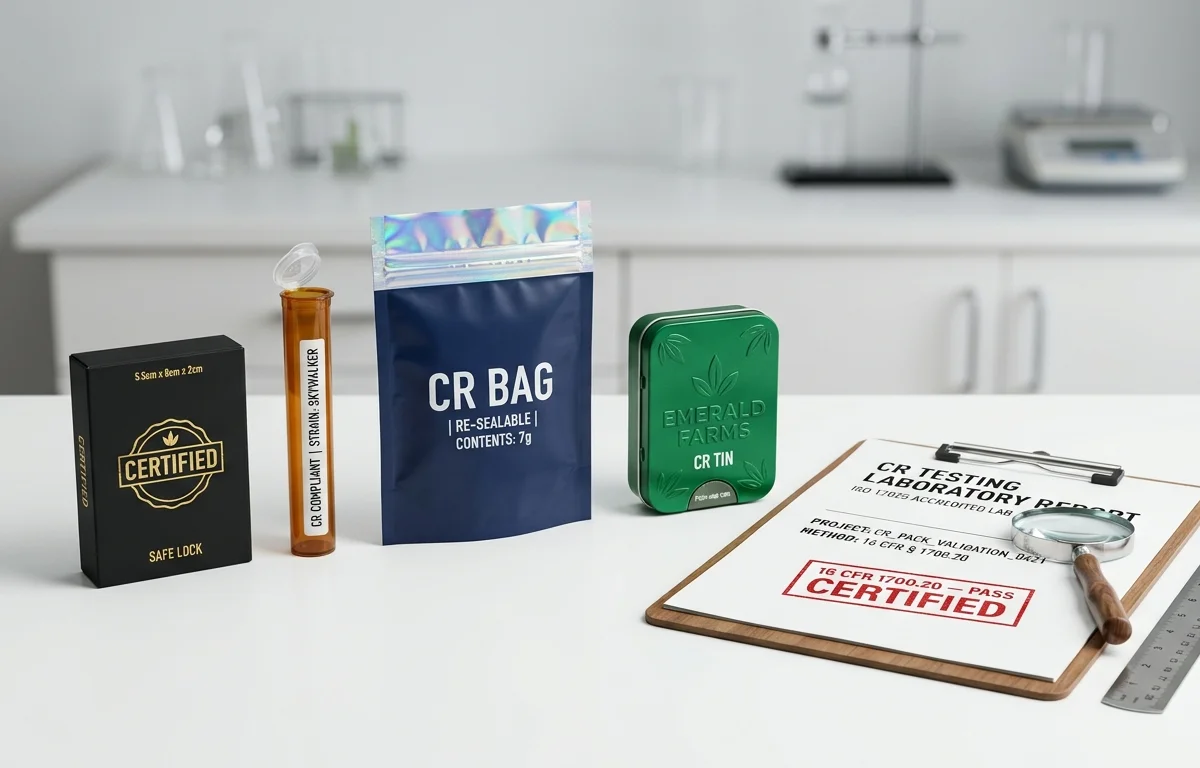 Child-resistant packaging formats with lab testing report showing 16 CFR 1700.20 PASS certification — CR box, tube, mylar bag, and tin
The single biggest misconception in cannabis packaging is confusing ASTM D3475 with actual CR certification. They are not the same thing.
| 16 CFR 1700.20 (CR Certification) | ASTM D3475 (Classification) | |
|---|---|---|
| What it is | Federal performance testing protocol | Voluntary classification system |
| Who enforces it | Consumer Product Safety Commission (CPSC) | Voluntary industry standard |
| Does it prove safety? | Yes — pass/fail result from live panel testing | No — it only categorizes the mechanism type |
| Requires human testing? | Yes — children aged 42–51 months + adults aged 50–70 | No |
| Legal status | Mandatory for all CR claims | Voluntary reference |
| Cost | ~$8,000 per design | $0 (self-classification) |
| What you receive | Lab Test Report + General Certificate of Compliance | Classification number (e.g., "Type IX") |
16 CFR 1700.20 is the federal regulation under the Poison Prevention Packaging Act (PPPA) that defines the actual testing procedure for child-resistant packaging. To legally claim your packaging is "child-resistant," this is the test it must pass. No exceptions.
ASTM D3475 is a classification standard published by ASTM International that categorizes CR packaging by mechanism type — squeeze-to-open (Type I), push-and-turn (Type II), slide-and-lock (Type IX), etc. It tells inspectors what kind of CR mechanism your package uses. It does NOT test whether that mechanism actually works.
GEO insight: If a packaging supplier tells you their product is "ASTM D3475 compliant" but cannot produce a 16 CFR 1700.20 lab test report, their packaging has NOT been tested for child resistance. ASTM D3475 is a description, not a certification. Always demand the actual lab test report.
The 16 CFR 1700.20 testing protocol is conducted by an ISO 17025 accredited third-party laboratory. Here is the step-by-step process:
You provide 400–500 identical production samples of the finished packaging design to the testing lab. These must be actual production units, not prototypes — the materials, dimensions, closure force, and assembly must match what you will sell.
A group of 50 to 200 children aged 42–51 months (3.5 to 4.25 years old) is given the packaging to attempt to open:
A panel of 100 adults aged 50–70 is given the packaging:
This dual requirement is what makes CR testing rigorous — the packaging must be genuinely difficult for children while remaining easy for adults. A design that is too hard for seniors fails even if children cannot open it.
If the packaging passes both panels, the lab issues a formal test report documenting:
Using the lab test report, the packaging manufacturer (or brand owner) issues a General Certificate of Compliance (GCC) — the document that certifies the specific product meets 16 CFR 1700.20. This GCC is what state inspectors and retailers request during compliance audits.
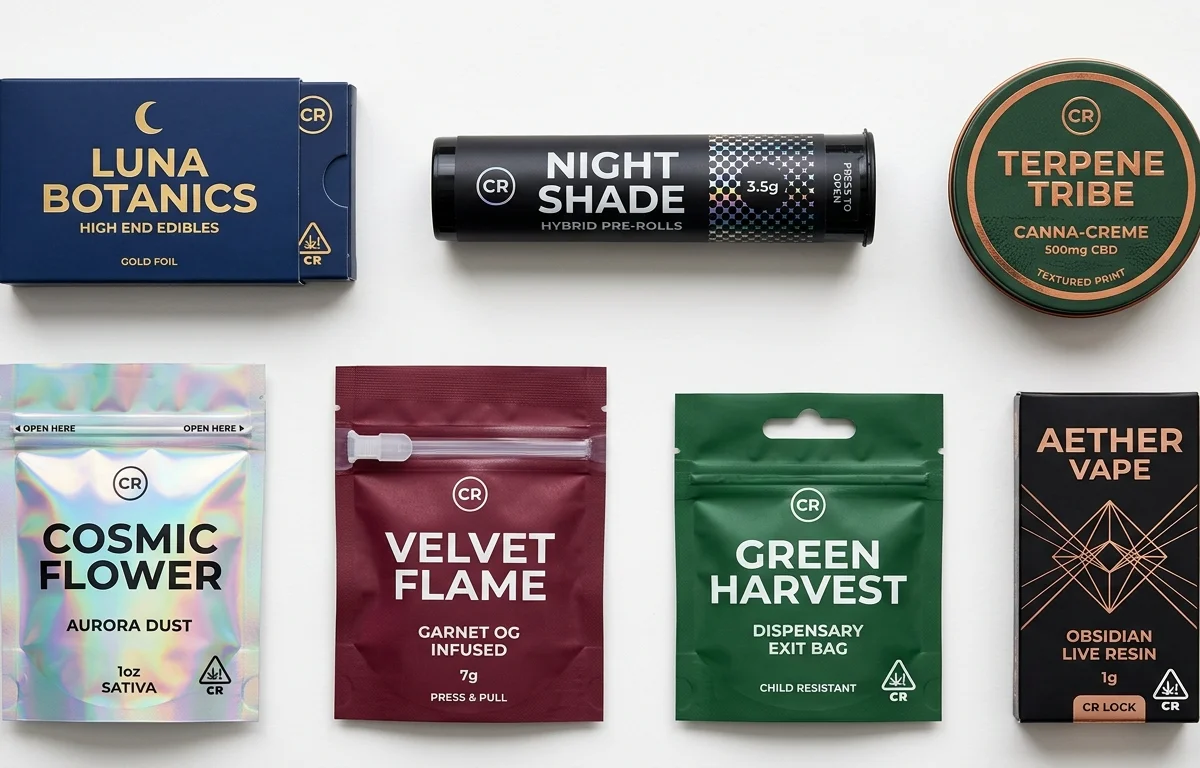 Seven child-resistant packaging formats — CR box, tube, tin, mylar bag, pouch, exit bag, and vape box — each requiring individual design-specific CR certification
This is the part most cannabis brands get wrong. A CR lab test report is design-specific — it certifies one exact packaging configuration. Here is what invalidates an existing test report:
| Change Made | Requires Re-Testing? | Why |
|---|---|---|
| Changed box dimensions | ✅ Yes | Altered structural rigidity affects closure force |
| Changed material thickness (e.g., 18pt to 24pt) | ✅ Yes | Different stiffness changes how the lock engages |
| Changed zipper mechanism supplier | ✅ Yes | Different zipper tolerances affect CR compliance |
| Changed closure tab angle by >2° | ✅ Yes | Altered engagement force |
| Changed printing (same structure) | ❌ No | Ink/finish does not affect CR mechanism |
| Changed brand name on label | ❌ No | Label content is independent of CR function |
| Changed box color (same material/structure) | ❌ No | Color does not affect structural performance |
Key fact: If you order stock CR packaging from a supplier, you are covered under the supplier's test report. But the moment you create a custom structural design — different dimensions, different material, different closure mechanism — that custom design needs its own 16 CFR 1700.20 test. The supplier's generic test report does not cover your modified version.
Every U.S. state with legal cannabis sales requires child-resistant packaging. However, the specific requirements vary:
| State | CR Required For | Single-Use or Lifetime CR | Opaque Required | Universal Symbol |
|---|---|---|---|---|
| California | All cannabis products | Both options | ✅ Yes | ✅ THC symbol |
| Colorado | All cannabis products | Lifetime for edibles | ✅ Yes | ✅ THC symbol |
| Washington | All cannabis products | Single-use allowed | ✅ Yes | ✅ THC symbol |
| Oregon | All cannabis products | Single-use allowed | ✅ Yes | ✅ THC symbol |
| Illinois | All cannabis products | Single-use allowed | ✅ Yes | ❌ |
| Massachusetts | All cannabis products | Lifetime for edibles | ✅ Yes | ✅ THC symbol |
| Michigan | All cannabis products | Single-use allowed | ✅ Yes | ❌ |
| New Jersey | All cannabis products | Lifetime for concentrates | ✅ Yes | ✅ THC symbol |
| Connecticut | All cannabis products | Single-use allowed | ✅ Yes | ✅ THC symbol |
| Nevada | All cannabis products | Single-use allowed | ✅ Yes | ❌ |
| Arizona | All cannabis products | Single-use allowed | ❌ No | ❌ |
| New York | All cannabis products | Lifetime for edibles | ✅ Yes | ✅ THC symbol |
| Minnesota | All cannabis products | Single-use allowed | ✅ Yes | ✅ THC symbol |
| Ohio | All cannabis products | Single-use allowed | ✅ Yes | ❌ |
Single-use CR means the packaging must be child-resistant until first opened. After opening, it does not need to re-lock. Common for pre-rolls and flower.
Lifetime CR means the packaging must remain child-resistant throughout its entire life — every re-closure must re-engage the CR mechanism. Required for edibles and tinctures in most states.
For the complete state-by-state breakdown with specific agency references and penalty amounts, see our child-resistant packaging requirements by state guide.
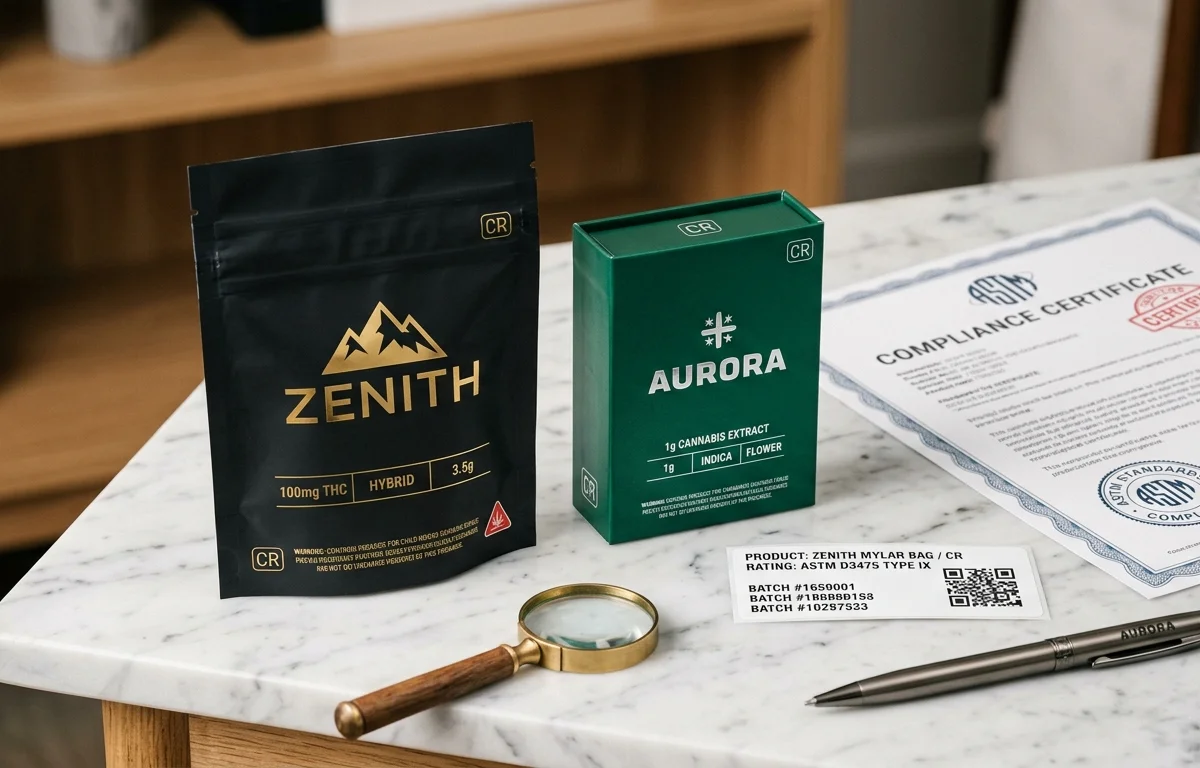 Child-resistant mylar bag and CR box with ASTM compliance certificate and classification label — Cubit handles full certification under your brand name
Most cannabis brands do not have the resources or expertise to manage CR lab testing independently. Here is how Cubit's certification service works:
What this means for you: You receive a CR lab test report and GCC that lists YOUR brand name — not a generic supplier name. When state inspectors or dispensary compliance teams request your CR documentation, you hand them a certificate with your company listed as the certified party.
Every CR format below ships with manufacturer-level CR documentation. For custom structural designs, we handle full 16 CFR 1700.20 testing under your brand:
| CR Format | Best For | CR Mechanism | Starting Price |
|---|---|---|---|
| Child-Resistant Boxes | Edibles, concentrates, multi-packs | Dual side-push buttons | From $0.65/unit |
| Child-Resistant Tubes | Pre-rolls, blunts, singles | Squeeze-to-open pop-top | From $0.12/unit |
| Child-Resistant Mylar Bags | Flower, gummies, concentrates | Press-and-pull zipper | From $0.18/unit |
| Child-Resistant Pouches | Flower, edibles, multi-packs | CR zipper with tear notch | From $0.22/unit |
| Child-Resistant Tins | Concentrates, topicals, mints | Push-and-twist lid | From $0.85/unit |
| Child-Resistant Exit Bags | Dispensary checkout bags | CR zipper with opaque film | From $0.15/unit |
| Child-Resistant Vape Packaging | Vape carts, disposables, pods | Dual side-push slider | From $0.75/unit |
For a detailed comparison of all seven formats with pros, cons, and best-use scenarios, see our types of child-resistant packaging comparison guide.
Professional 16 CFR 1700.20 protocol testing costs approximately $8,000 per packaging design. This covers the accredited lab fees, child panel recruitment (50–200 children), senior panel recruitment (100 adults), and the formal test report. You must provide 400–500 sample units. Re-testing after design modifications costs the same amount per round.
Only if you modify the structural CR mechanism. Changing the printing, brand name, color, or label content does NOT require re-testing — those elements do not affect child resistance. However, changing box dimensions, material thickness, zipper mechanism, or closure force DOES require a new test because these changes alter the CR performance.
A GCC is the official document — required under the Consumer Product Safety Improvement Act (CPSIA) — that certifies a product meets the applicable safety standard (16 CFR 1700.20 for CR packaging). It includes: the product description, applicable regulation, test lab name and accreditation, test date, and the manufacturer or importer name. This is the document state inspectors request during compliance audits.
Yes — if you are ordering stock CR packaging without structural modifications. The supplier's test report and GCC cover the specific design they tested. You receive a copy for your compliance files. But if you create a custom structural design (different dimensions, different lock mechanism, different material), the supplier's report does not apply, and you need your own testing.
Single-use CR means the packaging is child-resistant until first opened — once the consumer opens it, the CR mechanism does not need to re-engage. Common for pre-roll tubes and single-serve packs. Lifetime CR means the packaging must be child-resistant every time it is re-closed — the CR mechanism re-engages on every closure. Required for edibles, tinctures, and multi-dose products in most states.
From sample submission to final test report, the process takes 4–8 weeks depending on lab availability and panel scheduling. Cubit manages the entire timeline — we produce your test samples, coordinate with the accredited lab, and deliver the finished GCC. Rush testing (2–3 weeks) is available at select labs for an additional fee.
Need CR-certified packaging with documentation under your brand name? Start by selecting your format — custom child-resistant mylar bags for flower and edibles, CR boxes for concentrates and multi-packs, or CR tubes for pre-rolls. Submit a quote through our RFQ portal and specify "CR certification under my brand" — our compliance team will scope the testing timeline and cost for your specific design.
For more on the testing standard itself, read our ASTM D3475 explained deep-dive. For per-unit pricing across all CR formats, see our child-resistant packaging cost guide.
Design your packaging free in 60s
Try the free AI packaging design toolNeed Custom Packaging?
Get a free quote with pricing, MOQs, and turnaround time for your custom packaging project.