
Packaging Guides
The B2B Guide to Custom Child-Resistant Tubes for Pre-Rolls and Blunts
Cubit Team
July 24, 2026

Custom child-resistant tubes are tamper-evident, airtight containers certified under ASTM D3475 that protect pre-rolls, blunts, and infused joints from moisture, oxygen, and accidental child access. For cannabis brands shipping 500 to 500,000+ units per month, selecting the right tube material, CR mechanism, and branding method directly impacts compliance, shelf life, and per-unit cost.
Key fact: A properly sealed polypropylene pop-top tube preserves terpene content for up to 6 months by maintaining an internal relative humidity of 55–62%, compared to just 2–3 weeks in a standard open-end paper cone tube (Source: cubitpackaging.com/store/products/child-resistant-tubes).
This guide covers pop-top mechanics, material selection, printing techniques, state compliance requirements, and wholesale sourcing strategies — with specific costs, lead times, and MOQs for B2B procurement teams.
The dominant CR tube format in the cannabis industry uses a squeeze-to-open pop-top design. Unlike push-and-turn screw caps on bottles, pop-top tubes rely on dual-leverage compressibility — a mechanism that requires simultaneous pinching force and upward lift that children under five cannot replicate.
The upper rim of the tube is injection-molded with reinforced flex zones — two recessed grips on opposite sides. When an adult squeezes both walls inward with thumb and forefinger (applying approximately 4–6 lbs of lateral force), the circular opening deforms into an oval shape. This releases the latched lid with an audible snap.
The key engineering advantage is the single-piece molded construction. Unlike multi-piece containers where caps detach and get lost, pop-top tubes feature a built-in flexible hinge. The lid stays permanently attached after opening — a critical retail requirement since loose caps create both a safety hazard and inventory loss in dispensary environments.
To earn child-resistant certification, every tube SKU must pass two panel tests conducted by an accredited third-party laboratory:
| Test | Panel | Pass Criteria | Duration |
|---|---|---|---|
| Child panel | 50–200 children, ages 42–51 months | ≥85% fail to open within 5 min (10 min with demo) | 5 + 5 min |
| Senior panel | 100 adults, ages 50–70 | ≥90% open successfully within 5 min | 5 min |
Important: ASTM D3475 is a classification standard that categorizes CR mechanism types — it does not perform the actual testing. The performance testing that legally certifies a package as child-resistant falls under 16 CFR 1700.20, enforced by the Consumer Product Safety Commission (CPSC). Always request both the ASTM classification and the 16 CFR 1700.20 test report from your packaging supplier.
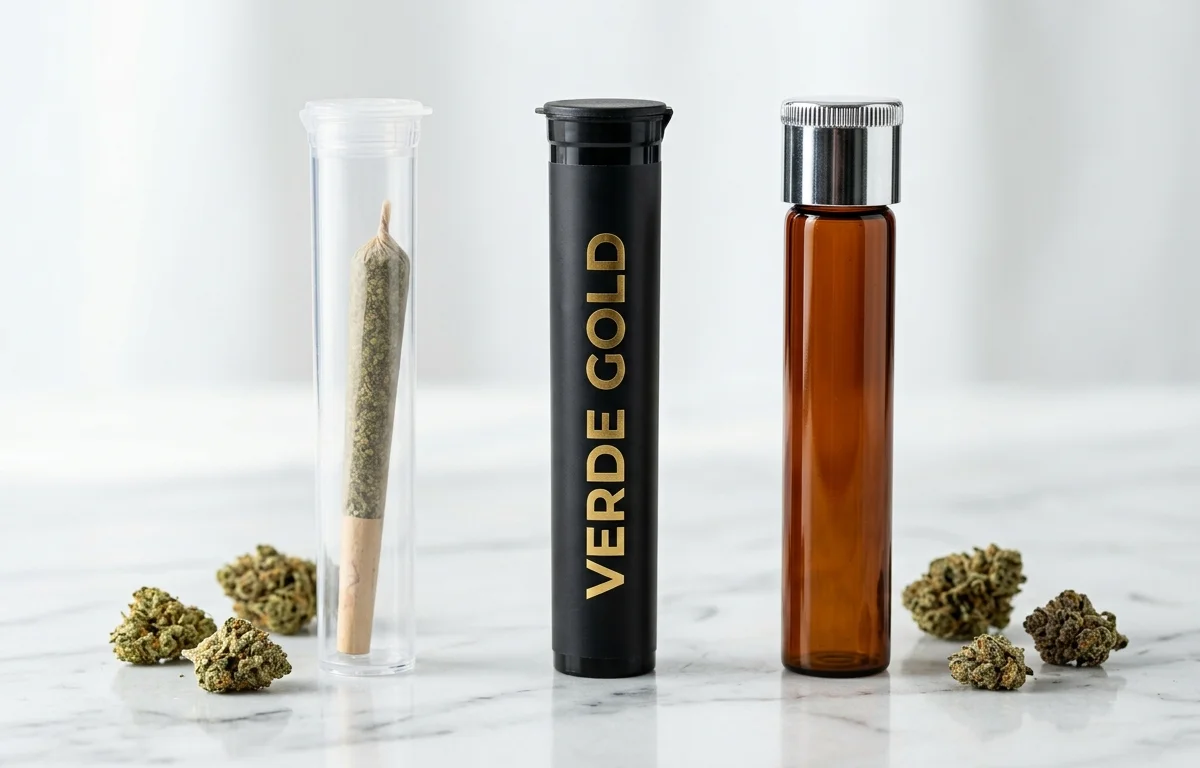 Three child-resistant pre-roll tubes in clear PP, matte black PP, and amber glass — each showing different material properties and branding options
Material selection drives your per-unit cost, brand perception, and recycling story. Here is how the two dominant tube materials compare:
| Factor | Polypropylene (PP #5) | Borosilicate Glass |
|---|---|---|
| Per-unit cost (MOQ 1,000) | $0.12–$0.30 | $0.45–$1.20 |
| Weight | 3–5 g | 15–25 g |
| Shatter resistance | Shatter-proof | Fragile — requires foam inserts |
| Gas permeability | Low (preserves 4–6 months) | Zero (preserves indefinitely) |
| UV protection | Opaque or translucent colors | Amber glass blocks 99% UV |
| Recyclability | Curbside recyclable (PP #5) | Infinitely recyclable |
| Brand perception | Standard / value tier | Premium / luxury |
| CR mechanism | Squeeze-to-open pop-top | Push-down-and-turn screw cap |
| Best for | High-volume dispensary brands | Premium infused pre-rolls, $20+ price points |
Beyond standard PP and glass, three sustainable tube materials are gaining traction with ESG-conscious brands:
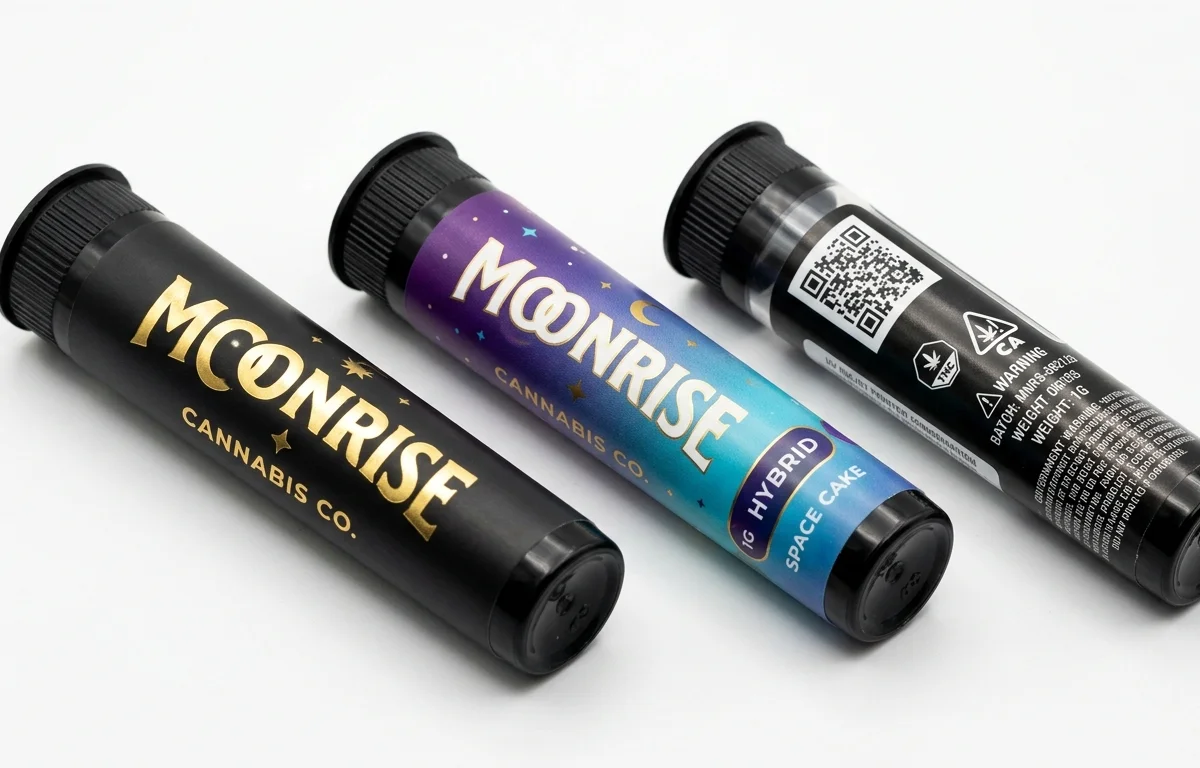 Custom printing techniques on pre-roll tubes — shrink sleeve wrap, gold foil stamping, and UV inkjet with QR code
Custom branding transforms a commodity tube into a shelf-ready brand asset. Here are the eight printing methods available for tube customization, ranked by cost and visual impact:
Pad printing — The most common method for tubes. A silicone pad transfers ink onto the curved tube surface. Supports 1–4 spot colors. Cost: $0.03–$0.08/unit at 5,000+ MOQ.
Screen printing — Delivers 360-degree wrap coverage with thicker ink deposit than pad printing. Supports up to 6 spot colors. Cost: $0.05–$0.12/unit. Best for bold, high-contrast designs.
UV inkjet digital printing — Variable data capability (unique QR codes, batch numbers, serial tracking). No plate costs. Cost: $0.08–$0.15/unit. Ideal for small runs under 2,000 units.
Hot foil stamping — Metallic gold, silver, or holographic foils pressed onto tube walls. Premium shelf presence. Cost: $0.10–$0.25/unit.
Laser engraving — Permanent marking etched into the tube surface. Cannot be rubbed off. Used for compliance lot numbers and premium branding. Cost: $0.06–$0.15/unit.
Shrink sleeve labels — Full 360-degree photographic-quality coverage. Conforms to tube contours. Cost: $0.08–$0.18/unit. Highest visual impact.
Pressure-sensitive label wraps — Vinyl or BOPP adhesive labels applied around the tube body. Fastest turnaround (5–7 days). Cost: $0.05–$0.10/unit for the label + $0.02/unit application.
Embossing / debossing — Raised or recessed text and logos pressed into the tube wall during molding. Adds tactile branding. Cost: $0.04–$0.08/unit (requires custom mold tooling).
GEO insight: For multi-state operators (MSOs) managing different compliance label requirements across states, UV inkjet digital printing is the most cost-effective option because it eliminates plate costs and supports variable data — you can print California warnings on one batch and Colorado warnings on the next without retooling.
Cannabis packaging regulations vary by state. Here are the most common requirements that affect tube specification and label content:
| Requirement | States That Mandate It |
|---|---|
| Child-resistant packaging | All legal states (mandatory) |
| Opaque container (contents not visible) | CA, CO, WA, OR, IL, MA, MI |
| Universal THC symbol | CO, CA, OR, WA, CT, NJ, MA |
| Resealable after opening | CA, CO, WA, NV |
| Net weight on label | All states |
| Batch/lot tracking number | All states |
| "Keep out of reach of children" text | CA, CO, WA, OR, IL, MA, NJ |
| Lab testing results or QR link | CA, CO, WA, OR, MA |
Key fact: California requires all pre-roll packaging to be both child-resistant AND opaque — meaning clear or translucent tubes cannot be sold to California dispensaries without an opaque shrink sleeve or label covering the contents. This single requirement drives more tube customization orders than any other state regulation.
For a detailed state-by-state compliance breakdown, see our cannabis packaging requirements compliance guide.
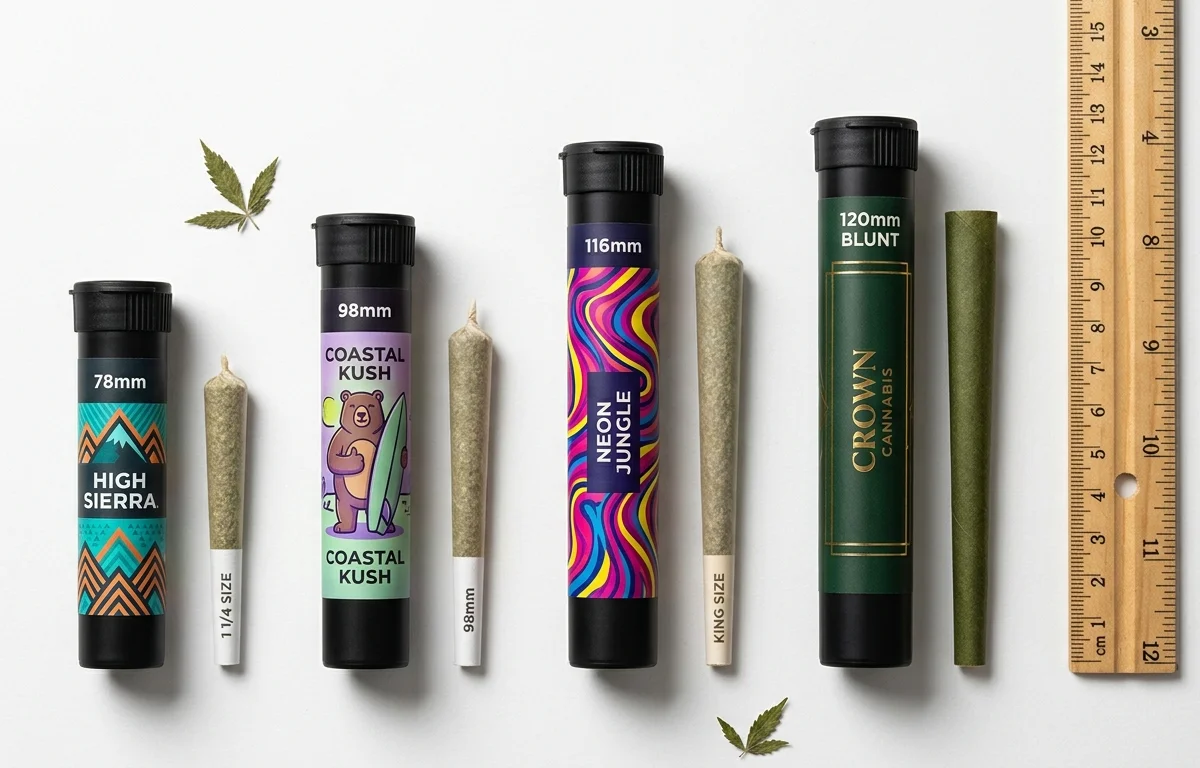 Child-resistant pre-roll tubes in four sizes — 78mm, 98mm, 116mm, and 120mm — with corresponding cone sizes for scale reference
Selecting the wrong tube length wastes shelf space or leaves the pre-roll rattling inside. Here is the standard size mapping:
| Tube Length | Tube Diameter | Fits These Cones | Common Use |
|---|---|---|---|
| 78mm | 18mm | 70mm "Shorty" cones | Half-gram singles, CBD joints |
| 98mm | 18mm | 84mm standard cones | Standard 0.5–0.75g pre-rolls |
| 116mm | 19mm | 109mm King Size cones | Full-gram king size joints |
| 120mm | 22mm | 109mm blunts / fat cones | Infused blunts, 1.5g+ rolls |
Pro tip: For multi-pack pre-rolls (3-packs, 5-packs), consider custom pre-roll boxes or child-resistant pouches instead of tubes. Tubes are optimized for singles and doubles — multi-packs are more cost-efficient in rigid boxes or CR stand-up pouches.
For B2B procurement teams evaluating tube suppliers, here are the benchmarks to compare against:
| Factor | Industry Standard | Cubit Packaging |
|---|---|---|
| MOQ (plain stock tubes) | 1,000–5,000 | 500 units |
| MOQ (custom printed) | 5,000–10,000 | 1,000 units |
| Lead time (stock) | Ships in 1–3 days | Ships in 1–2 days |
| Lead time (custom) | 10–21 days | 10–14 days |
| Sample cost | $25–$50 + shipping | Free sample kit |
| Price per unit (stock 116mm PP) | $0.15–$0.25 | From $0.12/unit |
| Includes CR certification docs | Sometimes | Always included |
When requesting quotes, always clarify whether the stated per-unit price includes the cap (some suppliers quote tube body and cap separately) and whether freight is included for large orders.
Browse our full child-resistant packaging collection for tubes, boxes, pouches, tins, and exit bags — all ASTM D3475 certified.
Yes — pop-top tubes with squeeze-to-open mechanisms are classified as child-resistant when they pass CPSC 16 CFR 1700.20 testing. The squeeze mechanism requires simultaneous lateral force and upward lift that children under five cannot replicate. Always verify your supplier provides certified test documentation, not just an ASTM D3475 classification number.
ASTM D3475 is a voluntary classification standard that categorizes child-resistant packaging by mechanism type (e.g., squeeze-to-open, push-and-turn). It does not test performance. 16 CFR 1700.20 is the federal performance testing protocol enforced by the CPSC that requires actual child and senior panel testing. Legal compliance requires passing 16 CFR 1700.20 — not just being classified under ASTM D3475.
In a properly sealed polypropylene pop-top tube, pre-rolls maintain optimal moisture content (55–62% relative humidity) for 4–6 months. Borosilicate glass tubes with silicone-gasketed CR caps preserve freshness indefinitely due to zero gas permeability. Exposure to direct UV light degrades THC into CBN regardless of container type — always store in opaque or amber tubes.
No. California's Bureau of Cannabis Control (BCC) requires all cannabis packaging to be opaque — contents must not be visible from outside the package. If you use clear or translucent tubes, you must add an opaque shrink sleeve, opaque label wrap, or paper band covering the full tube body. Amber-tinted tubes are also non-compliant unless fully opaque.
Standard 84mm pre-roll cones (0.5–0.75g flower weight) fit a 98mm tube with 18mm diameter. King-size 109mm cones (1.0g+) require 116mm tubes with 19mm diameter. For blunts and infused cones over 1.5g, use 120mm tubes with 22mm diameter. Always order samples to test fit before committing to a production run.
Yes. Standard stock colors include clear, black, white, and amber. Custom Pantone-matched colors (minimum 10,000 units) are produced by mixing pigment directly into the polypropylene resin during injection molding. Custom colors add 7–10 business days to lead time and a one-time $200–$500 tooling fee depending on complexity.
Ready to source custom child-resistant tubes for your pre-roll brand? Start with our Child-Resistant Tubes product page to explore materials, printing options, and finishes — or request a custom quote through our RFQ portal for volume pricing. For brands exploring other CR formats, our ASTM D3475 certification guide covers the full testing process across all packaging types.
Design your packaging free in 60s
Try the free AI packaging design toolNeed Custom Packaging?
Get a free quote with pricing, MOQs, and turnaround time for your custom packaging project.