
AI vs Traditional Packaging Design: Cost, Speed & Quality Compared (2026)
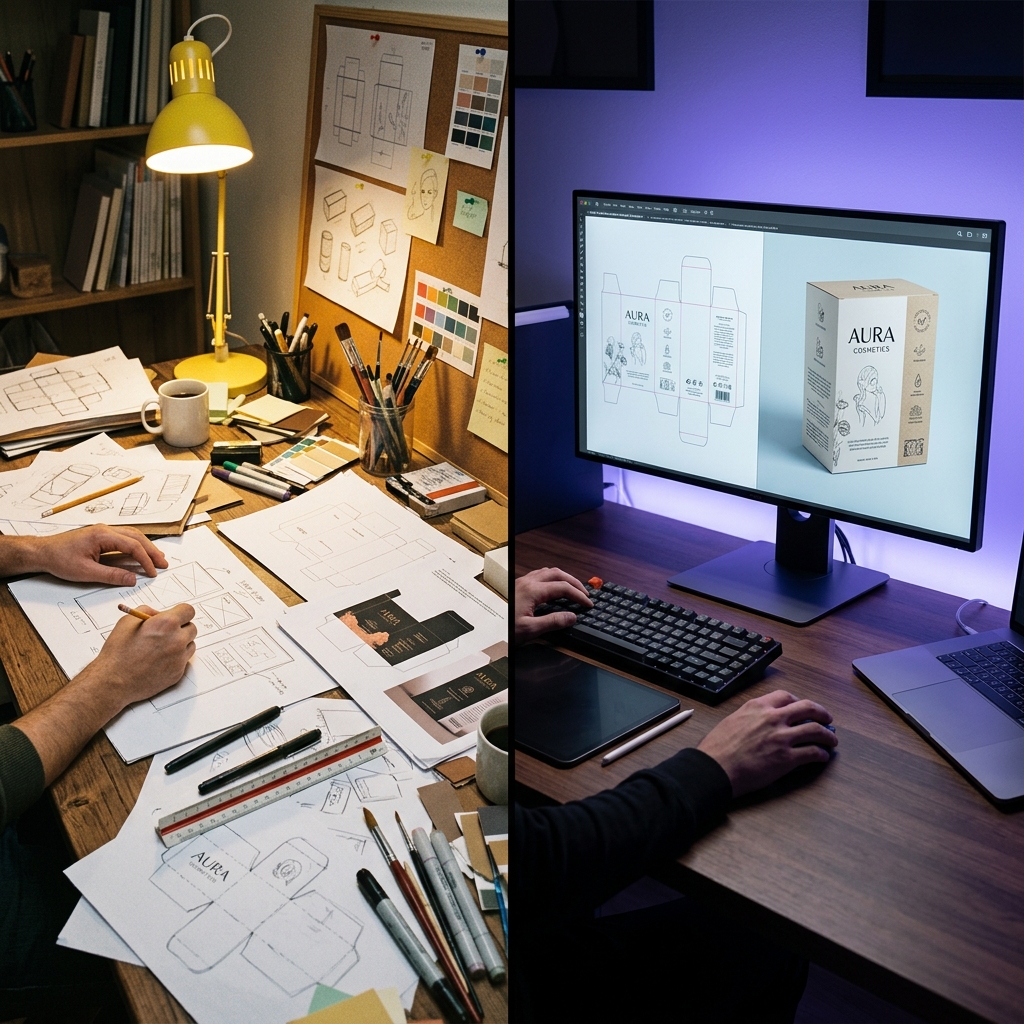
- AI packaging design costs 70–90% less than traditional design ($0–$50 vs $500–$5,000+)
- Traditional design still wins for complex structural engineering and ultra-premium brand identity work
- The sweet spot is hybrid: AI for rapid ideation (80% of the work), human designer for production finalization (20%)
- Time savings average 95%: 60 seconds vs 2–3 weeks for first-draft delivery
- By 2027, 45% of CPG brands plan to incorporate AI into their packaging design workflow (Deloitte Consumer Products Report, 2025)
The Honest Comparison
We're an AI packaging design company, so you'd expect us to tell you AI is better at everything. We won't — because it's not. Both approaches have genuine strengths, and the smartest brands use both.
Here's the full, unvarnished comparison:
Cost Comparison
| Cost Factor | AI Design (Cubit) | Freelance Designer | Design Agency |
|---|---|---|---|
| First design | Free | $200–$800 | $2,000–$5,000 |
| Each revision | Free (unlimited) | $50–$200 each | Often included (2–3 rounds) |
| 10-SKU product line | Free | $2,000–$8,000 | $10,000–$25,000 |
| Annual design budget | $0–$600/yr | $2,000–$10,000/yr | $10,000–$50,000/yr |
| Production file prep | Included in handoff | Usually separate ($100–$300) | Usually included |
The math is clear: for a small brand launching 5–10 products, AI design saves $2,000–$20,000 in the first year alone.
But cost isn't everything. A $200 Fiverr design and a $5,000 agency design look different — and sometimes that difference matters.
Speed Comparison
| Milestone | AI Design | Freelance | Agency |
|---|---|---|---|
| Brief to first draft | 60 seconds | 3–7 days | 1–2 weeks |
| Revision turnaround | Instant | 1–3 days | 3–5 days |
| Final approved design | 1–2 hours | 2–3 weeks | 4–6 weeks |
| Production-ready files | Same day (with handoff) | 1–3 days after approval | 1 week after approval |
Where speed matters most: Seasonal packaging. Limited editions. Product launches with hard deadlines. Trade shows in two weeks. Your competitor just released something similar and you need to respond. These are the scenarios where "60 seconds to first draft" changes everything.
Where speed doesn't matter: Long-term brand identity development. Packaging that will be on shelves for 5+ years. When the design IS the product differentiation (luxury goods).
Quality Comparison
This is where the conversation gets nuanced:
AI Design Quality: What's Good
- Structural accuracy: AI knows exactly where fold lines, glue tabs, and dust flaps go on standard box types
- Brand consistency: Once trained on your brand, AI produces consistent results across SKUs
- Industry compliance: Built-in knowledge of FDA panels, INCI lists, THC warnings, barcode placement
- Creative range: Can generate 20 wildly different concepts in the time it takes a human to sketch one
- Print specifications: Automatic bleed areas, safe zones, and dimension annotations
AI Design Quality: What's Not (Yet) Great
- Typographic nuance: AI doesn't kern like a human typographer. Letter-spacing on display text can feel off.
- Color subtlety: Specifying exact Pantone spot colors from a text prompt is imprecise. "Sage green" to an AI vs. "Pantone 7494 C" to a designer produces different results.
- Brand soul: A great designer captures the feeling of a brand — the intangible quality that makes Apple packaging feel like Apple. AI mimics aesthetics, but doesn't yet understand brand philosophy at that depth.
- Complex structures: Custom inserts with tight tolerances, multi-component packaging, unusual closures — these still need human structural engineering.
Traditional Design Quality: What's Good
- Brand depth: A skilled designer spends time understanding your brand positioning, competitive landscape, and target demographic before touching a pixel
- Typographic craft: Professional typographers make text beautiful in ways AI can't replicate yet
- Material expertise: Experienced designers know how specific finishes (soft-touch, spot UV, foil) interact with different substrates
- Structural innovation: Novel box structures, unusual closures, and engineering solutions come from human creativity
Traditional Design Quality: What's Not Great
- Inconsistency: Quality varies wildly between designers. A $200 Fiverr designer and a $5,000 agency designer produce very different work.
- Revision fatigue: After 3–4 rounds of revisions, even good designers start rushing
- Template reliance: Many freelancers start from stock templates — you're paying for customization of existing work
- Communication overhead: Explaining what you want in words, waiting days, discovering it's not what you meant, repeating — this cycle wastes weeks
The Hybrid Approach (What Smart Brands Actually Do)
The AI-vs-traditional debate creates a false binary. The best results come from combining both:
- AI for ideation (5 minutes) — Generate 10–20 concept variations using AI. Explore directions you wouldn't have considered.
- Selection and refinement (30 minutes) — Pick the 2–3 strongest concepts. Use canvas annotation tools to mark up what you like and what needs changing.
- AI iteration (10 minutes) — Refine the chosen concept through 5–10 AI generations until it's 80% there.
- Human designer finalization (2–3 days) — A professional designer takes the AI concept and brings it to production quality: exact Pantone matching, press-ready files, die-cut tolerance verification.
Total time: 2–3 days. Total cost: A fraction of the agency approach. Quality: Production-ready.
This is the workflow Cubit Design Studio is built around — AI generates, you annotate and refine, then a human designer finalizes for manufacturing.
Decision Framework: Which Approach for You?
Choose AI Design If:
- You're a small business or startup watching your budget
- You need packaging for 1–20 SKUs
- You're doing seasonal or limited-edition runs
- You need designs fast (days, not weeks)
- You're creating mockups for presentations or investor decks
- You want to test multiple creative directions before committing
Choose Traditional Design If:
- You're building a luxury brand where packaging IS the product experience
- You need complex structural engineering (custom inserts, unusual closures)
- You have a $10,000+ design budget and 6+ weeks of timeline
- You're creating packaging that will be unchanged for 3–5 years
- You need exact Pantone spot color matching across global production runs
Choose Hybrid (Recommended for Most) If:
- You want the speed and cost of AI with the polish of human expertise
- You're scaling a brand with regular new SKU launches
- You want creative exploration without the hourly billing clock running
- You need production-ready files with proper press specifications
FAQ
Can AI replace my packaging designer?
Not entirely — and it shouldn't. AI handles the ideation, iteration, and structural work (80% of the process). Human designers add the craft, brand depth, and production expertise (20%). Together, they're faster and cheaper than either alone.
Is AI-designed packaging lower quality?
For standard box types, no. AI-generated structural designs (dielines, panel layouts) are as accurate as human-created ones for common formats. The quality difference appears in typography, color nuance, and brand storytelling — areas where human designers still excel.
How do I start with AI packaging design?
Sign up for a tool like Cubit Design Studio. Describe your product and brand. Generate your first design in under 60 seconds. Iterate with annotations. Hand off to a human designer when ready for production.
What if I'm not happy with the AI design?
Regenerate. Unlimited times. That's the fundamental advantage — there's no cost or guilt to saying "try again." With traditional design, every revision costs time and money. With AI, iteration is free and instant.
Will traditional packaging design become obsolete?
No. It will become more specialized. Just as photography didn't kill painting, AI design won't kill traditional design — it will push it toward higher-value work: brand strategy, structural innovation, and luxury craft. The routine work (standard box layouts, basic mockups, template variations) will move to AI.
Try both approaches and decide for yourself. Start with AI Design in Cubit Studio — free, instant, unlimited generations. When you're ready for human expertise, our designer handoff is one click away.
Related Reading:
- AI Packaging Design: Complete Guide
- How to Design Custom Packaging Online
- How Much Does Custom Packaging Cost?
Ready to order custom packaging? Custom Mailer Boxes → | Custom Folding Cartons → | Custom Mylar Bags → — full-color printing, free design support. From 500 units. Browse all products →