
Design Tips
Minimalist Packaging Trends for Modern Brands in 2026
Cubit Packaging Team
June 17, 2026
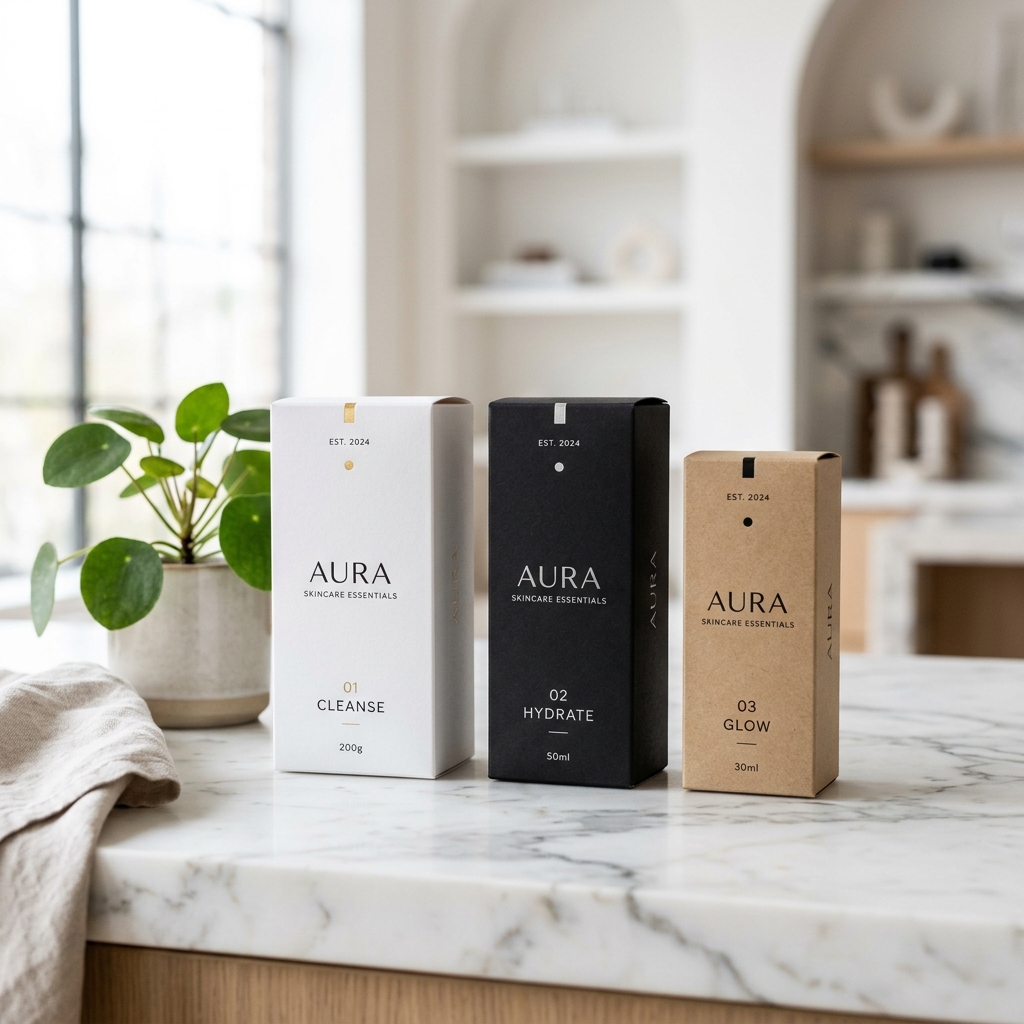
Minimalist packaging is not about doing less work — it is about making every element count. In a retail environment where products fight for attention with louder, busier packaging, restraint becomes a differentiator.
The psychology is straightforward: consumers associate visual simplicity with quality, honesty, and sophistication. When your packaging is clean, the implicit message is that your product is so good it does not need to shout.
What the data says: In a 2025 Ipsos study, products with minimalist packaging were perceived as 28% more trustworthy and 34% more premium than products with busy, information-dense packaging — even when the actual products were identical.
Whitespace (or negative space) is not empty space — it is breathing room that directs attention. The most effective minimalist packages dedicate 60–70% of surface area to blank space.
When you strip away illustrations and busy patterns, your typography carries the entire brand personality. Invest in a distinctive typeface. Minimalist brands typically use one font family with two weights maximum.
Limit your palette to 1–2 colors plus your substrate (kraft or white). A single Pantone spot color on natural kraft creates more impact than a full CMYK rainbow.
In minimalist packaging, the material IS the aesthetic. Uncoated kraft shows fiber texture. Unbleached chipboard communicates authenticity. The material speaks before the printing does.
| Brand | Category | Packaging Approach | Result |
|---|---|---|---|
| Apple | Technology | White rigid box, minimal text, product-first | Packaging became part of brand value |
| Aesop | Skincare | Apothecary-style, dense type on amber glass | Commands 3x industry-average pricing |
| Glossier | Beauty | Millennial pink, simple sans-serif, whitespace | 600% growth in 4 years |
| Muji | Retail | No logo on packaging, material-forward | Global cult following |
| Everlane | Fashion | Plain kraft, single-color stamp | Built on "radical transparency" |
Choose your substrate before your design:
Your packaging should have exactly one thing that draws the eye. This could be:
Look at your design and remove elements one by one. Does the packaging still work? Keep removing until it does not. Then add back the last thing you removed.
If you add a premium finish, pick ONE:
Never combine more than one. Restraint is the entire point.
Minimalist packaging is not just an aesthetic choice — it is a smart financial one:
A minimalist kraft mailer box with one-color print typically costs 25–35% less than a full-color printed box with finishing — while actually looking MORE premium.
Expert insight from Cubit: "The best minimalist packaging we produce uses premium materials with simple execution. A soft-touch matte black box with debossed logo costs about the same as a standard full-color box but creates a radically different brand experience."
It depends on the category. Minimalist packaging outperforms in premium products, skincare, fashion, and wellness. Colorful packaging performs better in children's products, snacks, and impulse-buy categories. Know your audience.
Invest in three things: quality materials (thick, textured stock), precise printing (sharp registration, consistent ink density), and one premium finish (foil, embossing, or soft-touch). The material quality compensates for design simplicity.
One-color flexo print on natural kraft corrugated is the most affordable minimalist option. At 500+ units, expect $0.80–$1.50/unit for a standard mailer box. No coating, no finish — just clean typography on beautiful kraft.
Yes, with considerations. Food packaging requires specific label information (nutrition facts, ingredients, allergens). Design your label layout around these requirements, using clean typography and ample whitespace. The result can be strikingly minimal despite the required content.
Print your design on the actual packaging material (not paper). View it from 3 feet away — can you identify the brand? Place it next to competitor products — does it stand out? If yes to both, your minimalist design works.
Ready to design minimalist packaging? Start with Cubit's AI design studio — describe your brand aesthetic, and explore clean, modern packaging concepts instantly.
Design your packaging free in 60s
Try the free AI packaging design toolNeed Custom Packaging?
Get a free quote with pricing, MOQs, and turnaround time for your custom packaging project.