
Brand Protection
How to Spot Counterfeit CBD Products by Their Packaging
Cubit Packaging Team
June 17, 2026
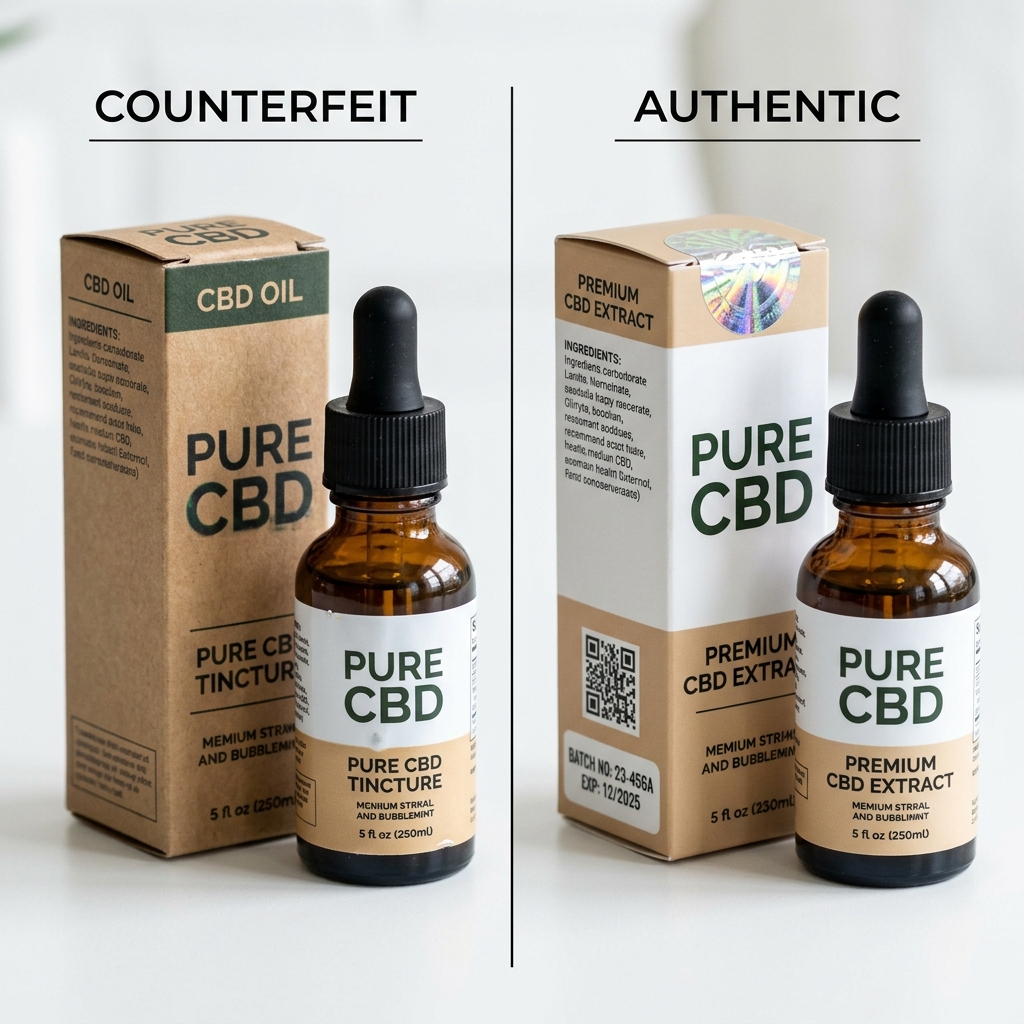
The CBD market is projected to reach $47 billion by 2028 (Grand View Research). High margins and inconsistent regulation have made it a target for counterfeiters. Unlike pharmaceuticals with strict chain-of-custody requirements, CBD products can be manufactured, packaged, and sold with minimal oversight.
For consumers, the risk is real: counterfeit CBD products may contain harmful substances, incorrect dosages, or no active CBD at all. For legitimate brands, counterfeits erode trust and steal market share.
Packaging is your first and most accessible verification tool. Here is exactly what to look for.
Legitimate CBD brands link QR codes to third-party lab results (COA) specific to each batch. Scan the QR code with your phone:
| Quality Indicator | Authentic | Counterfeit |
|---|---|---|
| Text sharpness | Crisp, readable at all sizes | Blurry, especially small text |
| Color consistency | Uniform across the package | Uneven saturation, color shifting |
| Registration | Elements align perfectly | Slight offset between colors |
| Barcode readability | Scans immediately | Often unscannable |
| Foil/hologram quality | Sharp, shifts clearly | Dull, static, or peeling |
Every legitimate CBD product package should display:
If any of these elements are missing, the product is either counterfeit or non-compliant — neither is acceptable.
Authentic CBD products use tamper-evident features:
Compare the packaging to the brand's official website and social media. Look for:
If the price is significantly below market average (more than 30% cheaper), the product is likely counterfeit. Quality CBD packaging alone costs $1–$4 per unit — brands cannot sell at deep discounts and maintain quality.
Child-resistant packaging is required in 33 states for CBD products. If the packaging opens without any resistance mechanism, it may not be from a compliant manufacturer.
Brands invest in anti-counterfeiting features:
Consumer tip: "If you cannot verify a CBD product's lab results by scanning a QR code on the packaging, do not buy it. Period. Any legitimate CBD brand provides batch-specific, third-party lab verification through their packaging." — Consumer Safety Alliance
The FDA estimates that 25–30% of CBD products sold online have inaccurate labeling, with some containing no CBD at all. Counterfeit products are most prevalent on unregulated online marketplaces and social media platforms.
A COA is a third-party lab report testing the product's cannabinoid content, heavy metals, pesticides, residual solvents, and microbials. It should list the specific batch number matching your product, the testing laboratory's accreditation, and detailed results for each test category.
Yes. Counterfeit CBD products have been found containing synthetic cannabinoids, heavy metals, pesticides, and bacterial contaminants. Without third-party testing verification, there is no way to know what is actually in the product.
Authentic brands print unique QR codes linked to batch-specific lab results. When scanned, the code directs you to a page showing the exact test results for the product in your hand, verified by the batch number on the label.
Licensed dispensaries offer the highest level of product verification, but reputable online brands with transparent COA access are also safe. The key is verifying lab results — not the sales channel.
Building a CBD brand that customers trust? Design compliant packaging with built-in authentication features.
Design your packaging free in 60s
Try the free AI packaging design toolNeed Custom Packaging?
Get a free quote with pricing, MOQs, and turnaround time for your custom packaging project.