
Brand Protection
Anti-Counterfeit Packaging: Technologies, Costs & Implementation
Cubit Packaging Editorial Team
June 9, 2026
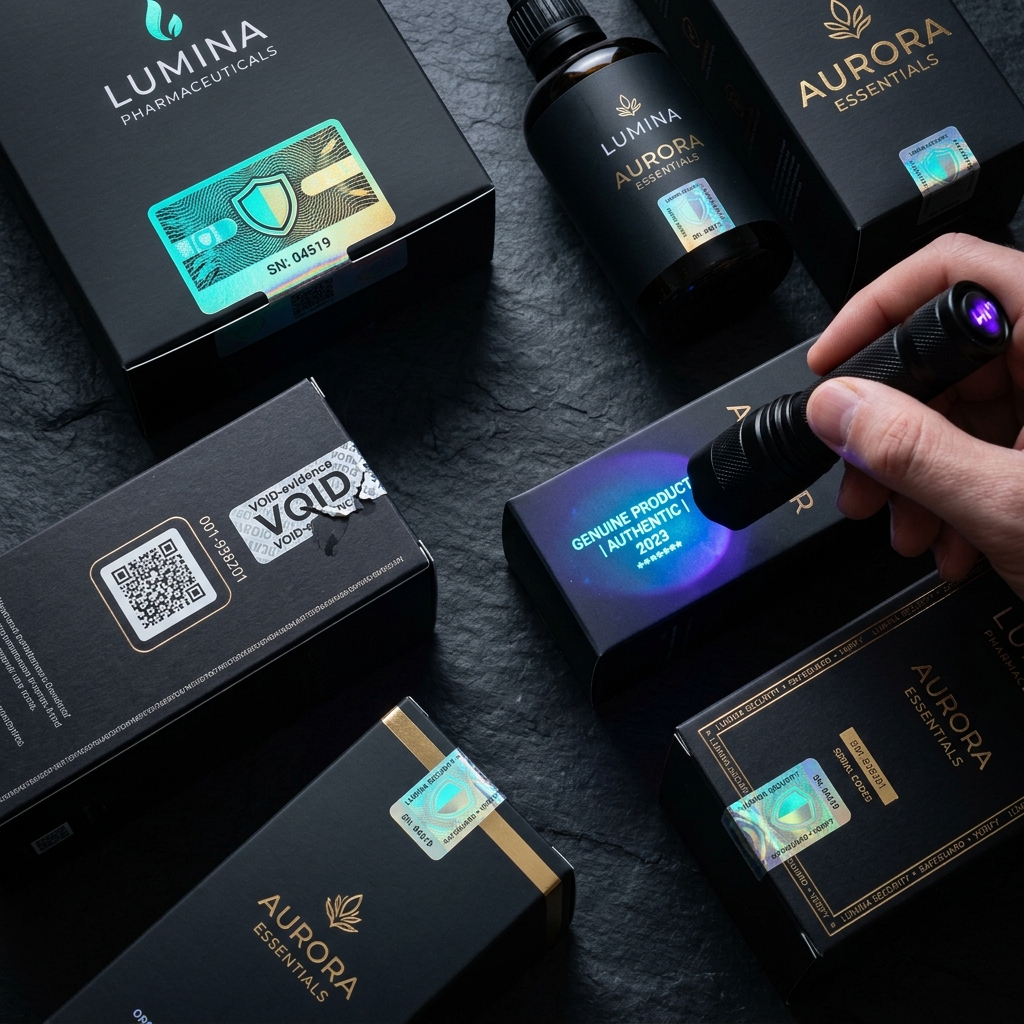
Anti-counterfeit packaging uses embedded security technologies — such as serialized QR codes, NFC authentication chips, holographic labels, and covert markers — to verify product authenticity and deter counterfeiting. Global counterfeiting costs an estimated $2.2 trillion annually according to the OECD/EUIPO 2026 Illicit Trade Report, affecting every industry from pharmaceuticals to luxury goods. Effective anti-counterfeit packaging combines overt features (visible to consumers), covert features (detectable only with special tools), and digital verification (cloud-connected authentication) to create multiple layers of protection that are economically impractical to replicate.
Key Takeaway: A three-layer anti-counterfeit strategy — overt holographic labels ($0.05–$0.15/unit) + covert UV ink ($0.01–$0.03/unit) + digital QR authentication ($0.003–$0.05/unit) — costs $0.06–$0.23 per unit and reduces counterfeit incidents by 60–80%. For most brands, this total cost is less than 1% of the product's retail price.
Counterfeiting is the largest criminal enterprise in the world, exceeding drug trafficking in total revenue. Key statistics:
| Metric | Value | Source |
|---|---|---|
| Global annual counterfeiting losses | $2.2 trillion | OECD/EUIPO 2026 |
| Counterfeit pharmaceuticals (developing markets) | 10–30% of supply | WHO |
| Counterfeit goods as % of world trade | 2.5–3.3% | OECD |
| US customs seizures (2025) | $3.3 billion | CBP |
| Consumer health incidents from fakes | 1 million+ annually | WHO |
| Jobs lost to counterfeiting globally | 4.2 million | ICC/BASCAP |
Effective brand protection requires multiple layers because no single technology is sufficient on its own:
Features that consumers can see and verify without special tools.
Features invisible to the naked eye, detectable only with specific equipment.
Technology-driven authentication using cloud databases and consumer smartphones.
The layered approach means a counterfeiter must replicate ALL three layers to produce a convincing fake — exponentially increasing cost and complexity beyond economic viability.
Holographic labels use diffraction patterns that create 3D visual effects impossible to reproduce with standard printing. Modern holograms include:
Cost: $0.05–$0.15/unit | Security level: ⭐⭐⭐⭐ | Consumer recognition: High
Optically variable inks change color when viewed from different angles. Used on currency worldwide (e.g., the color-shifting numerals on US $100 bills).
Cost: $0.03–$0.08/unit | Security level: ⭐⭐⭐⭐ | Consumer recognition: Medium
Specialized printing techniques that are difficult to replicate:
Cost: $0.02–$0.06/unit | Security level: ⭐⭐⭐ | Consumer recognition: Low
Invisible under normal light but glow under UV (365nm wavelength). Can be used for hidden logos, batch codes, or verification patterns.
Cost: $0.01–$0.03/unit | Security level: ⭐⭐⭐ | Detection: UV flashlight ($5–$15)
Microscopic particles with unique chemical signatures added to ink, adhesive, or packaging material. Verified using handheld scanners or laboratory analysis.
Cost: $0.02–$0.10/unit | Security level: ⭐⭐⭐⭐⭐ | Detection: Proprietary reader
Data encoded into the printed artwork at a level invisible to the human eye. Verified using a smartphone app that reads the embedded data from the packaging's visual appearance.
Cost: $0.01–$0.05/unit + licensing | Security level: ⭐⭐⭐⭐ | Detection: Smartphone app
Each unit gets a unique QR code linked to a cloud database. Consumers scan to verify authenticity.
Embedded chips with unique hardware IDs verified against a cloud database when tapped with a smartphone.
Immutable distributed ledger recording every supply chain transaction. Each product's journey from manufacture to retail is permanently recorded.
| Technology | Cost/Unit | Security | Consumer Verify | Counterfeiter Cost to Replicate | Best For |
|---|---|---|---|---|---|
| Holographic label | $0.05–$0.15 | ⭐⭐⭐⭐ | ✅ Visual check | $50K+ origination | Mass-market deterrent |
| Color-shifting ink | $0.03–$0.08 | ⭐⭐⭐⭐ | ✅ Tilt to see | $100K+ ink + plates | High-value goods |
| UV ink | $0.01–$0.03 | ⭐⭐⭐ | ⚠️ UV light needed | $5K ink + awareness | Covert layer |
| Serialized QR | $0.003–$0.05 | ⭐⭐⭐ | ✅ Phone scan | Easy to copy (first-scan detects) | Digital verification |
| NFC chip | $0.10–$0.50 | ⭐⭐⭐⭐⭐ | ✅ Phone tap | Impossible to clone chip | Premium authentication |
| Chemical taggant | $0.02–$0.10 | ⭐⭐⭐⭐⭐ | ❌ Lab/reader only | $500K+ R&D to identify | Forensic verification |
| Digital watermark | $0.01–$0.05 | ⭐⭐⭐⭐ | ✅ App scan | Difficult (in-image encoding) | Connected packaging |
| Blockchain | $0.05–$0.30 | ⭐⭐⭐⭐ | ✅ View history | Cannot fake chain of custody | Luxury/pharma provenance |
Recommended stack: Serialized 2D code (DataMatrix/QR) + tamper-evident seal + holographic label Regulatory: DSCSA (US), EU FMD mandatory Budget: $0.08–$0.25/unit
Recommended stack: NFC chip (NTAG424 DNA) + holographic hangtag + blockchain provenance Regulatory: Voluntary, but brand equity demands it Budget: $0.30–$0.80/unit
Recommended stack: Serialized QR code + holographic seal + UV-reactive batch code Regulatory: FDA labeling requirements Budget: $0.06–$0.20/unit
Recommended stack: NFC tag in closure + QR on label + tax stamp integration Regulatory: TTB compliance, varies by country Budget: $0.20–$0.60/unit
Recommended stack: VOID warranty seal + serialized QR code + holographic label Regulatory: UL/CE marking, warranty terms Budget: $0.05–$0.15/unit
| Layer | Technology | Per Unit | Total (100K) |
|---|---|---|---|
| Overt | Holographic label | $0.08 | $8,000 |
| Covert | UV-reactive ink | $0.02 | $2,000 |
| Digital | Serialized QR + platform | $0.01 | $1,000 |
| Total | Three-layer protection | $0.11 | $11,000 |
For a product with $50 retail price and 2% counterfeit rate:
Cubit Secure provides an end-to-end platform covering all four phases, from security design through ongoing monitoring.
No single technology is "most effective" alone. The most effective approach is a layered strategy combining overt features (holographic labels), covert features (UV ink, taggants), and digital verification (serialized QR codes or NFC). NFC chips with NTAG424 DNA provide the highest single-technology security because each chip has an unclonable unique ID with cryptographic authentication.
A basic anti-counterfeit solution (serialized QR code + holographic label) costs $0.05–$0.20 per unit. A comprehensive three-layer strategy (overt + covert + digital) costs $0.06–$0.23 per unit at scale. For most consumer products, this represents less than 1% of the retail price.
Consumers verify products by scanning a QR code with their smartphone camera or tapping an NFC-enabled phone on the packaging. The verification app or webpage instantly displays whether the product is genuine, suspicious, or counterfeit. Overt features like holograms and color-shifting inks can be verified visually without any technology.
For pharmaceuticals, yes — the DSCSA (US) and FMD (EU) require serialization and tamper-evident features. For most other industries, anti-counterfeit measures are voluntary but strongly recommended for brand protection. The EU Digital Product Passport (starting 2027) will require product authentication capabilities for textiles, batteries, and electronics.
Counterfeiters can produce crude approximations of holograms, but replicating the exact optical effects requires the original master hologram and specialized e-beam equipment costing $50,000–$200,000. This makes hologram counterfeiting economically unviable for most product categories. However, holograms alone are insufficient — always combine with digital verification for comprehensive protection.
Counterfeiting is a $2.2 trillion threat that affects brands of every size. The good news: effective anti-counterfeit packaging starts at $0.06 per unit.
Explore Cubit Secure or talk to our AI Consultant for a personalized anti-counterfeiting strategy.
Published by Cubit Packaging Editorial Team. Last updated June 2026.
Design your packaging free in 60s
Try the free AI packaging design toolNeed Custom Packaging?
Get a free quote with pricing, MOQs, and turnaround time for your custom packaging project.