
Packaging Guides
The Ultimate Guide to Custom Kraft Stand-Up Pouches for Growing Brands
Cubit Team
June 22, 2026
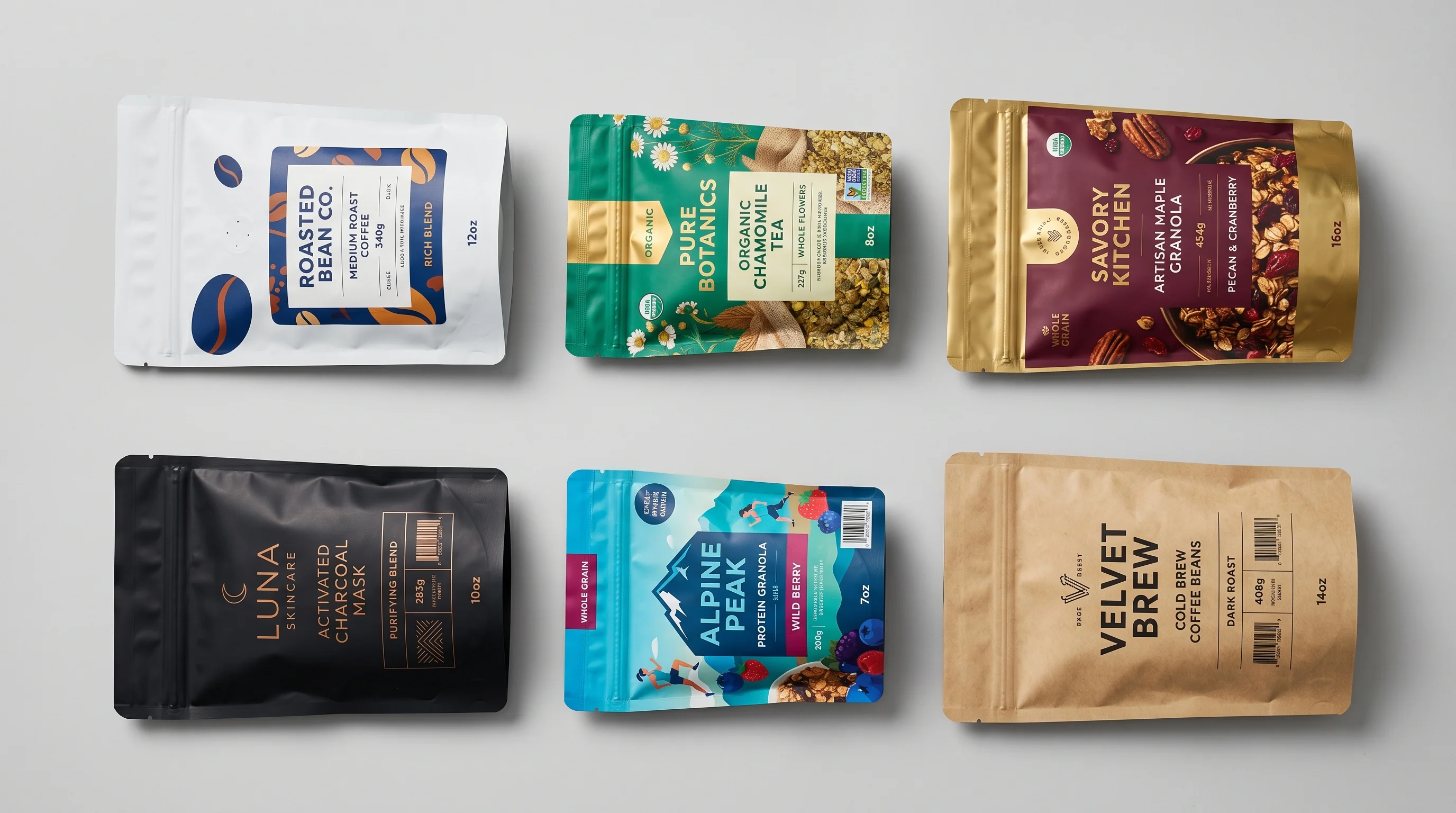
Custom Kraft Stand-Up Pouches are flexible packaging solutions constructed from natural kraft paper laminated to high-performance barrier layers. They provide food, coffee, tea, beauty, and pet brand owners with an efficient, professional, and visually appealing way to package, store, and display their products on retail shelves. Unlike rigid plastic canisters or glass jars, these flexible pouches ship flat, which reduces storage footprint and inbound freight costs before filling. They utilize a bottom gusset that expands to allow the package to stand upright independently once filled, creating a secure and highly visible presentation on store shelves.
For growing brands, choosing the right material composition and barrier structure is the most direct way to protect product freshness and extend shelf life. The decision involves selecting from a range of internal liners, sealing mechanisms, and custom printing techniques to match your specific product properties. At Cubit, we work with brands to navigate these technical decisions, matching your product weight and volume with the right gauge of laminated packaging.
In this guide:
Brands looking to scale up from manual, unlabeled zip bags to professional custom Kraft Stand-Up Pouches usually do so to improve margins and secure retail placement. A standard 250g capacity glass jar with a metal lid weighs approximately 180 grams. A high-barrier kraft pouch of the same capacity weighs only 9.5 grams. This reduction in tare weight lowers shipping costs by up to 94% on empty containers, directly improving your bottom line.
And shipping efficiency is just one side of the coin. On store shelves, space is highly valuable. Pouches occupy roughly 30% less retail shelf space than round jars of equivalent volume, allowing retailers to stock more of your units per shelf face. The unbleached, textured paper of natural kraft communicates a raw, authentic, and eco-friendly character that appeals to modern consumers. This visual aesthetic works particularly well for specialty foods, spices, coffee beans, and natural skincare products.
But transitioning to flexible packaging is not just about shelf appearance. These packages are highly durable and resist tearing and punctures during transit, which prevents product loss and return rates. The bottom gusset expands under the weight of the product, providing a stable foundation that prevents tipping on production lines, retail displays, and pantry shelves alike. Whether you use manual gravity-filler funnels or high-speed automated filling lines, kraft pouches provide the physical stability needed for consistent operations.
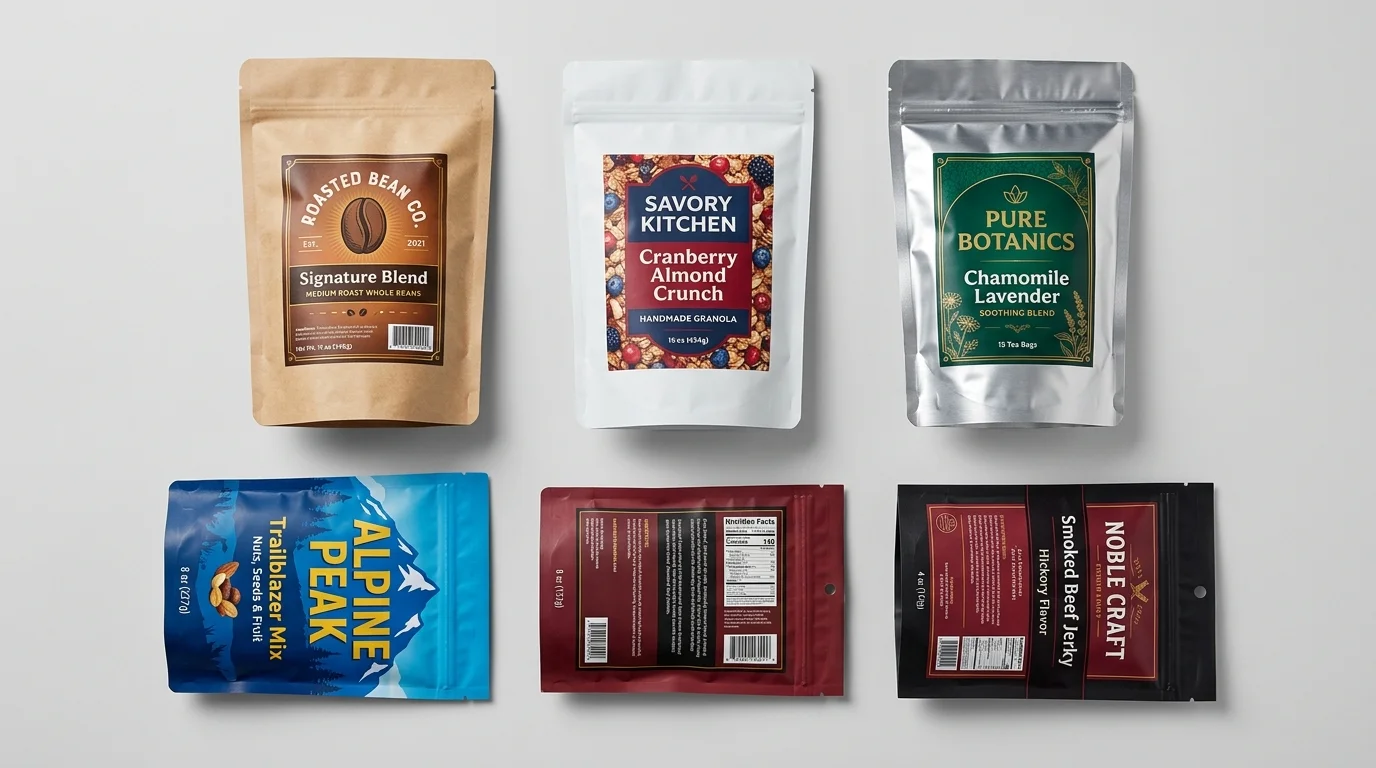 Custom printed Kraft stand-up pouches standing on a wooden store shelf
A common misconception is that paper pouches are made purely of paper. In reality, raw kraft paper is highly porous and offers zero protection against grease, moisture, or oxygen. To preserve shelf life and protect dry goods, custom Kraft Stand-Up Pouches require a multi-layer laminated structure.
Each layer plays a specific role in keeping your product fresh:
For example, a standard high-barrier configuration uses a structure of Kraft / VMPET / LLDPE with a total thickness of 120 to 150 microns. This configuration blocks 99% of UV light and maintains moisture vapor transmission rates (MVTR) below 0.1 grams per 100 square inches per 24 hours. For oxygen-sensitive products like roasted coffee, this barrier stops oxygen from degrading essential oils, keeping your product tasting fresh for up to 12 months. We suggest reviewing our flexible packaging catalog to see the range of barrier options available for your specific product type.
Choosing the right pouch material requires balancing your budget, required shelf life, and sustainability targets. The table below compares the three primary material compositions available for custom Kraft Stand-Up Pouches.
| Material Composition | Barrier Rating | Average Shelf Life | Relative Cost | Recyclability | Typical Applications |
|---|---|---|---|---|---|
| Kraft / VMPET / LLDPE | Excellent (High) | 12 to 18 months | 1.0x (Baseline) | Landfill Only | Coffee, nuts, oily foods, pet treats |
| Kraft / PET / LLDPE | Good (Medium) | 6 to 12 months | 1.0x | Landfill Only | Granola, dry spices, tea, bath salts |
| Kraft / AL / LLDPE | Maximum (Ultra) | 18 to 24 months | 1.25x | Landfill Only | Freeze-dried food, medical items |
| Kraft / PLA (Bioplastic) | Moderate (Low) | 3 to 6 months | 1.45x | Industrially Compostable | Oats, dry powders, fast-turn snacks |
| Kraft / PE (Mono-material) | Good (Medium) | 6 to 9 months | 1.30x | Store Drop-off | Dry pet kibble, non-greasy foods |
Standard laminates containing aluminum foil or VMPET provide the highest level of barrier protection at the lowest manufacturing cost. However, because they fuse paper, metal, and plastic layers together, they cannot be recycled in municipal systems. Recyclable structures use mono-material plastics that can be collected at store drop-off points, though they require a larger initial investment.
Compostable pouches use plant-based polylactic acid (PLA) linings that break down in industrial composting facilities within 90 to 180 days according to ASTM D6400 testing standards. While compostable pouches align with eco-conscious brands, they typically cost 30% to 50% more than standard poly-lined pouches and provide a shorter moisture barrier. For products with high oil content or a target shelf life of over one year, standard barrier laminates remain the safest choice to prevent package discoloration and spoilage. You can browse our stock pouch collection to compare pricing on standard sizes and material samples.
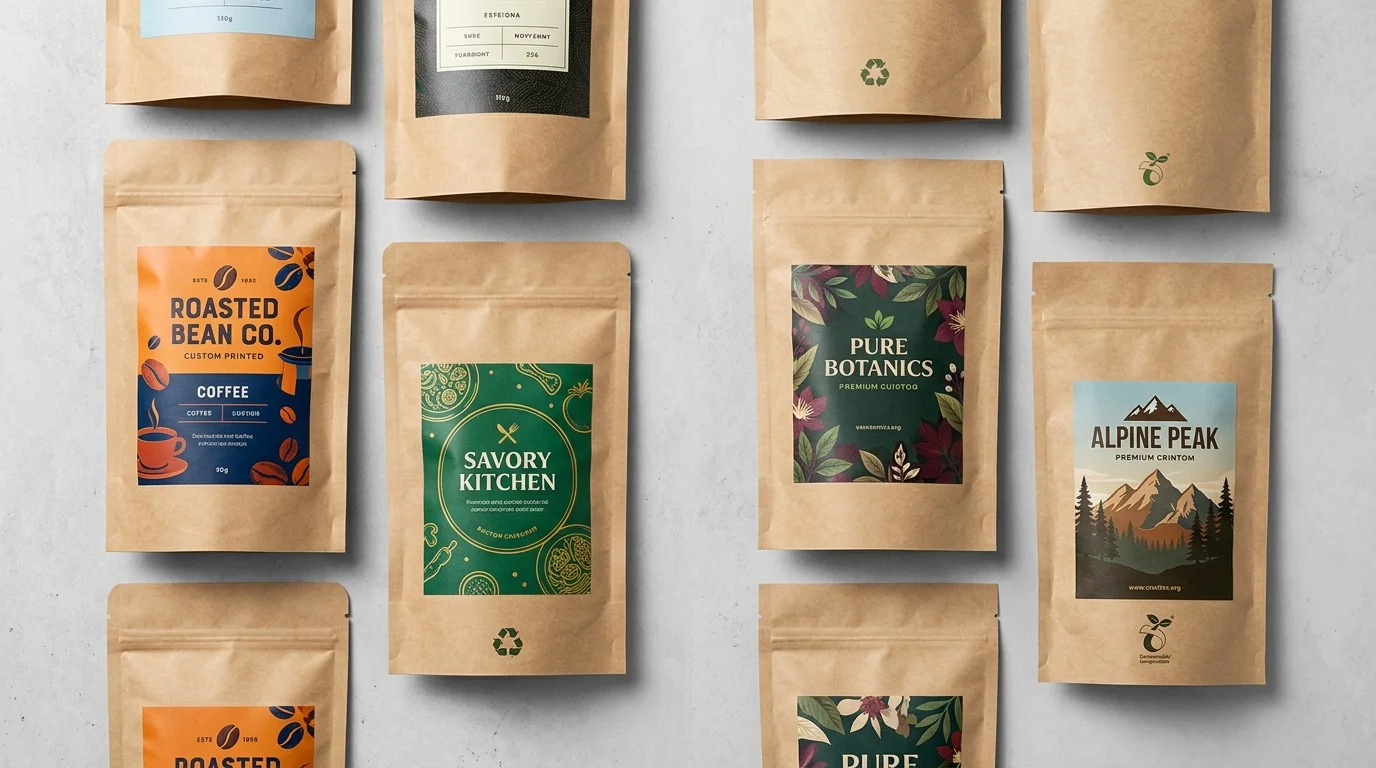 Side-by-side comparison of standard high-barrier kraft and compostable kraft pouches
Designing artwork for Kraft paper surfaces requires a different approach than designing for white paperboard or plastic. Because unbleached kraft paper is naturally brown, the base color affects every ink color printed on top of it.
Light colors, pastel yellows, and light blues will look muddy or wash out entirely when printed directly on brown kraft. To prevent this, packaging designers use a technique called white underprinting. By printing a solid layer of white ink underneath your colored artwork, the colors remain sharp and true to your brand's digital files.
Here are three primary design styles to consider:
When selecting a printing method, volume dictates your choice. Digital printing is ideal for small runs of 1,000 to 5,000 pouches because it has no setup or cylinder tooling costs. However, for larger volumes of 10,000 units or more, flexographic printing offers much lower per-unit costs, though it requires a one-time investment in printing plates. We advise reading our packaging design guidelines to learn how to prepare your artwork files for white underprinting layers.
One of the most common mistakes brands make is assuming that ounces of weight equal ounces of volume. A 16-ounce bag of whole-bean coffee requires a much larger pouch than a 16-ounce bag of fine sea salt. Pouches are measured by volume, while products are sold by weight.
To find the correct pouch size, you must measure your product's dry volume using a measuring cup or consult with a packaging specialist. Here are standard industry dimensions for popular dry-weight pouch sizes:
If your product is highly textured, light, or fluffy, like granola, dried mushrooms, or loose herbal tea, you will need to scale up to the next pouch size to accommodate the physical volume. Always measure your product volume in fluid ounces or milliliters first, then map it to the pouch's maximum capacity. We always recommend sending a physical product sample to our team so we can test the volume inside a physical mock-up pouch before you place a large custom order.
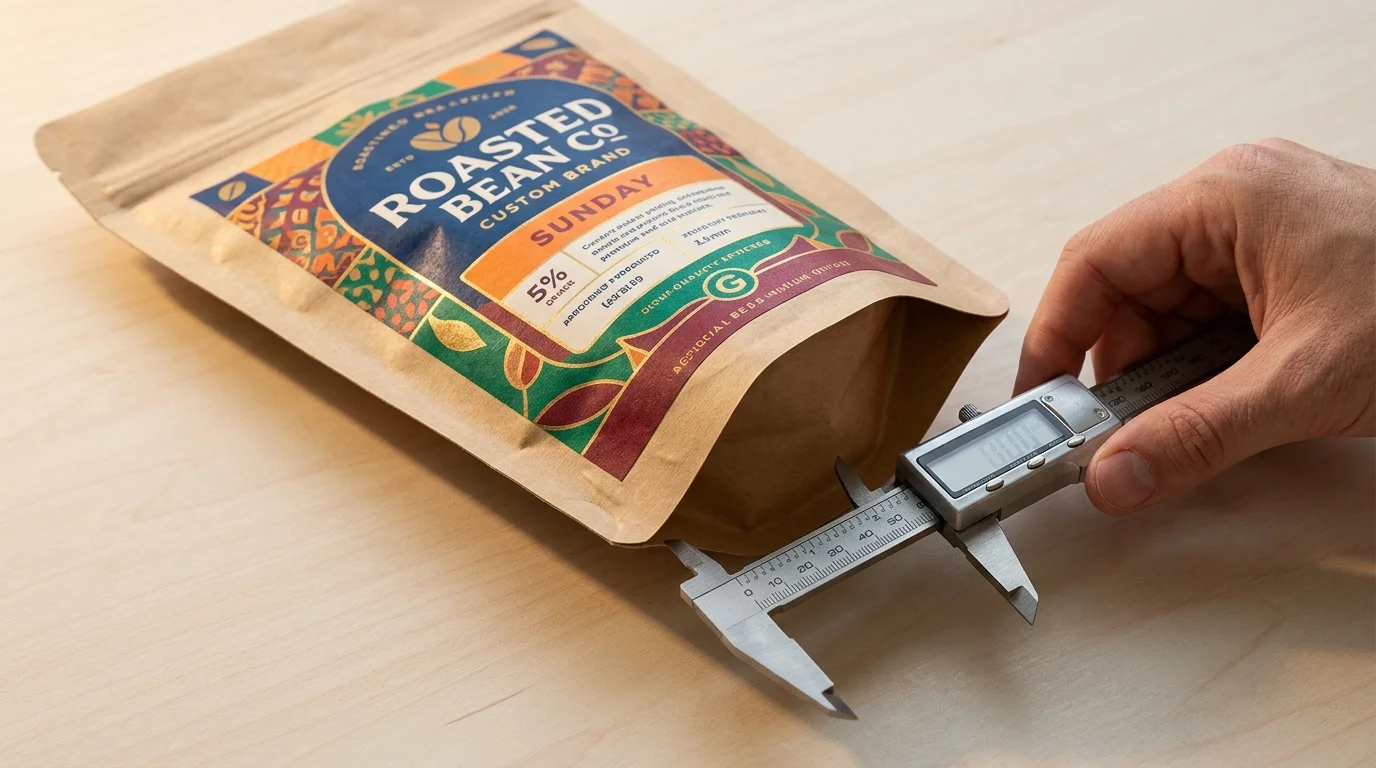 Measuring the bottom gusset of a natural Kraft stand-up pouch
If you are packaging food, cosmetics, or supplements, your packaging must comply with strict safety rules. In the United States, the Food and Drug Administration (FDA) requires all packaging materials that come into contact with food to be certified safe for direct contact. When ordering custom Kraft Stand-Up Pouches, ensure your supplier provides an FDA compliance certificate for the inner heat-seal layer.
Environmental claims also require careful validation to avoid legal issues and greenwashing accusations. The Federal Trade Commission (FTC) Green Guides set strict rules on how brands can market recycled or compostable packaging. For example, you cannot label a pouch as compostable unless it meets ASTM D6400 standards for industrial compostability.
Furthermore, raw material sourcing is a key factor. Sourcing paper from certified sustainable forests helps verify your brand's environmental claims. Look for packaging raw materials certified by the Forest Stewardship Council (FSC). This certification guarantees that the wood pulp used to manufacture your kraft paper comes from responsibly managed forests that preserve biodiversity and support local communities. Furthermore, compliance with ISO 9001:2015 quality management standards ensures that your packaging is manufactured with consistent safety and quality control measures across every batch.
Based on the packaging orders we process at Cubit, over 64% of brands that start with standard stock bags transition to custom-printed pouches within their first 18 months of retail growth. This shift typically reduces manual labeling labor costs by $0.22 per unit and virtually eliminates misaligned labels on retail shelves.
Yes, but only if they are constructed from mono-material plastics like high-density polyethylene (HDPE). Traditional multi-layer laminates with aluminum or mixed plastics must go to landfills. Always check with your supplier to verify the specific plastic layers used in your pouches.
Absolutely. Custom Kraft Stand-Up Pouches are highly safe for food packaging, provided the inner sealing liner is made from FDA-approved food-grade polyethylene (PE) or cast polypropylene (CPP). These food-safe layers act as a barrier to ensure no external ink or paper contaminants touch your food products.
For digitally printed pouches, minimum order quantities typically start at 500 to 1,000 units per design. For flexographic printing, which is more cost-effective for high volumes, the minimum order quantity usually starts at 10,000 units due to the setup costs of physical plates.
Dry goods like flour and sugar only need basic barriers. However, products sensitive to oxygen and moisture, like coffee, nuts, or pet treats, require high-barrier linings like metallized polyester (VMPET) or aluminum foil (AL) inside your custom Kraft Stand-Up Pouches to maximize freshness and prevent premature spoilage.
Yes, you can add a clear plastic window to show off your product. This is done by die-cutting the outer kraft paper layer and using a clear polyester (PET) or polyethylene (PE) barrier layer, allowing consumers to see the contents while keeping the pouch completely sealed.
Selecting the perfect pouch structure requires balancing design, budget, and shelf-life needs. Custom Kraft Stand-Up Pouches offer a practical, professional packaging solution that grows alongside your business. By understanding your material layers and sizing requirements, you can protect your products while keeping shipping costs low.
When you are ready to transition your packaging to custom printed bags, our team can help you select the exact dimensions and high-barrier properties required for your product type.
Get a free quote for your packaging project
Get started on your custom branding with custom Kraft Stand-Up Pouches directly from our online marketplace, or build a personalized quote at our RFQ Procurement portal.
Design your packaging free in 60s
Try the free AI packaging design toolNeed Custom Stand-Up Pouches?
Custom printed stand-up pouches from 500 units. Coffee, food, snack, and pet food packaging. Barrier films, resealable zippers, and degassing valves.