
Packaging Guides
A practical guide to custom holographic labels for growing brands
Cubit Team
July 8, 2026
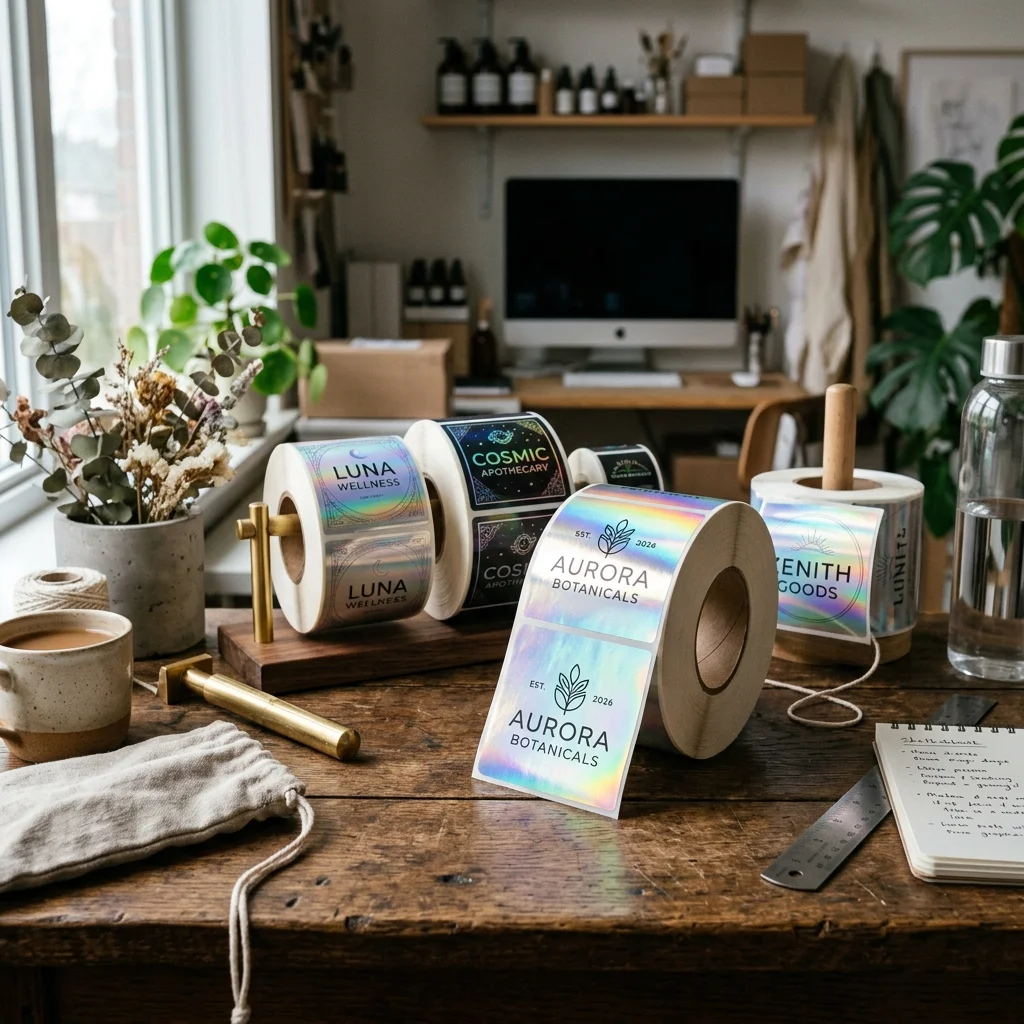
Custom holographic labels are specialized packaging decals printed on a thin, metallized polyester substrate that diffracts light to create a shifting rainbow effect. These labels help consumer brands secure visual prominence on crowded retail shelves by reflecting a full spectrum of colors when viewed from different angles. For growing businesses, they offer a cost-effective way to signal premium quality without the high tooling expenses of hot foil stamping. When designed and applied correctly, these labels increase shelf visibility, protect against product counterfeiting, and withstand exposure to moisture and oils.
We see brands across the cosmetics, beverage, and dietary supplement industries transition to these materials to solve a specific problem: standing out in a crowded market. The visual impact is immediate, but success requires understanding the underlying material science and printing mechanics. This guide breaks down the technical details, costs, and design principles you need to know before sending your artwork to print.
In this guide:
To use custom holographic labels effectively, you have to understand how they work. Unlike standard silver foil papers that act like simple mirrors, holographic materials are engineered with micro-embossed patterns. These microscopic ridges, often measuring less than 1 micron in depth, split white light into its component wavelengths. This physical phenomenon, known as light diffraction, is what creates the shifting rainbow pattern as the angle of observation changes.
In the packaging industry, the most common base material is a 2.0 mil (0.05 mm) metallized biaxially-oriented polypropylene (BOPP) or polyester (PET) film. This film is paired with a clear topcoat that accepts printing inks. Standard pressure-sensitive adhesives are then applied to the back, protected by a siliconized glassine liner.
Understanding this physical structure is important because it dictates how printing inks behave. Standard digital or flexographic inks are transparent. When you print directly onto a holographic surface, the metal shines through the ink, transforming flat CMYK colors into metallic, shimmering hues. If you want a specific part of your design to remain flat and non-reflective, you must print a layer of opaque white ink beneath your color layer. This white underprint blocks the light from reaching the holographic substrate, creating a stark visual contrast between the shimmering background and your solid design elements.
Not all holographic materials are the same. The visual pattern you choose sets the tone for your entire product line. The most common option is a seamless rainbow pattern, which displays a smooth, continuous color shift without any visible repeat lines. Other options include repeating geometric patterns, cracked ice effects, and micro-dot patterns.
Selecting the right material requires balancing visual goals with functional needs. For example, a beverage brand using glass bottles needs a material that handles moisture condensation without peeling. A cosmetics brand using squeezable plastic tubes needs a flexible film that will not crease or wrinkle when the container is compressed.
| Material Type | Thickness | Best Use Case | Key Advantage | Typical Cost Factor |
|---|---|---|---|---|
| Rainbow Holographic BOPP | 2.0 mil | Cosmetics, craft beer, premium supplements | Highly flexible, water-resistant, smooth color shift | Baseline (1.0x) |
| Cracked Ice Holographic PET | 2.5 mil | Promotional stickers, limited editions | High visual impact, scratch-resistant surface | 1.25x |
| Holographic Paper | 3.0 mil | Dry goods, gourmet food packaging | Easily recyclable with paperboard, classic matte look | 0.90x |
| Tamper-Evident Holographic PET | 1.5 mil | Security seals, high-value electronics | Leaves a 'void' pattern or breaks apart when peeled | 1.50x |
Selecting the laminate finish is just as important as choosing the base film. A glossy laminate maximizes the light diffraction, making the rainbow effect as bright and sharp as possible. A matte laminate softens the reflection. It diffuses the light, turning the intense rainbow flash into a subtle, pearlescent glow. This matte approach is highly effective for luxury and wellness brands that want to convey premium quality without looking too loud.
Designing for custom holographic labels requires a completely different approach than designing for white paper. The most common mistake we see is failing to utilize white ink layers. When you submit your artwork, your design program must contain a dedicated spot color layer, usually named 'White Ink' or 'Hpi-White', to tell the press where to block the holographic effect.
Without this white underprint, light pastel colors will completely disappear into the reflective background. Dark colors, like deep navy, forest green, and black, block the reflection naturally and stand out beautifully against the shifting metallic background.
We recommend using strong typographic elements and clean vector shapes. Thin, delicate lines tend to get lost in the color shifts of the holographic film. By surrounding highly detailed, non-reflective graphic elements with a clean, open holographic background, you create a balanced design that guides the shopper's eye directly to your logo and product name.
To ensure your text remains legible, keep your body copy and ingredient lists entirely on top of a solid white underprint. Small text, especially anything below 6pt, should always be printed in solid black or white over a non-reflective background. Readability must always come before visual flair, especially when complying with food, cosmetic, or supplement labeling regulations.
Based on the packaging orders we process, brands that use a matte laminate over their holographic labels see a 30% increase in repeat purchases for luxury product lines compared to those using high-gloss finishes. The subtle, diffused metallic glow conveys a much higher perceived value.
When planning your packaging budget, you must account for the physical differences between digital and flexographic production. For small businesses, digital printing is almost always the best route. Digital presses require no physical plates, making short runs of 500 to 2,500 labels economically viable.
However, as your brand grows and your order volumes cross the 10,000-unit threshold, flexographic printing becomes much more cost-effective. While flexographic printing requires an upfront investment in physical printing plates, the per-unit cost drops dramatically at higher volumes.
Let us look at some concrete cost examples. For a standard 2x3 inch custom holographic label printed digitally, a run of 1,000 labels typically costs around $0.35 per unit. If you scale that same order to 10,000 labels printed on a flexographic press, the unit price drops to approximately $0.08 per label, even after factoring in the initial plate costs. We always advise growing brands to calculate their total cost of acquisition over a six-month period rather than just looking at the initial cash outlay.
To keep your production costs low, consider consolidating your various product scents, flavors, or formulations into a single print run. Digital presses allow you to print multiple design variations in a single production batch, provided the physical label dimensions, shape, and base material remain identical. This approach lets you take advantage of higher-volume price tiers while maintaining a diverse product lineup.
Your label must do more than look good on a screen; it must perform flawlessly in the real world. This requires matching the adhesive to your specific packaging material and application environment. Most custom holographic labels use an acrylic-based, permanent pressure-sensitive adhesive. This adhesive works well on standard surfaces like glass, PET plastic, and high-density polyethylene (HDPE).
If you are packaging craft beers, wines, or chilled juices, you must specify an adhesive rated for wet environments. These specialized emulsions prevent the label corners from lifting or bubbling when the bottles are submerged in ice buckets or exposed to refrigeration condensation.
For products packaged in squeezable tubes or bottles with tight curves, like lip balms or travel-size cosmetics, a high-tack adhesive is required. Standard adhesives may not have enough initial grip to resist the natural memory of the plastic film, causing the label edges to lift over time. This lifting is known in the industry as 'flagging'.
If you use automatic labeling machinery, you must specify the correct unwind direction when ordering your rolls. Label rolls can unwind in eight different configurations. Getting this wrong means your labels will be applied upside down or sideways on your production line, requiring costly manual rework. Work closely with your co-packer to determine their exact equipment specifications before placing your final printing order.
Standard custom holographic labels finished with a glossy or matte laminate cannot be easily written on with standard pens. If your packaging design requires hand-written elements, such as batch numbers or expiration dates, we recommend applying a printable matte varnish over those specific areas instead of a standard laminate film.
Yes, holographic labels printed on 2.0 mil BOPP or PET films are fully waterproof and oil-resistant. To ensure maximum durability, they are finished with a clear protective laminate. This makes them ideal for bath products, cosmetics, craft beers, and other items exposed to moisture, condensation, or frequent handling.
At Cubit, we process custom holographic label orders with a minimum starting quantity of 100 units for digital printing. This low threshold allows emerging brands to test designs, launch seasonal products, and verify market fit without committing to the high costs of large-scale production runs.
To set up your file, create a new vector layer in your design software named 'White Ink'. Draw solid vector shapes in this layer using a distinct spot color to represent where the white underprint should go. Any area left without this white layer will print directly onto the reflective holographic substrate.
Holographic paper labels are generally compatible with standard paper recycling streams. However, holographic film labels made from BOPP or PET must be removed from the container before recycling, or processed through facilities that accept mixed plastic materials. Check your local municipal guidelines and container materials for compatibility.
Choosing the right material combination can feel overwhelming when balancing aesthetic goals, technical application requirements, and production budgets. If you are ready to start planning your next packaging release, we can help you navigate the process from initial design setup to final roll specifications.
Get a free quote for your packaging project and speak directly with one of our material experts.
Get started on your custom branding with custom Holographic Labels directly from our online marketplace, or build a personalized quote at our RFQ Procurement portal.
Design your packaging free in 60s
Try the free AI packaging design toolNeed Custom Packaging?
Get a free quote with pricing, MOQs, and turnaround time for your custom packaging project.