
Product Guides
Custom E-Commerce Boxes: The Complete DTC Shipping Guide (2026)
Cubit Packaging
June 9, 2026
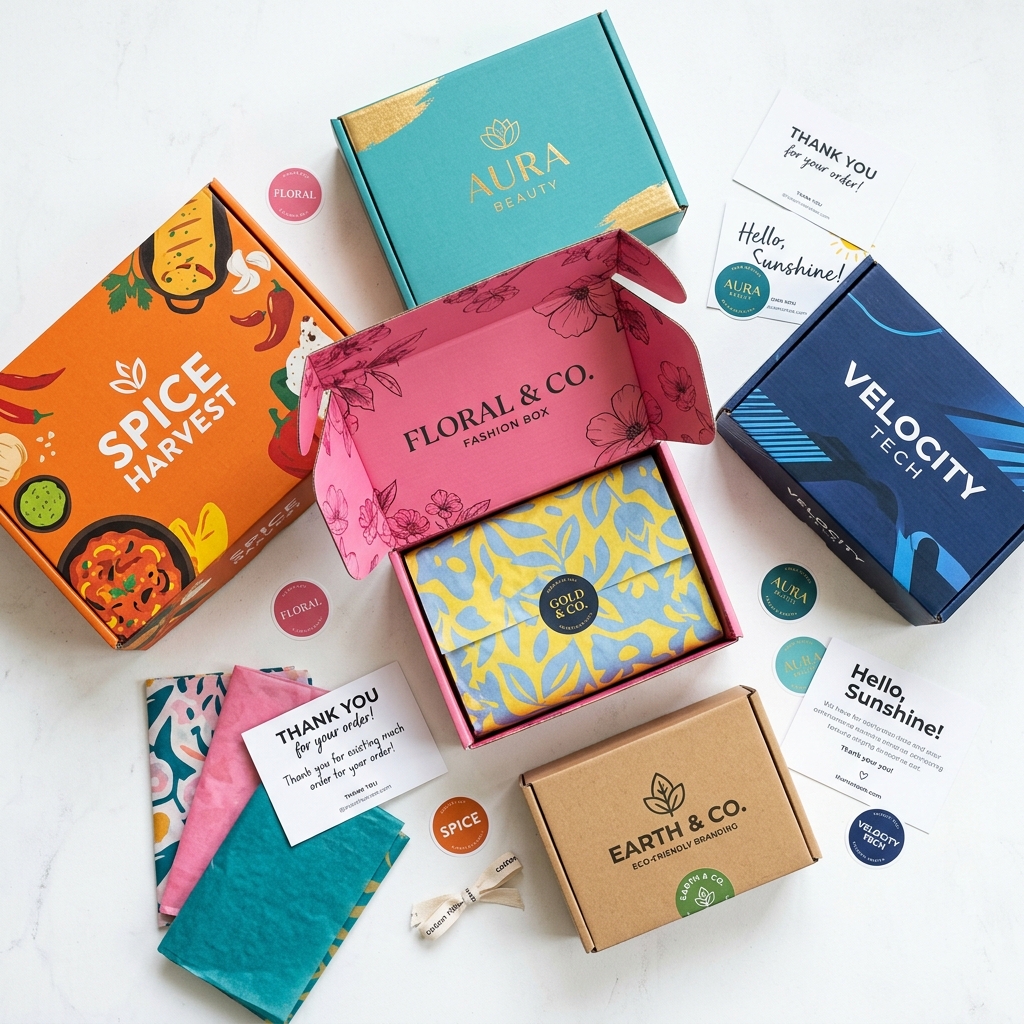
Custom e-commerce boxes are the first physical interaction between your brand and your online customer. That brown shipper from your 3PL? It tells your customer exactly nothing about who you are. A branded corrugated mailer with interior printing, a tear strip opening, and a thank-you card inside? That's a $0.85 marketing asset that generates repeat purchases.
This guide breaks down everything you need to know about choosing, designing, and ordering custom e-commerce boxes — from corrugated flute types to printing methods to the exact unboxing sequence that drives social sharing.
A 2025 Dotcom Distribution study found that branded e-commerce packaging generates 40% more social media shares than plain brown boxes. For DTC brands spending $15-$40 per customer acquisition, a shipping box that triggers organic Instagram stories and TikTok unboxings is the highest-ROI touchpoint in your entire marketing stack.
The math is simple: if your CAC is $25 and a $0.85 custom box generates even one social share per 20 shipments, that share reaches 200+ followers. Organic impressions at a fraction of paid media costs.
Beyond social, branded packaging directly impacts repeat purchase rates. Shopify's 2025 DTC benchmark report showed that brands with custom unboxing experiences saw 28% higher repeat purchase rates compared to those shipping in generic packaging. Your box isn't a cost — it's a retention tool.
The "flute" is the wavy inner layer that gives corrugated board its strength. Different flute types serve different weight classes and print quality requirements.
E-flute is the DTC industry standard. At 1.5mm thick, it's thin enough for high-definition CMYK printing but strong enough for items under 5 lbs. Perfect for cosmetics, candles, apparel, and small accessories. The smooth liner surface reproduces photographic imagery and fine typography without the "washboard" effect that thicker flutes sometimes show. Most custom e-commerce boxes ship in E-flute.
B-flute is the workhorse for heavier e-commerce shipments from 5-30 lbs. Electronics, kitchenware, multi-item subscription kits, and home goods all benefit from the extra crush resistance. B-flute handles stacking during carrier transit better than E-flute, which matters when UPS is tossing your box onto a pile in the sorting facility.
For brands that want a folding-carton aesthetic with corrugated strength, F-flute delivers. The ultra-thin profile prints like SBS board but provides 2-3x the protection. Ideal for premium cosmetics and luxury DTC brands where the box needs to look like a retail carton, not a shipping container.
Heavy-duty double-wall corrugated for items over 15 lbs or extremely fragile products. Two layers of fluted medium sandwiched between three liners. The heaviest protection available in a mailer format. Think home appliances, glass, or high-value electronics.
Your printing method depends on three factors: order quantity, color complexity, and budget.
The gold standard for e-commerce boxes at 500+ units. Four-color process reproduces photographic imagery, gradients, and complex designs. Requires plate setup ($200-$400 one-time), so unit cost drops significantly at higher volumes. Best for brands with established designs ordering 500-50,000 units.
Water-based flexo is the cost leader at 5,000+ units. Limited to 1-3 spot colors, but the price per unit drops to $0.35-$0.65 at scale. Perfect for brands with simple logo-forward designs who order in bulk quarterly. The trade-off: no photographic imagery, no gradients. Clean, bold graphics only.
Digital eliminates plate costs entirely, making it viable at 250+ units. Full CMYK color with no setup fees. The catch: slightly higher per-unit cost than offset at volume, and some digital presses show slight banding on large solid color areas. Best for startups, seasonal campaigns, A/B testing designs, and short-run limited editions.
The unboxing experience isn't just about the box. It's a sequence of five touchpoints, each building anticipation:
This five-layer stack is why DTC brands see 28% higher repeat rates with custom packaging. Each layer reinforces brand loyalty. Learn more about our shipping packaging category for related products like poly mailers and tissue paper.
Dimensional weight pricing is the #1 hidden cost in e-commerce shipping. Carriers charge based on whichever is greater: actual weight or dimensional weight (L x W x H / DIM divisor). An oversized box filled with void fill is costing you $1-$3 extra per shipment in DIM surcharges.
Standard e-commerce box sizes and their best applications:
We manufacture custom dimensions at no extra cost. Our engineering team analyzes your product dimensions and recommends the tightest-fitting box that still provides adequate cushioning — typically saving 15-25% on DIM-weight shipping costs.
All corrugated e-commerce boxes are 100% curbside recyclable. Corrugated cardboard has a 93.6% recycling rate in the US — the highest of any packaging material. For brands prioritizing sustainability, we offer:
73% of e-commerce consumers say sustainable packaging influences their purchase decision (Nielsen, 2025). Printing your sustainability story directly on the box — "This box is 100% recycled and 100% recyclable" — turns a material choice into a brand message.
Real pricing based on a standard 12 x 9 x 4 inch box with CMYK exterior printing:
Add-ons: Interior printing (+$0.10-0.20/unit), tear strip (+$0.05/unit), matte/gloss lamination (+$0.08-0.15/unit), custom insert (+$0.15-0.40/unit depending on complexity).
Check out our custom mailer boxes guide for more packaging cost comparisons and volume pricing strategies.
250 units for digital printing, 500 units for offset lithography. Sample orders of 1-5 units are available for $15-$25 each for design approval before committing to a full run.
10-14 business days for standard production. Rush orders ship in 7 business days at a 15-20% premium. Add 2-3 days for interior printing or custom inserts.
Yes. Interior plus exterior printing is our most popular upgrade. Full CMYK on both surfaces. The interior print is the highest-ROI element — it's the "surprise" that drives social sharing and unboxing videos.
ECT (Edge Crush Test) measures how much stacking pressure the box can withstand. 32 ECT is standard for most e-commerce — it handles 3-4 boxes stacked during carrier sorting. 42+ ECT is available for heavier products or shipments that will be stacked higher in warehouses.
Yes. All custom e-commerce boxes ship flat (knocked down), saving 85% storage space compared to pre-assembled boxes. They fold into shape at your packing station in seconds.
Yes. Corrugated cardboard is 100% curbside recyclable and has a 93.6% recycling rate in the US. Even printed and laminated boxes are accepted in standard recycling streams. FSC-certified and 100% recycled content options available.
Your shipping box is the only marketing channel with a 100% open rate. Every customer opens it. Start with our custom e-commerce boxes — choose your size, flute type, and printing method, then upload your artwork or use our free AI design tool to generate a complete box design in 60 seconds.
Product damage accounts for 20% of all e-commerce returns, according to packaging industry data. The right box eliminates most of these. Here's what works:
A box that's too large lets products shift during transit — the #1 cause of shipping damage. A box that's too tight creates pressure points. Your e-commerce box should leave exactly 1-2 inches of clearance on all sides for void fill (crinkle paper, air pillows, or custom inserts). Most DTC brands need 3-4 box sizes to cover their full product range without over-packing.
Die-cut corrugated inserts cost $0.10-$0.25 each and hold products in place during 3-5 day transit. For fragile items, molded pulp inserts absorb shock better than foam at a similar price point. Branded tissue paper adds a premium unboxing moment for about $0.03/sheet — one of the highest-ROI packaging additions you can make.
67% of online shoppers consider packaging sustainability when choosing brands. Using 100% recycled corrugated with soy-based inks and paper tape (instead of plastic tape) makes your entire package curbside recyclable. This matters for repeat purchases — customers who perceive your brand as eco-conscious show 28% higher repurchase rates. Pair your e-commerce boxes with custom tissue paper printed on recycled stock for a complete sustainable unboxing experience.
Not ready for fully custom boxes yet? Start with branded tape on plain kraft corrugated. Custom-printed packing tape costs $15-$25 per roll (100 yards) and instantly brands any box. Once your order volume justifies custom boxes (typically 500+ units/month), switch to fully printed corrugated with interior designs. Many of our DTC clients started with custom shipping boxes in plain kraft with branded tape before graduating to full CMYK exteriors.
Design your packaging free in 60s
Try the free AI packaging design toolNeed Custom Packaging?
Get a free quote with pricing, MOQs, and turnaround time for your custom packaging project.