
Packaging Guides
Complete guide to custom child-resistant exit bags for growing brands
Cubit Team
July 1, 2026
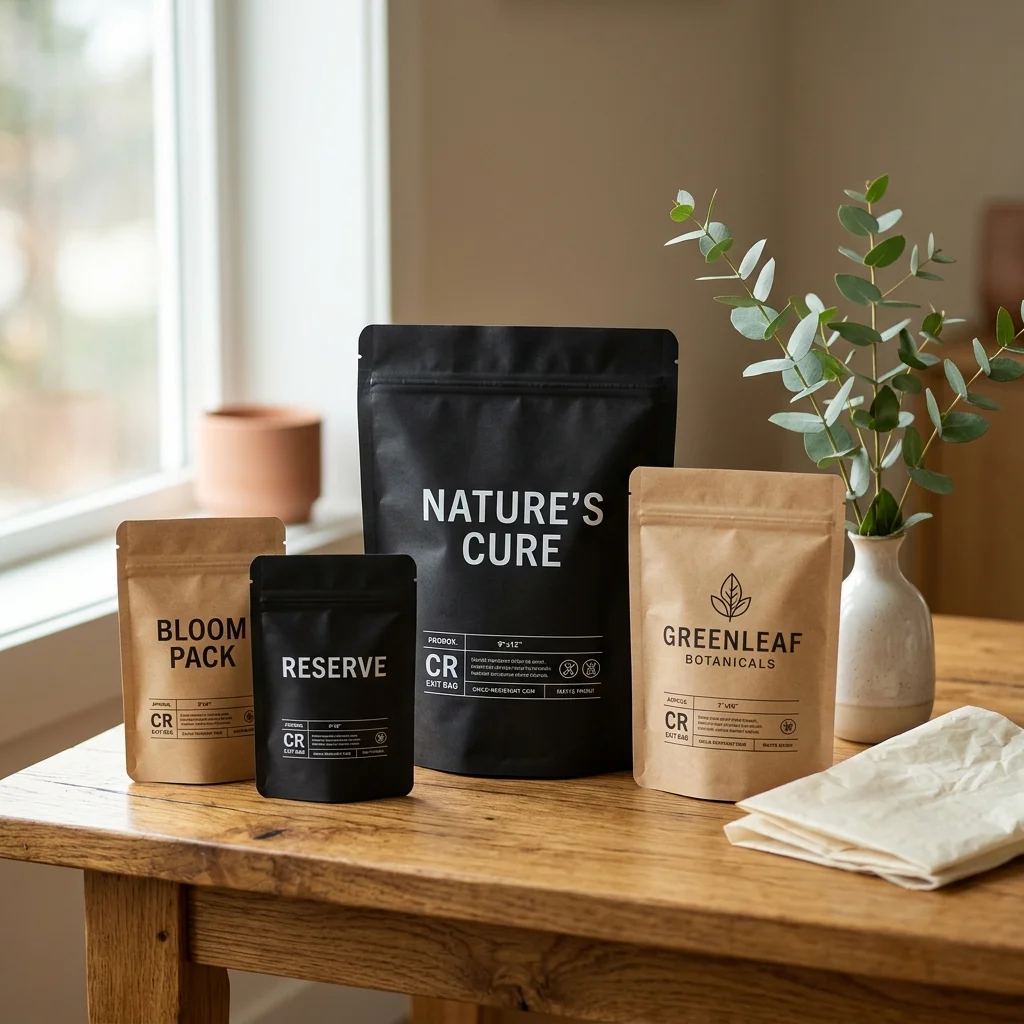
Custom child-resistant exit bags are secure, opaque outer packaging containers designed to meet strict safety standards like 16 CFR Part 1700.20, preventing children under five years old from accessing hazardous or regulated contents while allowing easy access for adults. These heavy-duty barrier pouches are widely used in the cannabis and pharmaceutical industries to satisfy state-level exit packaging mandates. If you purchase custom Child-Resistant Exit Bags, you can ensure compliance at the point of sale while maintaining your brand design throughout the consumer experience.
For growing brands, navigating the requirements of compliant packaging is a necessary step to scale operations. You must balance federal safety criteria, regional rules, and the physical requirements of your product, all while keeping packaging costs manageable. This guide breaks down the technical details, materials, and testing parameters you need to understand when buying packaging.
In this guide:
The regulatory framework for exit packaging is highly localized and subject to frequent changes, particularly in the cannabis sector. Most jurisdictions with legal cannabis retail markets require that any product leaving a dispensary be placed in child-resistant, resealable, and completely opaque packaging. The gold standard for verifying these packaging properties relies on the ASTM D3475 standards, which classify child-resistant packaging designs based on their opening mechanisms and physical characteristics.
To be legally compliant, the packaging must undergo physical testing governed by the Consumer Product Safety Commission (CPSC) under 16 CFR Part 1700.20. Under 16 CFR Part 1700.20, a package is certified child-resistant if 80% of children aged 42 to 51 months cannot open it within 10 minutes, while 90% of adults can open it within 5 minutes. This testing process ensures that the physical bag can resist entry by young children, who might otherwise ingest harmful contents.
When sourcing your packaging, you should always ask your supplier for a physical copy of their third-party laboratory testing certification. Relying on self-certification from overseas factories is a risk that can lead to product recalls, distribution delays, or significant regulatory fines. A certified child-resistant package will have a specific test report number linked to the exact size and closure style you are purchasing.
High-performance flexible packaging bags are rarely constructed from a single film. Instead, they use multi-layer laminated structures where each layer serves a specific purpose. For child-resistant packaging, the laminate must provide a high barrier to oxygen, moisture, and light, while remaining tough enough to resist tearing or biting.
The outermost layer is typically made of polyethylene terephthalate (PET) or oriented nylon, which provides a clean surface for high-resolution printing and adds puncture resistance. Below this sits the barrier layer, which is often metallized polyethylene terephthalate (VMPET) or aluminum foil. Custom child-resistant exit bags with a standard metallized lining reduce oxygen transmission to less than 0.1 cc/m²/day, protecting organic matter from oxidation. The innermost layer is usually linear low-density polyethylene (LLDPE), which is food-safe and seals under heat to create strong seams.
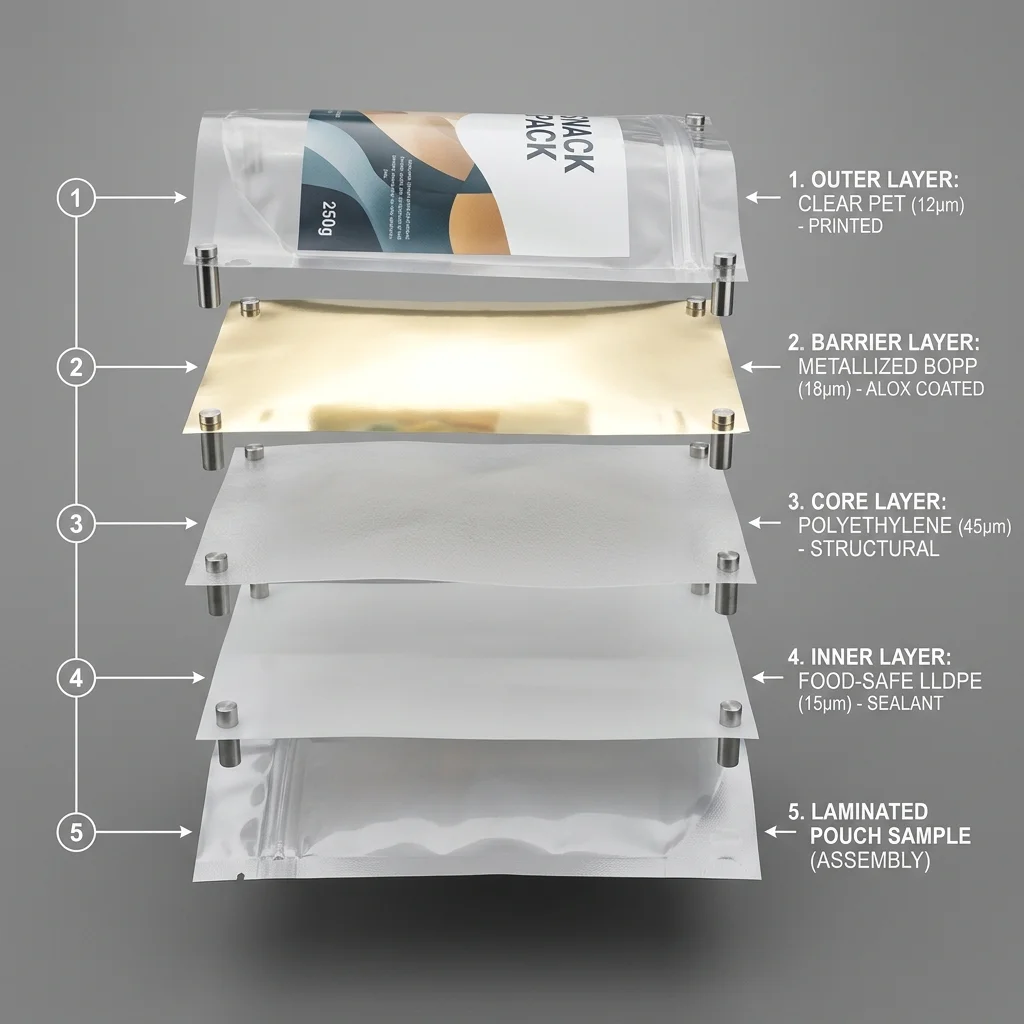 Material structure comparison
Selecting the right laminate depends on your product line and shelf-life requirements. If your product contains highly aromatic terpenes or volatile organic compounds, you must use a high-barrier structure to keep odors contained. Below is a comparison of common material structures used in protective packaging:
| Material Structure | Moisture Barrier | Oxygen Barrier | Odor Resistance | Common Use Case |
|---|---|---|---|---|
| PET / LLDPE | Moderate | Moderate | Moderate | Non-aromatic edibles, capsules |
| PET / VMPET / LLDPE | High | Excellent | High | Highly aromatic cannabis flower |
| Kraft Paper / VMPET / LLDPE | High | High | High | Premium brands, dry botanicals |
| PET / Nylon / LLDPE | High | Moderate | Moderate | Heavy products requiring puncture resistance |
A bag is only as secure as its closure. To meet ASTM D3475 standards, the locking mechanism must require a level of cognitive function and manual dexterity that children under five years of age have not yet developed. This is usually accomplished with a two-step opening process that requires users to perform two distinct physical actions at the same time.
One common closure style is the push-and-slide zipper, where the user must press down on a specific tab while sliding the zipper pull across the track. Another popular system is the pinch-grip zipper, which requires the user to pinch a specific area on the back of the bag while pulling the zipper tracks apart. Clear opening instructions must be legibly printed directly on the exterior of the bag to guide adult consumers on how to access the contents without tearing the film.
To ensure children cannot bypass the lock by biting or ripping through the body of the pouch, the plastic film must have sufficient thickness. Standard child-resistant pouches use materials with a thickness of 4.0 mils to 5.5 mils (102 to 140 microns). This gauge prevents easy tearing and gives the packaging a heavy, premium feel that customers associate with professional brands.
Compliance is your baseline, but your packaging is also your most visible marketing asset. When designing your layout, you must carefully arrange your branding, product details, and mandatory state warning labels. Many states mandate specific warning logos, such as the universal THC symbol, which often must be printed at a minimum size of 0.5 inches by 0.5 inches on the primary display panel.
When working with our custom packaging design team, you can choose from different finishes to align with your brand identity. Matte finishes provide a modern, tactile surface that reduces glare and finger smudges, making them popular for wellness and organic brands. Glossy finishes make colors look deeper and more saturated, which helps products stand out on retail shelves. Spot UV printing allows you to apply a glossy finish only to specific design elements, such as your logo, while keeping the rest of the pouch matte.
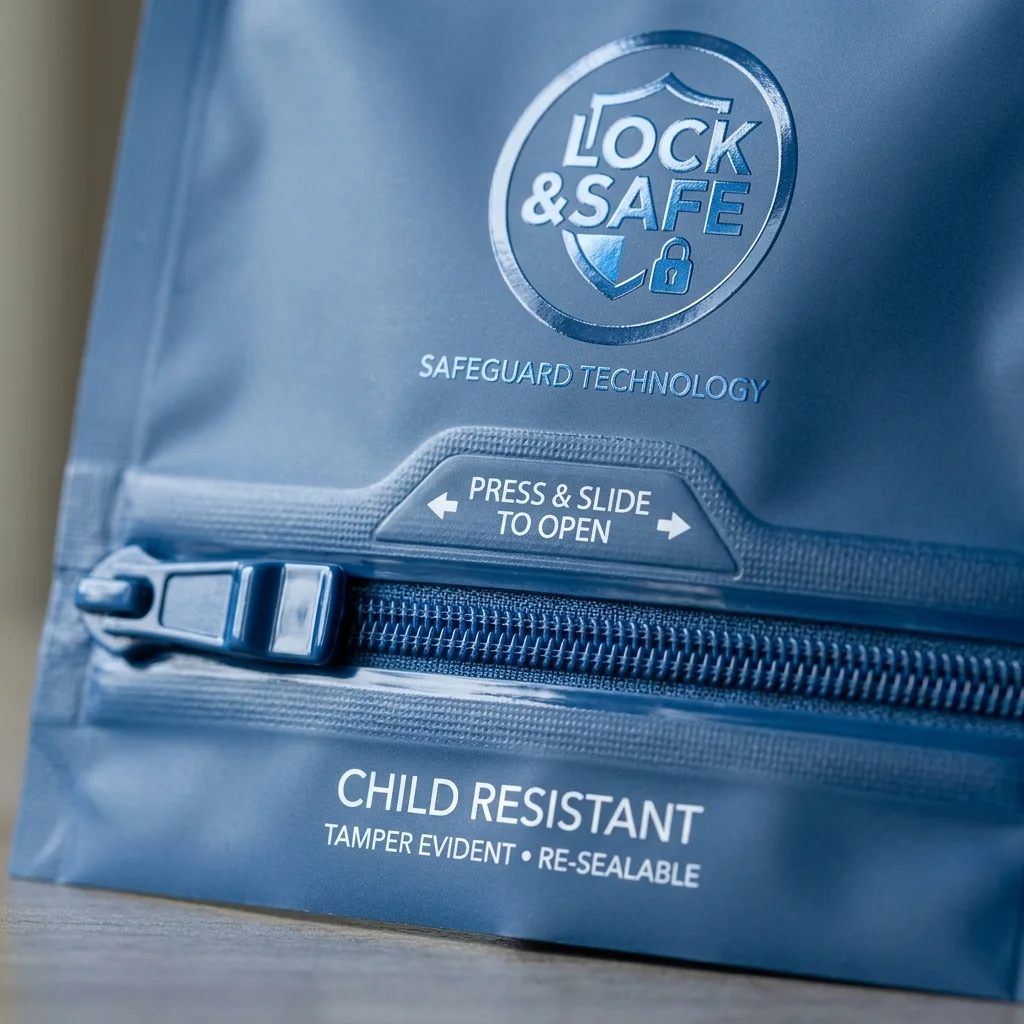 Finishes and design details on exit bags
You should also think about functional features that improve the retail experience. Bottom gussets are helpful because they allow the bags to stand upright on dispensary counters or shelves. Hanging holes are useful if your retail partners use peg hooks for display. Ensure that your design files leave at least 0.75 inches of clear space below the zipper track to allow for heat sealing after the bag is filled at your facility.
Your packaging budget is an important factor in your overall product margins. The unit cost of custom Child-Resistant Exit Bags is determined by order volume, printing methods, and material selection. Digital printing is best for small batches and multi-flavor product lines, while rotogravure printing offers the lowest per-unit costs for high-volume runs.
For a standard 8-inch by 6-inch by 2-inch bottom-gusset bag, pricing is highly dependent on scale. At an order volume of 1,000 units, digital printing might cost around $1.15 to $1.50 per bag. If you scale your order to 10,000 units using gravure printing, that per-unit cost often drops to $0.40 to $0.65. This price difference shows why scaling your inventory can significantly lower your overhead.
Production lead times also vary based on the printing technology used. Digital printing runs can be completed and shipped in 10 to 15 business days because they do not require physical printing plates. Gravure printing requires the fabrication of custom steel cylinders for each color in your artwork, which adds 3 to 4 weeks to the initial setup. For your first bulk order, you should plan for a total lead time of 6 to 8 weeks to allow for design proofing, plate tooling, production, and shipping.
Expert Insight from Cubit Packaging: Based on the packaging orders we process, brands that transition from standard 1,000-unit digital orders to 10,000-unit gravure runs save an average of 58% on their packaging spend. Over a typical annual production cycle of 50,000 bags, this simple scale adjustment saves enough capital to fund a secondary product line launch.
Many brands are looking for eco-friendly alternatives to traditional petroleum-based plastics. However, creating sustainable packaging that also meets CPSC child-resistance criteria is a technical challenge. The material must remain tough enough to pass physical stress tests without splitting or tearing.
One practical option is Post-Consumer Recycled (PCR) plastics. PCR films are made from recycled household plastics, reducing the demand for virgin fossil fuels. We can produce custom child-resistant exit bags with up to 50% PCR content in the outer and middle layers. This allows brands to meet sustainability goals without compromising the bag's tear resistance or barrier qualities.
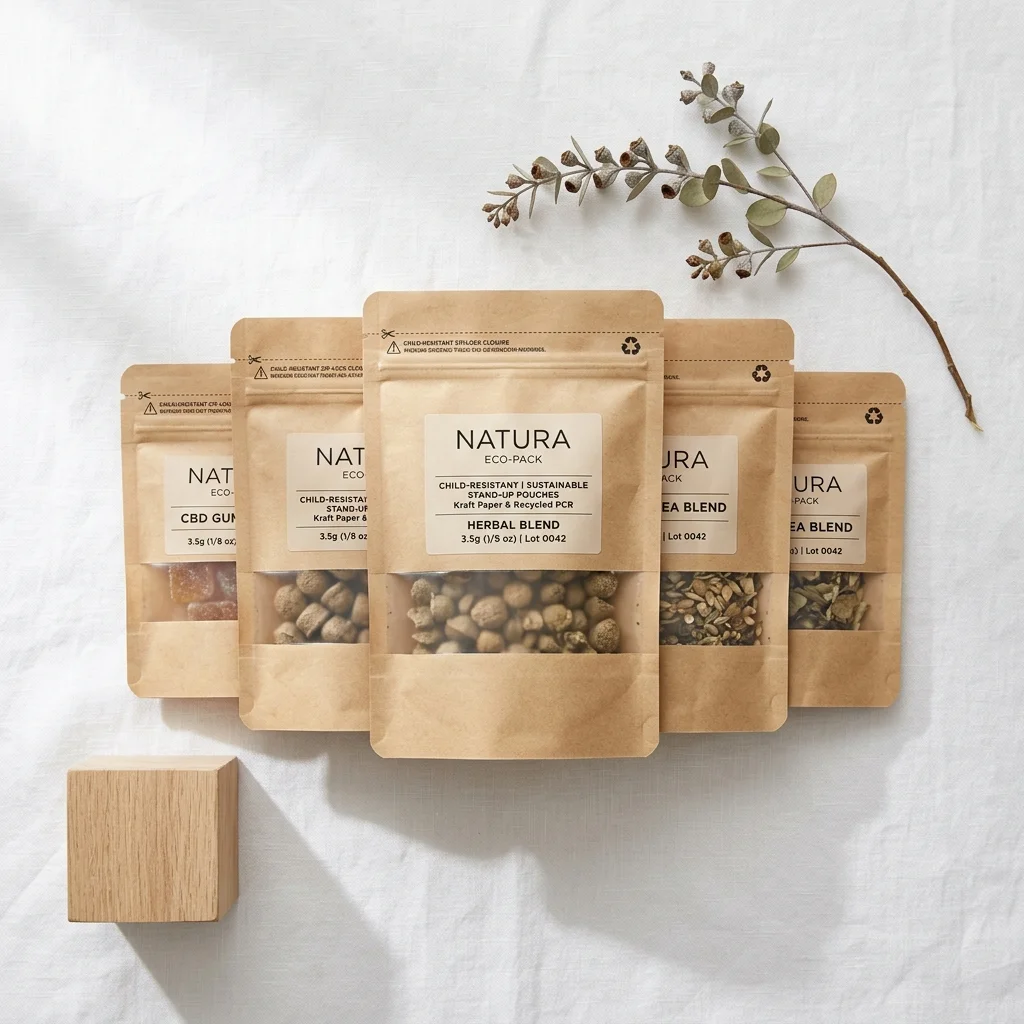 Eco-friendly child-resistant bags
Another option is using FSC-certified paper (Forest Stewardship Council) laminated to a compostable internal barrier film. While these paper hybrid bags are not completely biodegradable because of the heavy plastic zipper mechanism, they reduce plastic usage by up to 40% compared to standard all-plastic pouches. When exploring green packaging, always ask your manufacturer to verify how these materials affect the shelf life and compliant exit packaging status of your finished product.
An exit bag is a secure outer container used to carry products out of a retail store, ensuring compliance at the point of sale. Primary packaging directly touches the product, such as a glass jar or bottle. Many states allow non-compliant primary packaging as long as it is placed in a child-resistant exit bag before leaving the store.
These packaging containers are certified by undergoing standardized physical testing defined by the Consumer Product Safety Commission under 16 CFR Part 1700.20. Testing involves panels of young children and older adults to verify the package cannot be opened by children but remains accessible to adults. Certified suppliers can provide a formal certificate of compliance for their bag designs.
Yes, you can print full-color designs on both the front and back of your custom Child-Resistant Exit Bags. However, you must leave clear space for mandatory state warning labels and instructions for the locking zipper. Most brands place logos on the front and usage instructions, ingredients, and regulatory warnings on the back.
Minimum order quantities depend on the printing method used for production. Digitally printed bags often have minimums as low as 500 or 1,000 units, making them useful for product testing. Gravure-printed runs, which offer much lower per-unit costs, typically require a minimum order of 5,000 to 10,000 units per design.
Yes, these bags can be made completely smell proof by using a high-barrier aluminum foil or metallized polyester (VMPET) layer in the laminate structure. These materials block the transmission of volatile organic compounds, keeping strong odors contained inside the sealed bag and preserving product freshness.
Selecting the right custom Child-Resistant Exit Bags is an important step for any growing retail brand. By matching compliance standards with high-quality multi-layer barrier films and professional design choices, you protect both your consumers and your brand's bottom line. If you are ready to start planning your next packaging order, check out our packaging blog archives for more industry guides.
Ready to start your next packaging run? Get a free quote for your packaging project today and let our experts help you build compliant, high-quality exit bags.
Get started on your custom branding with custom Child-Resistant Exit Bags directly from our online marketplace, or build a personalized quote at our RFQ Procurement portal.
Design your packaging free in 60s
Try the free AI packaging design toolNeed Custom Packaging?
Get a free quote with pricing, MOQs, and turnaround time for your custom packaging project.