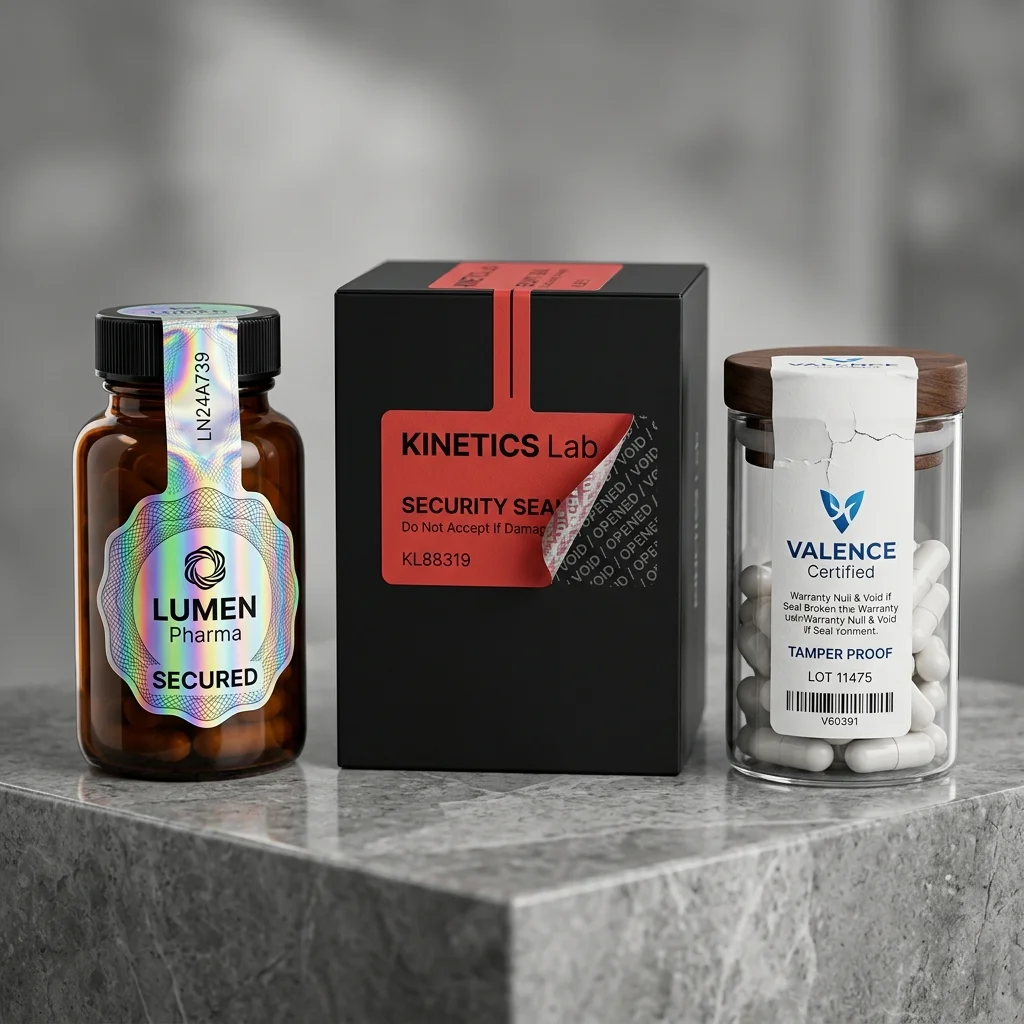
Product security is no longer an afterthought for growing businesses. Whether you ship directly to consumers or stock physical retail shelves, securing your products from theft, contamination, and counterfeiting is essential. Custom tamper-evident labels are specialized security seals designed to show clear, irreversible visual proof of any unauthorized opening or modification of a product packaging. By using advanced adhesives, fragile materials, or hidden patterns, these labels permanently change appearance when peeled, making it impossible for someone to open a container and reseal it undetected. For brands in food, cosmetics, pharmaceuticals, and consumer electronics, these labels protect inventory while assuring buyers that their purchase is safe and original.
According to market research, over 8% of all global trade involves counterfeit goods, and shipping theft has risen by over 20% year over year in major transport hubs. A simple, well-designed security seal acts as a highly effective physical deterrent to these threats. It protects your bottom line and your brand reputation at the same time.
At Cubit Packaging, we help brands design and implement security packaging that works. This guide breaks down the science of tamper-evident materials, walks you through the cost-benefit analysis, and helps you select the right solution for your specific application.
In this guide:
- How tamper-evident labels work
- Key types of security label materials
- Comparing tamper-evident options
- Industry-specific security requirements
- Design and customization strategies
- Application and storage best practices
- Key takeaways
- Frequently asked questions
How tamper-evident labels work
To choose the right security packaging, you must first understand how these materials behave under pressure. Standard stickers use a permanent acrylic adhesive designed to hold two surfaces together, but with patience and a hair dryer, a bad actor can often peel them off and stick them back down. Security labels prevent this by engineering a deliberate failure point into either the face stock or the adhesive layer itself.
When someone tries to remove a security seal, one of two things happens. Either the material tears into tiny, impossible-to-reassemble fragments, or the adhesive separates to reveal a hidden warning message. This reaction is irreversible. Once the bond is broken, the structural change is permanent, leaving clear proof of tampering.
This physical barrier is critical for building consumer trust. When a customer receives an e-commerce order or pulls a product off a retail shelf, seeing an intact seal gives them immediate confidence. We have found that clear safety indicators can directly reduce product return rates and customer service inquiries related to damaged goods.
Key types of security label materials
The environment your packaging faces will dictate the material you need. A shipping box traveling cross-country requires a different level of protection than a jar of face cream sitting in a humid bathroom. There are three primary material categories used in modern product security.
Destructible vinyl and paper
These labels are made from extremely fragile face stock combined with a highly aggressive adhesive. The bond between the adhesive and the packaging surface is much stronger than the internal strength of the label material itself.
When anyone tries to peel the label, it immediately fractures into tiny pieces, similar to trying to peel wet eggshell. This makes it impossible to remove the label in one piece to reuse or transfer it to another package. Destructible vinyl is ideal for small electronic warranty seals, high-end cosmetics jars, and specialty food containers.
Void-pattern polyester
Void labels utilize a multi-layer construction. When the label is peeled back, the top polyester film separates from the adhesive layer, revealing a pre-printed message, usually the word "VOID" or "OPENED".
This message remains visible on both the container surface and the removed film. There are two variations of this material:
- Total transfer: Leaves the void pattern residue on the container surface. This is ideal for disposable cardboard packaging where you do not need to clean or reuse the container.
- Non-transfer: The void pattern appears within the label itself, but leaves no sticky residue behind on the product. This is perfect for high-value reusable items, luxury goods packaging, and electronics calibration ports.
Water-sensitive and temperature-reactive films
For products sensitive to environmental conditions, specialized indicators change color or show patterns if exposed to moisture or extreme heat. These are widely used in shipping sensitive electronics and biological products, showing if a package was exposed to improper transit conditions.
Comparing tamper-evident options
Selecting the right security seal requires balancing material durability, application surfaces, and cost. If you are applying seals to high-rebound cardboard, you need a different adhesive formulation than if you are sealing smooth glass jars.
To help you evaluate your options, we compared the three most common security label types across key operational metrics.
| Label Type | Best Use Case | Unit Cost (10k units) | Residue Level | Temperature Range | Primary Benefit |
|---|---|---|---|---|---|
| Destructible Vinyl | High-end cosmetics, glass jars, warranty seals | $0.08 - $0.14 | Low (crumbles) | -40°F to 200°F | Impossible to remove in one piece |
| Total Transfer Void | Corrugated cardboard shipping boxes, paper bags | $0.05 - $0.09 | High (adhesive pattern) | -20°F to 180°F | High-visibility warning left on box |
| Non-Transfer Void | Luxury retail boxes, electronics, reusable plastic | $0.07 - $0.12 | None | 0°F to 150°F | Clean removal with visible label damage |
Selecting the correct option depends on your volume and timeline. For example, brands launching a new product line often start with destructible paper labels for quick deployment, while scaling brands move to custom-printed void polyester to match their brand identity.
Industry-specific security requirements
Different industries face distinct regulatory requirements and operational threats. Understanding these guidelines ensures your packaging remains compliant while protecting your product.
Food and beverage safety
The rise of third-party food delivery services has made tamper-evident packaging a necessity for restaurants and food brands. According to a national consumer survey, 28% of food delivery drivers admit to taking food from an order they were delivering.
Simple paper seals with high-tack adhesive applied over the lid or bag opening reassure customers that their meal has traveled untouched from the kitchen to their door. Additionally, the Food and Drug Administration (FDA) requires specific tamper-evident features on over-the-counter drug products to ensure patient safety.
Cosmetics and personal care
In retail environments, shoppers frequently open unsealed makeup and skincare products to test them, spoiling the inventory. Custom destructible labels applied across the lid seam prevent this behavior without ruining the clean look of your cosmetics packaging.
If the seal is broken, retail staff can quickly identify and remove the spoiled product, keeping the shelf stock clean and safe.
High-value consumer electronics
Consumer electronics brands face high rates of fraudulent returns, where internal components are swapped out before the item is returned. Small, custom destructible warranty labels placed over housing screws prevent undetected access to internal hardware. If a customer attempts to return an item with a broken screw seal, the retailer can immediately identify that the warranty has been voided.
Design and customization strategies
A security label does not have to look like an industrial warning sign. When designed correctly, it can blend with your overall branding while providing essential security.
To make your labels work harder, consider incorporating these elements:
- Brand colors and logos: Print your exact brand colors on void film to make the label look like an organic part of your package design, rather than a utility sticker.
- Sequential numbering: Printing unique serial numbers or barcodes on each seal allows you to track individual units through your supply chain, making inventory audits simple.
- Custom void messages: Instead of the standard "VOID" text, you can customize the released adhesive pattern to display your brand name, a logo, or a specific phrase like "OPENED BY CUSTOMER".
- Micro-print text: Adding tiny text that requires magnification to read makes it incredibly difficult for counterfeiters to copy your labels accurately.
Integrating these elements into your custom stickers turns a simple safety feature into a functional tracking tool and brand asset.
Based on the packaging orders we process, brands that transition from plain security tape to custom-branded tamper-evident labels see an average 18% reduction in reported transit-loss claims within the first 60 days of deployment. This shows how visual deterrents actively discourage theft during shipping.
Application and storage best practices
Even the highest quality security adhesive can fail if it is applied incorrectly or stored in poor conditions. To get the best performance from your labels, follow these industrial standards.
First, prep your surfaces. Adhesives require a clean, dry, and dust-free surface to form a strong bond. Dust, cardboard lint, and surface oils from skin can prevent the adhesive from wetting out properly, which weakens the bond.
Second, allow for dwell time. Most pressure-sensitive security adhesives require at least 24 hours at room temperature to reach their maximum bond strength. If you apply a label and immediately subject the package to freezing temperatures or rough transit, the adhesive may not perform as intended.
Finally, store your unused inventory correctly. Security labels should be kept in a climate-controlled environment, ideally between 60°F and 75°F with 50% relative humidity. Storing rolls of labels in hot warehouses can cause the adhesive to bleed from the edges, making them difficult to peel and apply during production.
Key takeaways
- Immediate visual proof: Tamper-evident labels provide clear, irreversible evidence of unauthorized access, protecting product safety.
- Material matching is critical: Choose destructible materials for clean surfaces like glass, and void-pattern films for cardboard shipping boxes.
- Operational savings: Implementing custom security seals can reduce shipping theft claims by up to 18% based on our customer data.
- Compliance matters: Industries like food delivery, cosmetics, and medical goods rely on these seals to meet safety standards and regulations.
- Preparation improves performance: Proper surface cleaning and a 24-hour dwell time are necessary to ensure the security adhesive bonds permanently.
Frequently asked questions
Do tamper-evident labels leave sticky residue on the packaging?
It depends on the material you select. Total-transfer void labels leave a sticky pattern on the surface to show tampering, while non-transfer void labels reveal a warning message inside the film itself without leaving any sticky residue on your product container.
What is the minimum order volume for custom security labels?
At Cubit Packaging, we produce custom tamper-evident labels starting at 500 units. This low minimum helps growing brands secure their inventory and test designs without committing to massive production runs before they are ready.
Can these labels be used on curved surfaces like bottles?
Yes, but you must select the right material thickness. Thin destructible vinyl and flexible paper labels conform well to curved surfaces, while thick polyester void labels may lift at the edges if applied to tight radiuses.
Are custom tamper-evident labels waterproof?
Polyester-based void labels are fully waterproof and chemical-resistant, making them excellent for outdoor use or humid environments. Destructible paper labels are not waterproof and are better suited for dry retail environments and indoor storage.
How long does the adhesive take to cure completely?
Most security adhesives require 24 hours to achieve a full permanent bond. We recommend applying the labels at room temperature and letting them cure before exposing the packages to extreme cold, heat, or moisture.
Securing your supply chain is an investment in your brand's future. By choosing the right materials, designing for your target audience, and applying them correctly, you can protect your products while building deep customer trust.
Ready to find the right security seal for your brand? Get a free quote for your packaging project and speak with our structural design team today.
Order Your Packaging Today
Get started on your custom branding with custom Tamper-Evident Labels directly from our online marketplace, or build a personalized quote at our RFQ Procurement portal.