
Industry Trends
Packaging Trends 2026: Seasonal Design Ideas for Spring, Summer & Beyond
Humizair by Cubit
April 14, 2026
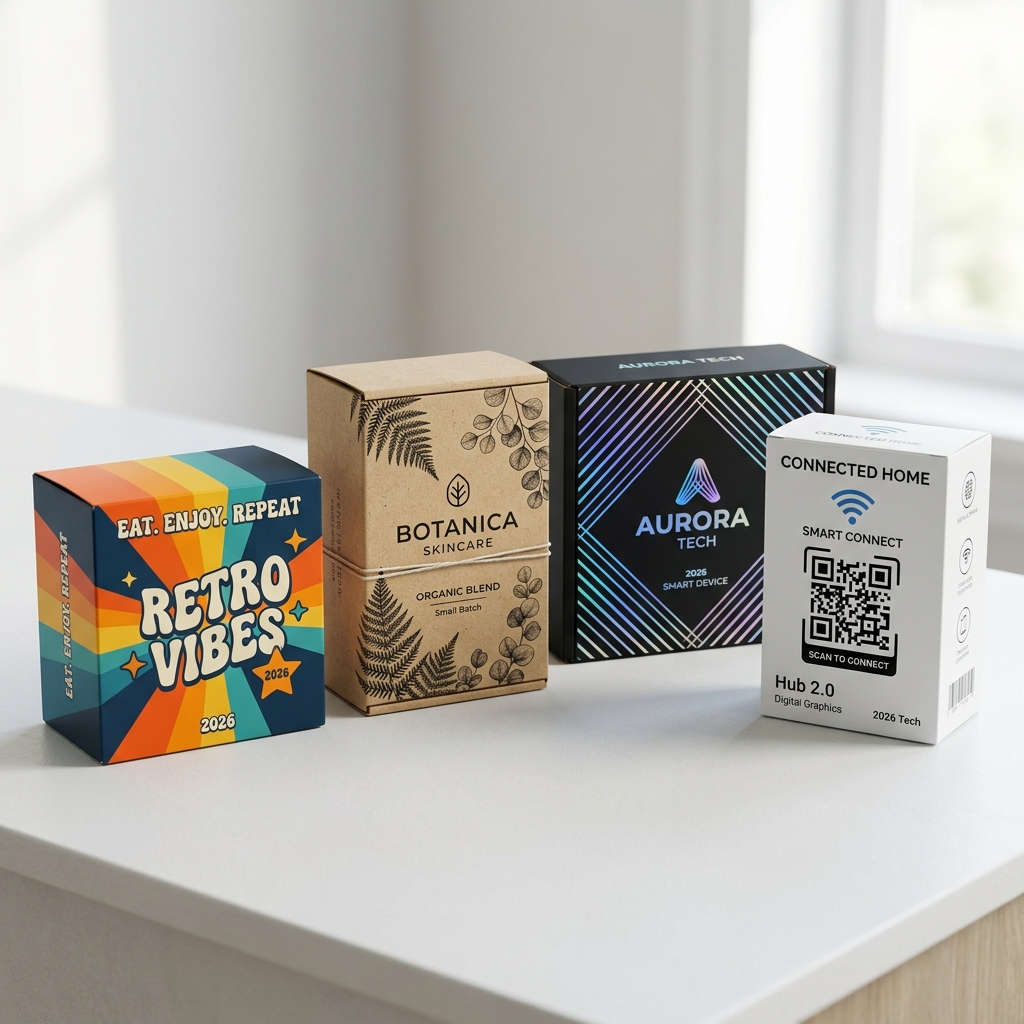
This trend report is for brand managers, packaging designers, marketing directors, and DTC founders who want their packaging to feel current, premium, and culturally relevant throughout every season of 2026.
The sustainability conversation has matured. In 2026, environmental responsibility is no longer a marketing angle — it is the cost of entry.
What's changed:
What leading brands are doing:
| Practice | Adoption Rate (2026) | Impact |
|---|---|---|
| Mono-material construction | 45% of new packaging launches | Simplifies recycling streams |
| High-PCW content (≥50%) | 38% | Reduces virgin material demand |
| Right-sizing (reducing void) | 52% | Cuts shipping emissions 15–25% |
| How2Recycle or equivalent labels | 61% | Communicates recyclability |
| Eliminating single-use plastics | 55% | Consumer-driven demand |
| Carbon-neutral/carbon-offset printing | 18% | Emerging differentiator |
Quotable fact: According to the Ellen MacArthur Foundation's 2025 Global Commitment report, packaging producers representing 20% of all plastic packaging produced globally have committed to making 100% of their packaging recyclable, reusable, or compostable by 2025 — though actual achievement rates average 58%, highlighting the gap between commitment and execution.
In a market saturated with AI-generated visuals, brands are doubling down on physical, tangible design qualities that digital cannot replicate.
Key finishes driving the trend:
| Finish | Effect | Why It Works in 2026 |
|---|---|---|
| Soft-touch lamination | Velvety, matte surface | Creates immediate "premium" perception |
| Textured papers | Linen, cotton, laid, felt | Signals craftsmanship over mass-production |
| Embossing/debossing | Raised or recessed designs | Adds depth without additional color/ink |
| Foil stamping (metallic or holographic) | Reflective accents | Draws eye on shelf and on camera |
| Raw, uncoated surfaces | Natural, tactile feel | Communicates authenticity |
| Spot UV on matte | Contrast between matte and gloss | Creates visual intrigue |
Quotable insight: The 2026 packaging design ethos can be summarized as "human over digital" — in direct response to AI design tools, brands are investing in physical textures, hand-drawn illustrations, and intentional imperfections that communicate craftsmanship and authenticity.
The integration of digital technology into physical packaging reached a tipping point in 2025 and is accelerating through 2026.
Smart packaging technologies:
| Technology | What It Does | Cost/Unit | Adoption Rate (2026) |
|---|---|---|---|
| QR code | Links to digital content, instructions, or campaigns | $0.00 (print only) | 34%+ of DTC brands |
| NFC tag | Tap-to-interact: authentication, experiences, pages | $0.15–$0.50 | 12% of premium brands |
| AR trigger | Augmented reality via camera scan | $0.00 (design only) | 8% of consumer brands |
| Temperature indicator | Reveals if cold-chain was broken | $0.05–$0.15 | 22% of food/pharma |
| Freshness sensor | Chemical indicator changes color | $0.10–$0.30 | 5% (emerging) |
What brands are using smart packaging for:
The dominant visual trend for spring/summer 2026 is "Retrovana" — a joyful, nostalgic design language that evokes optimism and social connection.
Retrovana design elements:
| Element | Characteristics | Applications |
|---|---|---|
| Color palette | Sunny yellows, cherry reds, ocean blues, warm pinks | Box exteriors, tissue paper |
| Typography | Rounded serifs, vintage scripts, bold geometric sans | Brand names, product labels |
| Patterns | Stripes, plaids, color blocking, checkerboard | Box interiors, inserts, belly bands |
| Illustration | Hand-drawn, playful, slightly imperfect | Product graphics, character mascots |
| Photography | Warm-toned, sun-drenched, lifestyle-oriented | Label imagery, campaign pieces |
Running parallel to Retrovana's vibrancy is a softer, nature-inspired trend — "Wild Prairie."
Wild Prairie design elements:
| Element | Characteristics | Applications |
|---|---|---|
| Color palette | Dusty blues, algae greens, warm neutrals, clay tones | Wellness, organic, skincare |
| Typography | Thin serifs, hand-lettered scripts, lowercase-forward | Premium beauty, food brands |
| Materials | Textured papers, kraft, uncoated stocks, seed paper | Outer packaging, inserts |
| Illustration | Watercolor, botanical prints, hand-painted motifs | Product imagery, packaging art |
| Photography | Muted, film-grain, outdoor settings | Labels, marketing inserts |
"Less but better" describes the 2026 approach to structural packaging design.
Key principles:
Packaging accessibility has moved from "nice to have" to competitive advantage.
Accessibility features gaining adoption:
| Feature | What It Achieves | Adoption (2026) |
|---|---|---|
| High-contrast text | Readability for low-vision users | 35% of new launches |
| Braille integration | Accessibility for blind consumers | 12% (growing from 5% in 2024) |
| Easy-open mechanisms | Usability for elderly/disabled | 28% |
| Clear allergen labeling | Safety for allergic consumers | 68% (food sector) |
| Large, legible type (≥10pt) | Universal readability | 42% |
| Tactile differentiation | Identify products by touch | 8% (emerging) |
| Theme | Design Elements | Packaging Applications |
|---|---|---|
| Fresh starts / renewal | Pastels, florals, clean lines | Product launches, DTC mailers |
| Earth Day (April 22) | Green tones, seed paper, "plant me" packaging | Limited-edition sustainability |
| Mother's Day | Soft pinks, botanical prints, ribbon closures | Gift sets, premium rigid boxes |
| Graduation | Navy, gold foil, milestone messaging | Gift packaging, personalized boxes |
| Theme | Design Elements | Packaging Applications |
|---|---|---|
| 4th of July | Red/white/blue, stars, patriotic typography | Seasonal food, beverage, gift |
| Outdoor/adventure | Earth tones, topographic patterns, rugged kraft | Outdoor brands, snack boxes |
| Tropical/vacation | Bold fruits, palm leaves, neon accents | Beauty, CPG summer editions |
| Back to school (August) | Primary colors, geometric patterns | Subscription boxes, supply kits |
| Theme | Design Elements | Packaging Applications |
|---|---|---|
| Harvest/autumn | Burnt orange, deep reds, leaf motifs | Food brands, seasonal launches |
| Halloween | Black/orange, gothic typography, holographic | Limited editions, candy |
| Thanksgiving | Warm metallics, gratitude messaging | Gift sets, premium food |
| Black Friday/Cyber Monday | Bold black + metallic accents | E-commerce, DTC mailers |
| Theme | Design Elements | Packaging Applications |
|---|---|---|
| Holiday season | Gold/silver foil, evergreen, snowflakes | Gift packaging, luxury boxes |
| New Year | Metallic, holographic, confetti patterns | Premium brands, champagne |
| Valentine's Day | Deep reds, rose gold, soft textures | Beauty, chocolate, jewelry |
| Lunar New Year | Red/gold, prosperity symbols, custom illustrations | Global brands, food products |
| Production Step | Duration | When to Start (for Summer launch) |
|---|---|---|
| Concept & brief | 1–2 weeks | February |
| Design & artwork | 2–3 weeks | March |
| Prototyping & approval | 1–2 weeks | Late March |
| Production | 3–6 weeks | April |
| Delivery & distribution | 1–2 weeks | May |
| In-market | — | June 1 |
Total lead time: 8–15 weeks
Not every brand can afford completely new packaging every season. Affordable rotation strategies:
| Strategy | Cost vs. Full Redesign | Seasonal Impact |
|---|---|---|
| Sleeve/belly band only | 10–15% of full redesign | ⭐⭐⭐⭐ |
| Insert card rotation | 5–8% | ⭐⭐⭐ |
| Sticker overlay | 3–5% | ⭐⭐ |
| Tissue paper change | 8–12% | ⭐⭐⭐ |
| Interior print only | 15–20% | ⭐⭐⭐⭐ |
| Limited-edition box | 100% (new tooling) | ⭐⭐⭐⭐⭐ |
The seven biggest packaging trends for 2026 are: (1) sustainability as a baseline requirement, not a premium feature, (2) tactile and sensory design emphasizing physical textures over digital aesthetics, (3) smart packaging integration with QR codes and NFC tags, (4) the "Retrovana" joyful nostalgia aesthetic, (5) the "Wild Prairie" natural design language, (6) minimalist structural design with bold typography, and (7) inclusive and accessible packaging features. The overarching theme is "human over digital" — brands are investing in physical experiences that digital cannot replicate.
For summer 2026, the dominant packaging trends are vibrant, warm color palettes inspired by the "Retrovana" movement — sunny yellows, cherry reds, and ocean blues paired with playful patterns like stripes and color blocking. Sustainable materials are expected as standard. Smart packaging elements (QR codes linking to summer campaign content) are increasingly common. For seasonal campaigns, brands are using tropical motifs, outdoor adventure themes, and patriotic red-white-blue designs for the 4th of July period.
Plan seasonal packaging 8–15 weeks before your target in-market date. This includes 1–2 weeks for concept and briefing, 2–3 weeks for design and artwork, 1–2 weeks for prototyping and approval, 3–6 weeks for production, and 1–2 weeks for delivery. For a summer launch (June 1), you should begin concepting in February and start production in April. For holiday packaging (November/December), start the process in August or September.
The most cost-effective seasonal packaging strategies are sleeve or belly band wraps (10–15% of a full redesign cost), insert card rotations (5–8%), and seasonal sticker overlays (3–5%). These approaches let you maintain your core box design year-round while adding seasonal touches without incurring new die-cutting, plate, or tooling costs. Another strategy is changing only the tissue paper or interior print, which costs 8–20% of a full redesign but creates a fresh unboxing experience.
The most in-demand sustainable packaging materials for 2026 are: mono-material paper constructions (paper box with paper inserts and paper tape), high post-consumer waste (PCW) corrugated (50%+ recycled content), FSC-certified virgin board for premium applications, compostable bio-based films (PLA and PHA) for flexible packaging, and molded paper pulp inserts replacing foam and plastic. Emerging materials include mushroom-based (mycelium) packaging and seaweed-based films, though these currently carry a 50–100% cost premium.
Stay ahead of every season. Cubit Packaging designs trend-forward, sustainable custom packaging with 3-week turnaround — from concept to production. Plan your seasonal packaging →
Explore our packaging solutions designed to bring these 2026 trends to life:
Ready to order custom packaging? Custom Mailer Boxes → | Custom Folding Cartons → | Custom Mylar Bags → — full-color printing, free design support. From 500 units. Browse all products →
Design your packaging free in 60s
Try the free AI packaging design toolNeed Custom Packaging?
Get a free quote with pricing, MOQs, and turnaround time for your custom packaging project.