
Packaging Guides
The complete guide to custom Gable Boxes for growing brands
Cubit Team
June 23, 2026
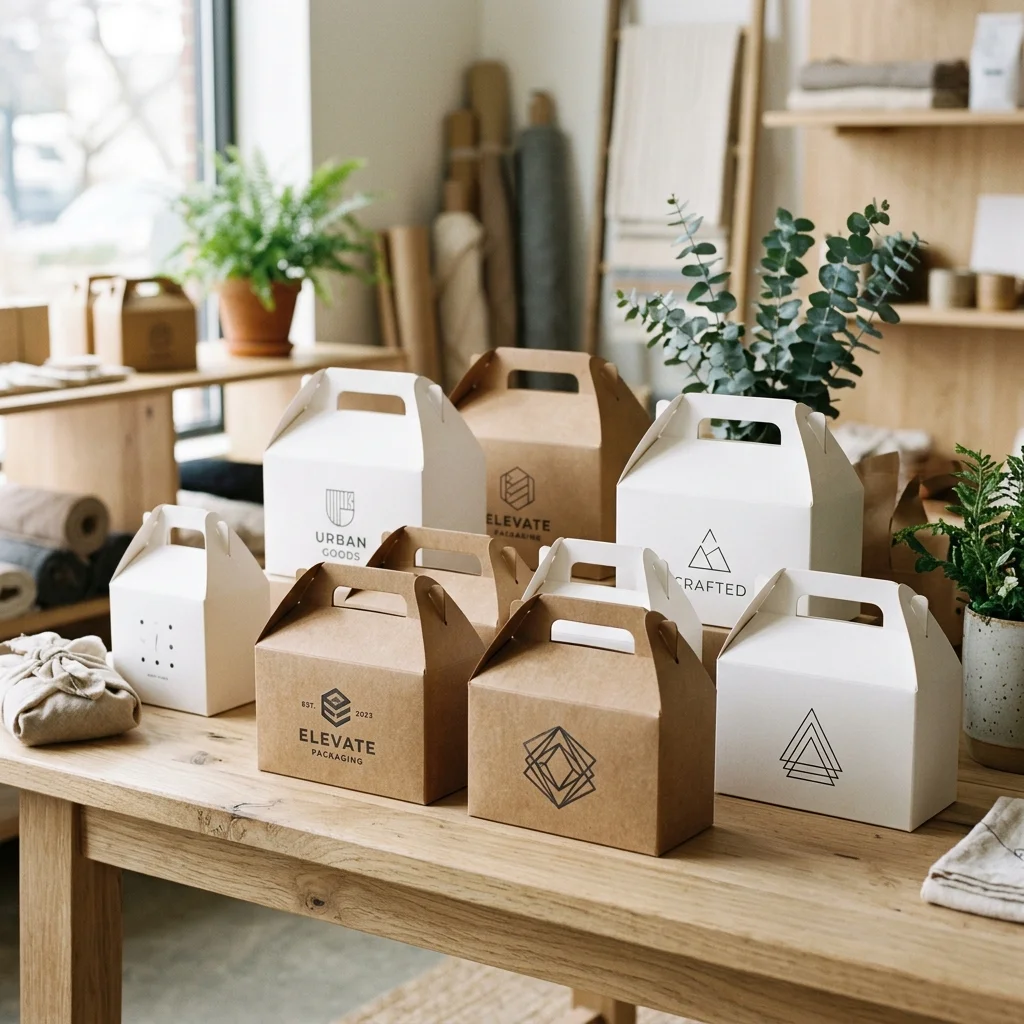
Custom Gable Boxes are paperboard packaging containers that combine a stable flat base with a triangular, tent-shaped top and an integrated carrying handle. These versatile boxes are widely used by retail, food service, and e-commerce brands because they function as both a secure shipping container and a convenient retail carrier. This design eliminates the need for an extra shopping bag. Growing brands use custom Gable Boxes to simplify their fulfillment workflows and create a memorable unboxing experience for customers. On average, switching to an integrated handle design can reduce retail checkout packaging costs by 22% compared to using separate boxes and paper bags.
Using these specialized containers helps businesses package everything from gourmet food items to cosmetics. But choosing the right material, size, and design requires an understanding of structural limits and printing techniques. This guide outlines the specifications, costs, and design decisions needed to build the perfect packaging for your product.
In this guide:
Gable boxes solve a practical problem in retail packaging. They offer a self-contained carrier that functions as both a product container and a gift bag. This dual utility is highly efficient for retail operations. When customers buy an item packaged in a gable box, the retail clerk does not need to place the item into a separate shopping bag. This simple design feature reduces the physical packaging footprint of a business and lowers total material costs.
Many e-commerce brands use these boxes for promotional mailers and retail influencer kits. The structural design of the box provides an interesting presentation when the recipient opens the top flaps. The built-in handle also makes the box easy for customers to carry out of a physical storefront. We have seen food service brands use grease-resistant paperboard variants for gourmet takeout, bakery assortments, and catering orders. Because the base is flat and the top is secure, these boxes stay upright in transit, which prevents delicate food items from shifting.
Using this style of packaging helps build brand recognition on the street. When a customer walks out of a store carrying a box with a distinctive handle and high-quality printing, they act as a moving advertisement for the business. This form of physical exposure is highly effective in dense retail environments. Unlike plain shopping bags, custom-printed handles draw the eye and generate curiosity.
Furthermore, the folding design means these containers require less storage space before they are filled. They arrive in flat sheets, which means a restaurant or boutique can store thousands of units under a single counter. This space-saving attribute is particularly useful for growing businesses operating in compact retail spaces where warehouse space is expensive.
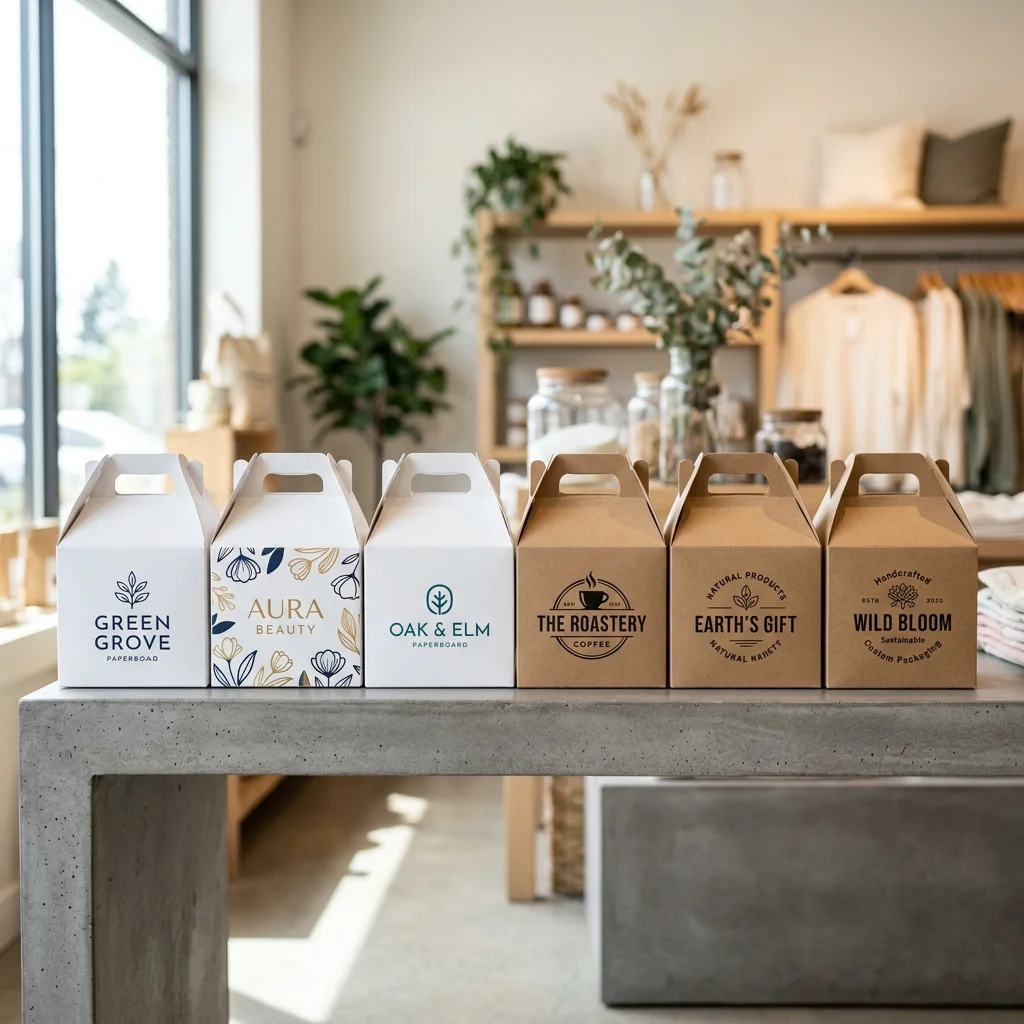 Custom printed gable boxes lined up on a display shelf
Selecting the correct material depends on the weight and fragility of your product. Custom Gable Boxes are generally manufactured from two categories of material: folding carton paperboard or corrugated cardboard.
Folding carton paperboard is thin, lightweight, and ideal for smaller items. The most common stock options are Solid Bleached Sulfate (SBS) and recycled Kraft paperboard. SBS paperboard is bleached white throughout, which provides a clean background for bright, multi-color prints. Kraft paperboard is brown and rustic, which appeals to organic and natural product manufacturers. For lightweight goods such as cosmetics, soaps, or baked treats, paperboard with a thickness of 18-point (0.018 inches) to 24-point (0.024 inches) provides sufficient rigidity.
If your products are heavy or fragile, corrugated cardboard is the safer choice. Corrugated cardboard contains a fluted inner layer between two flat liner boards, which offers superior cushioning and puncture resistance. For gable designs, E-flute corrugated cardboard, which is approximately 1/16 inch (1.6 mm) thick, or F-flute, which is 1/32 inch (0.8 mm) thick, are the industry standards. These micro-flute options provide a smooth surface for high-resolution printing while supporting heavier loads. Standard folding carton gable packaging built from 18-point SBS paperboard holds up to 3 pounds of product safely without structural warping.
Weight limits vary significantly by material choice. A folding carton gable box can support up to 3 pounds without risk of tearing. If your product weighs between 3 and 10 pounds, such as craft beer six-packs or heavy jarred sauces, corrugated cardboard is required. Ensure that your materials are certified by reputable organizations. If you pack direct-contact food items, the materials must meet standards set by the U.S. Food and Drug Administration. For environmentally conscious operations, choosing materials certified by the Forest Stewardship Council ensures that the wood pulp originates from responsibly managed forests.
Understanding paperboard density is also useful when selecting materials. Paperboard is often rated in grams per square meter (gsm). A typical 18-point board sits at roughly 350 gsm, which strikes a balance between flexibility and rigidity. When packaging bottles or heavy liquids, moving up to a 24-point board (around 450 gsm) prevents the base of the box from sagging. This thickness adjustment is a simple way to protect your goods without upgrading to more expensive corrugated materials.
To optimize your packaging budget, you must analyze structural costs, printing plates, and shipping fees. Custom Gable Boxes are cost-effective because they are shipped and stored flat. This flat-shipping format saves physical storage space in your warehouse and reduces inbound shipping costs compared to rigid, pre-assembled boxes.
Unit costs are heavily influenced by production volume, material thickness, and printing methods. For example, a small brand ordering 500 units will pay a higher price per unit than a larger brand ordering 5,000 units. This difference is due to setup costs for die-cutting machinery and printing presses. Minimum order volumes at Cubit Packaging typically start at 250 units to keep unit costs under $1.50 for standard sizes.
The following table compares the typical properties and cost ranges for various custom Gable Boxes configurations.
| Material Type | Caliper / Flute | Maximum Weight | Print Suitability | Estimated Unit Cost (1,000 Units) | Common Application |
|---|---|---|---|---|---|
| SBS Paperboard | 18-point to 24-point | Up to 3 lbs | High-definition litho, digital | $0.65 - $1.20 | Cosmetics, confectionery, gifts |
| Recycled Kraft | 18-point to 24-point | Up to 3 lbs | Minimalist flexo, digital | $0.55 - $1.10 | Organic soaps, artisan foods |
| E-Flute Corrugated | 1/16 inch (1.6 mm) | Up to 10 lbs | Direct digital, flexographic | $1.10 - $2.10 | Craft beer, heavy gift jars, tools |
| B-Flute Corrugated | 1/8 inch (3.2 mm) | Up to 15 lbs | Flexographic simple prints | $1.40 - $2.50 | Heavy retail kits, subscription boxes |
We have found that brands can lower their total expenses by matching material strength directly to product weight. Buying an over-engineered corrugated box for a lightweight tube of hand cream wastefully increases both material expenses and postal charges. Conversely, choosing thin paperboard for a heavy glass jar leads to torn handles and damaged merchandise during delivery. Custom folding carton gable boxes cost between $0.45 and $1.85 per unit at volumes of 2,000, compared to higher prices for two-piece rigid boxes.
Another factor is the choice between stock sizes and custom dimensions. Stock sizes do not require custom tooling, which means you avoid the one-time structural die charge that typically ranges from $150 to $400. However, if your product has unique proportions, a custom die-cut pattern ensures a snug fit that prevents movement. This extra upfront cost often pays for itself by reducing the amount of internal protective packaging, such as bubble wrap or shredded paper, that you need to purchase.
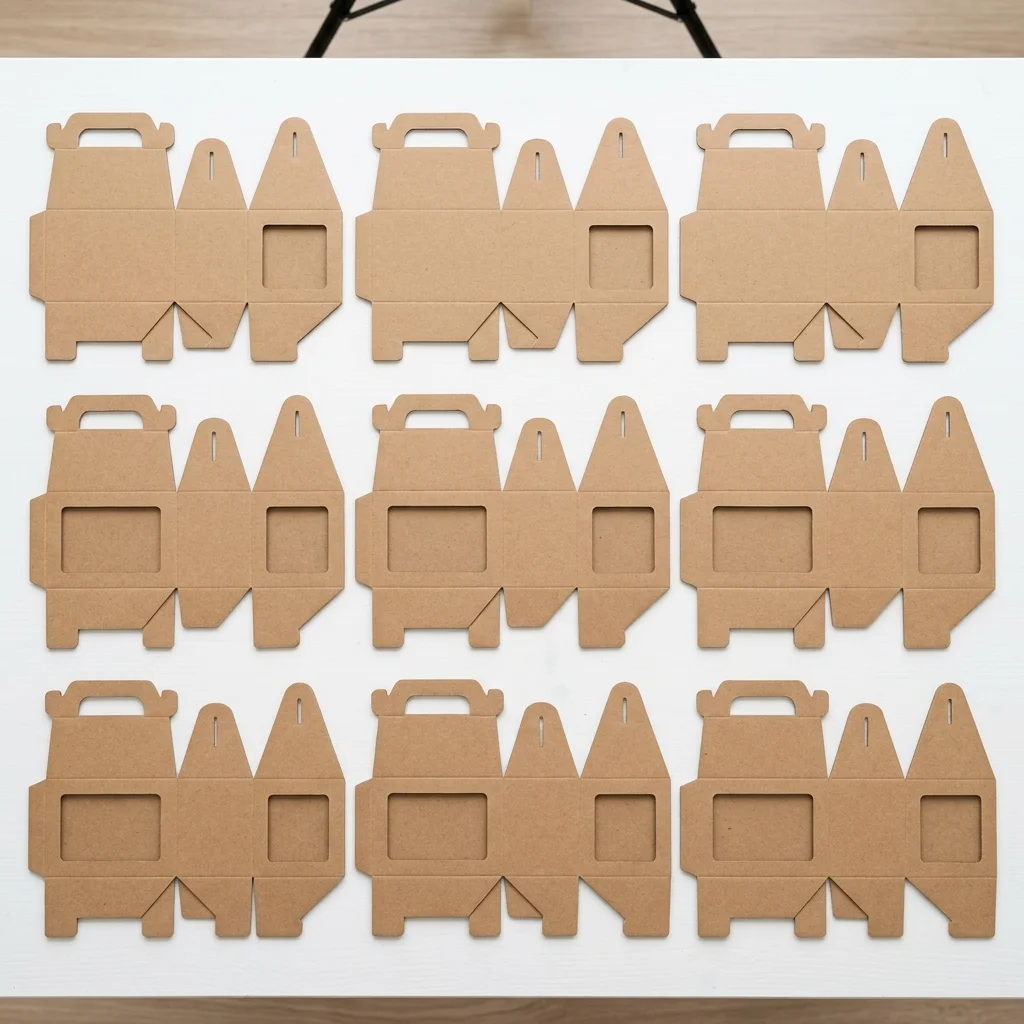 Flat cardboard sheets ready for assembly into custom gable boxes
Designing custom Gable Boxes requires careful attention to the flat die lines. The packaging template includes several panels that sit at different angles once assembled. The triangular top slopes inward, which means any text or logos printed on these panels must be oriented correctly so they do not appear upside down to the shopper.
There are three primary printing methods used for gable packaging: digital, offset, and flexographic printing. Digital printing is ideal for small runs under 1,000 units because it does not require expensive printing plates. This makes it highly suitable for seasonal promotions. Offset printing provides the sharpest text and most accurate color matching for high-volume orders, particularly when using specific Pantone Matching System (PMS) colors. Flexographic printing is a simpler, high-speed method best suited for high-volume, low-complexity shipping boxes with one or two ink colors.
You can apply several finishes to the printed surface to protect the ink and improve the tactile experience. A matte aqueous coating offers a soft, non-reflective finish that hides fingerprints during handling. A glossy ultraviolet (UV) coating makes colors appear more saturated and provides a scratch-resistant barrier. For premium products, spot UV printing applies a glossy layer to specific areas, such as your logo. This creates a physical contrast against a matte background.
When preparing your artwork, work closely with our team to ensure the graphic layout matches the physical folds. Keep critical design elements, such as product names and nutritional facts, at least 0.125 inches away from the crease lines to avoid cracking or distortion during folding. You can consult our packaging design guidelines to learn more about setting up vector layers and bleeds.
Color selection is also influenced by your choice of paperboard. When printing on natural brown Kraft paperboard, colors will appear more muted because the brown fibers absorb the ink. To achieve bright reds, blues, or yellows on Kraft, we apply a base layer of white ink beneath your artwork. This extra step ensures your branding remains distinct while retaining the organic texture of the paper.
The speed of your packing line is just as important as the cost of the raw materials. If a box is difficult to assemble, the labor costs of your fulfillment team will offset any initial savings on the material. Fortunately, custom Gable Boxes are designed for fast assembly, though the specific bottom closure mechanism you choose determines the speed. By replacing a traditional two-piece box and retail shopping bag with a single gable box, retail brands cut average packaging assembly time by 45% during peak fulfillment seasons.
The three primary bottom closure styles are standard tuck bottoms, 1-2-3 snap-lock bottoms, and auto-bottoms. Standard tuck bottoms are the simplest but require careful manual folding. A 1-2-3 snap-lock bottom requires you to fold the flaps in a specific sequence, which interlocks them for a secure hold without tape. The auto-bottom option is the fastest; the bottom of the box is pre-glued during manufacturing, so it pops into place automatically when you squeeze the sides. While auto-bottom styles have a higher unit cost due to the gluing step, they reduce manual labor significantly.
We have seen brands make the mistake of overloading the handle mechanism. The handle is formed by overlapping two matching die-cut tabs and securing them with two folding side flaps. This interlocking design distributes the weight across the entire top structure of the box. To maintain structural integrity, workers must ensure the handle pieces are completely aligned and pushed flat before handing the package to a customer.
For retail setups, we recommend training fulfillment staff to fold the base first, insert the product, and then close the handle. This order of assembly keeps the top of the box clean and prevents creasing along the delicate handle tabs. For businesses handling thousands of orders a week, we recommend purchasing custom retail packaging templates that have been stress-tested for your specific weight profile.
To ensure the handles do not rip under stress, we recommend keeping the handle slot width at a minimum of 3 inches. This width allows a customer to fit three or four fingers through the handle comfortably, which reduces twisting forces that can cause the paperboard to tear.
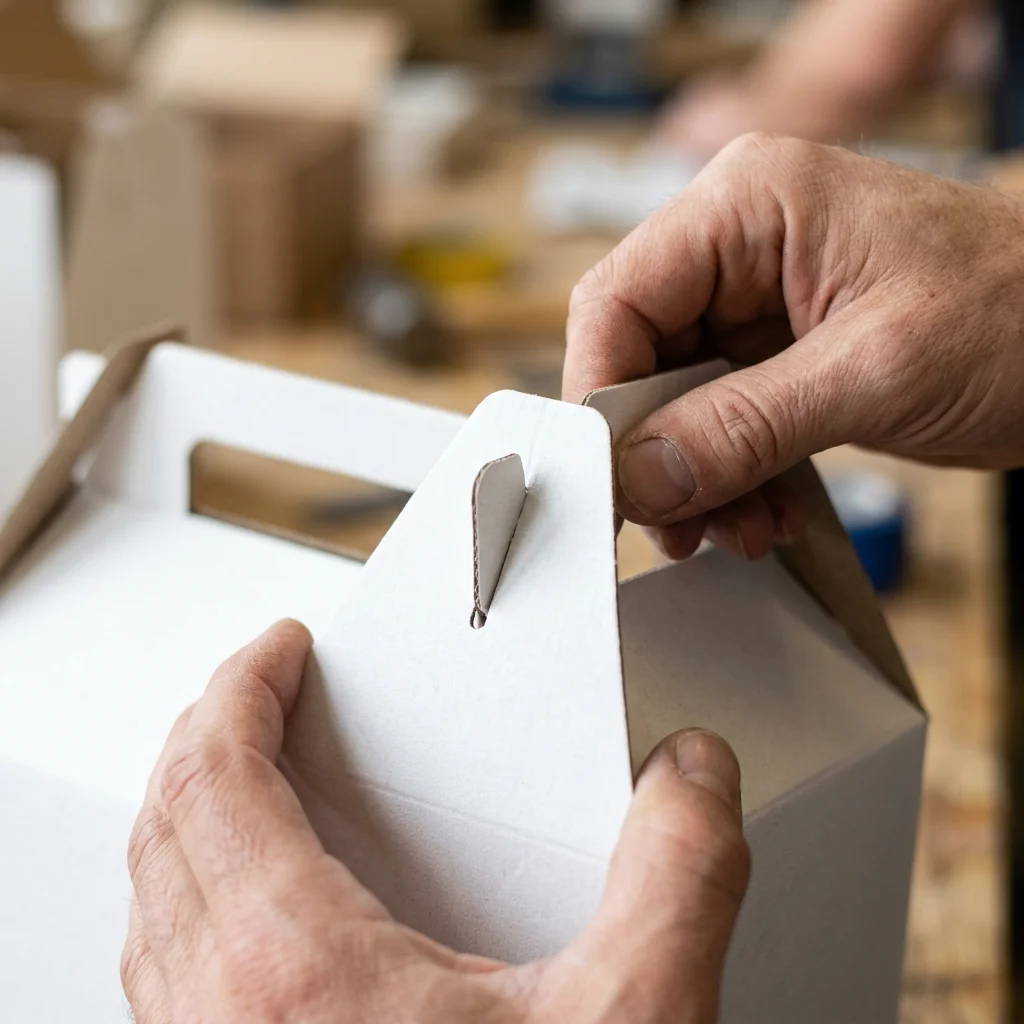 Close up of a hand locking the handle of a custom cardboard gable box
Based on the packaging orders we process at Cubit Packaging, 64% of brands choosing custom Gable Boxes select the auto-bottom option over standard snap-lock bottoms. Even though the auto-bottom structure carries a 15% higher initial material cost, it saves brands an average of 18 seconds of assembly time per unit, which translates to massive labor savings for high-volume operations.
No, standard custom Gable Boxes do not require glue or tape. The bottom flaps lock together mechanically, and the handle pieces interlock at the top to secure the lid. For faster fulfillment, you can choose pre-glued auto-bottom styles that pop open instantly.
At Cubit Packaging, our minimum order quantity for custom Gable Boxes starts at 250 units. Ordering higher volumes, such as 1,000 or 5,000 units, significantly reduces the price per unit due to minimized setup costs on our industrial die-cutting machines.
Yes, but they must be manufactured using food-safe materials that meet U.S. Food and Drug Administration guidelines. If your food is oily, we recommend using a grease-resistant barrier coating on the interior of the paperboard to prevent stains and structural failure.
While folding paperboard styles are designed for in-person retail, you can ship products in corrugated custom Gable Boxes through carriers like USPS or FedEx. We recommend using E-flute or B-flute corrugated cardboard to withstand the drops and vibrations of transit.
Designing artwork requires placing graphics within our provided structural template. Because the top panels slope toward each other, any logos or text placed on these sections must be oriented 180 degrees opposite the main front panels to ensure they appear upright.
Selecting the perfect packaging configuration is a balance of material strength, assembly speed, and design precision. By matching your product weight to the appropriate paperboard thickness, you protect your merchandise while minimizing raw material costs. When you are ready to design your own custom Gable Boxes, our team is here to help select materials, verify structural templates, and optimize your production run.
Get a free quote for your packaging project
Get started on your custom branding with custom Gable Boxes directly from our online marketplace, or build a personalized quote at our RFQ Procurement portal.
Design your packaging free in 60s
Try the free AI packaging design toolNeed Custom Packaging?
Get a free quote with pricing, MOQs, and turnaround time for your custom packaging project.