
Folding Carton Styles: Tuck End vs Auto-Bottom vs Window Boxes (2026)
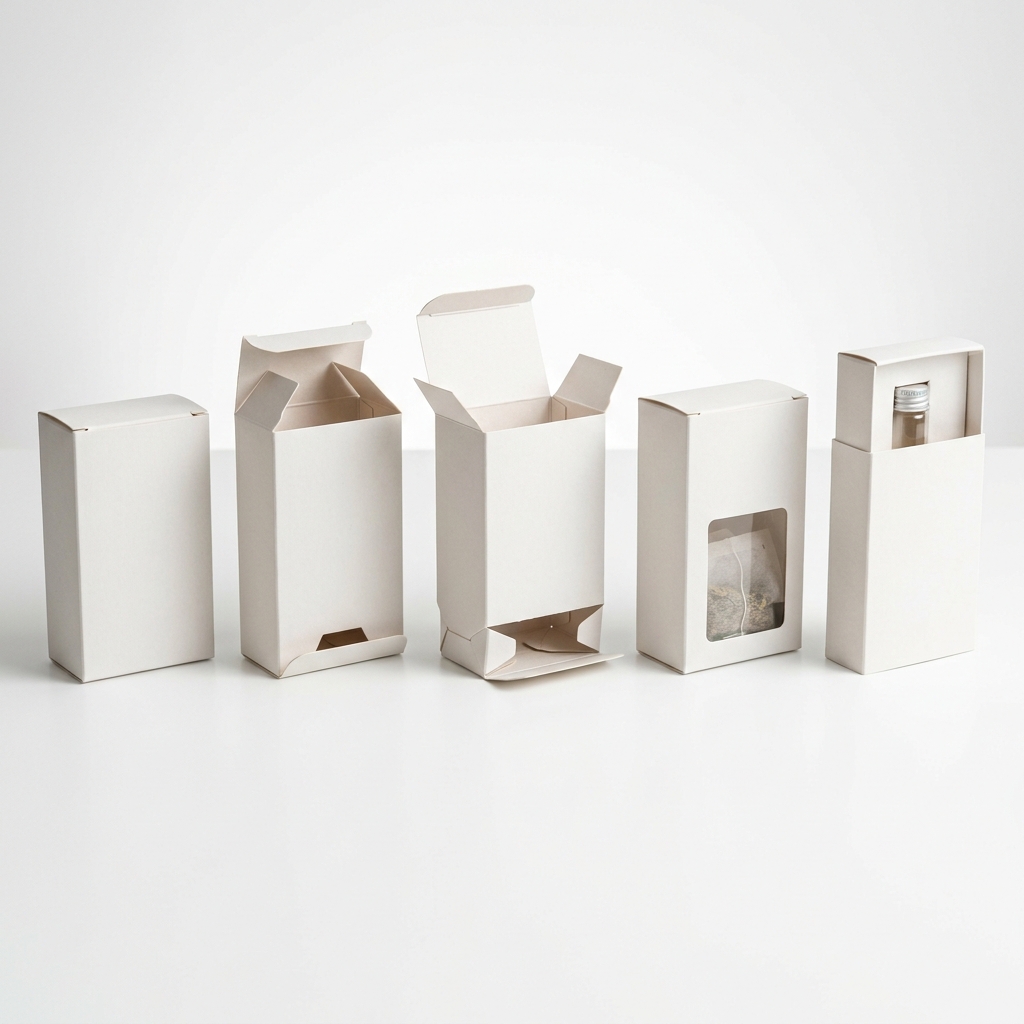
Folding Carton Styles: A Complete Guide to Every Box Type
Folding cartons come in multiple standardized styles, each engineered for specific retail, food, cosmetic, and pharmaceutical applications. Understanding the differences helps you choose the most cost-effective and functional packaging for your products.
1. Straight Tuck End (STE)
The STE is the most basic and cost-effective folding carton style. Both top and bottom flaps tuck in the same direction (toward the front).
- Assembly: Manual — both ends require hand tucking
- Cost: Lowest — minimal tooling, produces least waste
- Security: Moderate — flaps can be opened without damage
- Best for: General retail, pharmaceuticals, supplements, samples
- MOQ at Cubit: 500 units
When to choose STE: Budget-conscious projects where manual assembly speed is not critical and tamper-evidence is not required.
2. Reverse Tuck End (RTE)
The RTE is the most popular retail folding carton. Top and bottom flaps tuck in opposite directions — the top flap folds toward the back while the bottom folds toward the front.
- Assembly: Manual — slightly faster than STE due to opposing flap logic
- Cost: Same as STE (no additional tooling)
- Security: Better — opposing tuck provides more structural stability
- Best for: Cosmetics, personal care, electronics accessories, retail shelf display
- MOQ at Cubit: 500 units
When to choose RTE: The default choice for most retail packaging. The opposing tuck creates a cleaner shelf presentation.
3. Auto-Bottom (Snap Lock)
The auto-bottom carton has a pre-glued bottom that snaps into place when the carton is opened. This eliminates manual bottom-tucking and dramatically speeds up packing.
- Assembly: Semi-automated — bottom locks automatically, only top needs tucking
- Cost: +15–20% vs tuck end (requires gluing tooling)
- Security: High — glued bottom is tamper-resistant
- Best for: Heavy products (bottles, jars), food items, high-volume fulfillment
- MOQ at Cubit: 1,000 units
When to choose auto-bottom: Products over 8 oz, high-volume operations where assembly speed matters, or when the product weight requires structural bottom support.
4. Window Carton
A window carton features a die-cut aperture covered with transparent PET or cellophane film, allowing customers to see the product inside without opening the package.
- Assembly: Same as STE or RTE (window is pre-applied)
- Cost: +25–30% vs standard tuck end (die-cut + film application)
- Security: Moderate — depends on base style
- Best for: Food (bakery, confectionery), toys, cosmetics, any product where visual appeal drives purchase decisions
- MOQ at Cubit: 500 units
When to choose window carton: When your product sells based on appearance. Studies show window packaging increases purchase intent by 30–40% for food and beauty products.
5. Sleeve & Tray
A two-piece design consisting of an outer sleeve that slides over an inner tray. This creates a premium "drawer" unboxing experience.
- Assembly: Two pieces — tray + sleeve (pre-assembled or separate)
- Cost: +30–40% vs tuck end (two separate pieces + extra material)
- Security: High — requires intentional pulling to open
- Best for: Luxury cosmetics, electronics, gift sets, premium supplements
- MOQ at Cubit: 1,000 units
When to choose sleeve & tray: Premium brands where the unboxing experience is part of the product value. Creates a "reveal" moment.
Style Comparison Table
| Style | Cost vs STE | Assembly Speed | Weight Limit | Shelf Appeal | Best For |
|---|---|---|---|---|---|
| STE | Baseline | Slow | Up to 12 oz | Standard | Budget retail |
| RTE | Same | Moderate | Up to 12 oz | Good | Most retail |
| Auto-Bottom | +15–20% | Fast | Up to 32 oz | Good | Heavy products |
| Window | +25–30% | Moderate | Up to 16 oz | Excellent | Visual products |
| Sleeve & Tray | +30–40% | Slow | Up to 24 oz | Premium | Luxury brands |
Frequently Asked Questions
Which folding carton style is most popular?
The Reverse Tuck End (RTE) is the most widely used style, accounting for approximately 60% of all folding cartons produced. Its ease of assembly and clean shelf presentation make it the default choice.
Can I mix styles in one order?
Yes — Cubit Packaging can produce multiple styles in a single order. Many brands use RTE for standard products and auto-bottom for heavier items within the same product line.
Which style is best for food packaging?
Window cartons are the top choice for food because they let customers see the product. For heavy food items (jars, bottles), choose an auto-bottom window carton for both visibility and structural support.
Need help choosing the right folding carton style? Browse our collection or get a free quote. Our AI consultant can recommend the ideal style for your product.
🛍️ Order Custom Folding Cartons
Ready to order? Cubit offers custom folding cartons from $0.25/unit in SBS and kraft paperboard with tuck end, auto-bottom, window, and sleeve-and-tray styles. Full-color offset printing with spot UV, foil, and soft-touch finishes.
→ Browse Folding Cartons · Design with AI · Get a Free Quote
Order custom folding cartons. Custom Folding Cartons → — SBS & kraft, tuck-end, auto-bottom, window styles. From $0.25/unit. Browse folding cartons →
Need Custom Folding Cartons?
Custom folding cartons from $0.25/unit. SBS & kraft paperboard. Tuck end, auto-bottom, window box styles. Offset/digital print. 500 MOQ.
Browse Folding Cartons →