
Packaging Comparisons
Folding Cartons vs Stand-Up Pouches vs Mylar Bags for Food: Which Packaging Is Right? (2026)
Cubit Packaging Team
May 22, 2026
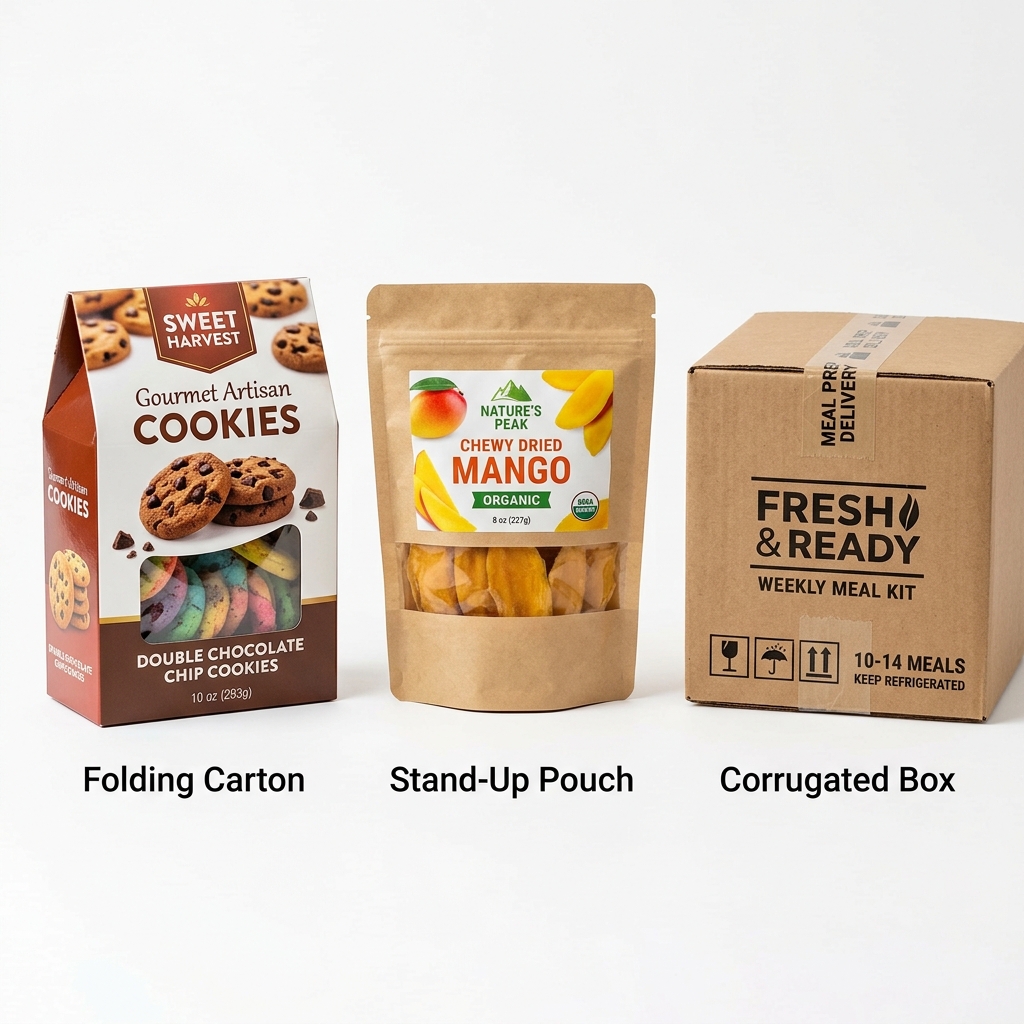
You've got a food product that needs packaging. The three formats your manufacturer will quote — folding cartons, stand-up pouches, and mylar bags — each solve different problems. Pick wrong and you're either overpaying per unit, watching product go stale on shelves, or losing retail accounts because your packaging doesn't stand out.
This comparison breaks down 8 real-world factors with actual cost figures so you can make the call confidently.
From our production floor: 80% of food startups switch packaging formats within 18 months. That retooling — new plates, new dies, new inventory — costs $8,000-$15,000. Spending 30 minutes on this comparison saves you real money.
| Factor | Folding Carton | Stand-Up Pouch | Mylar Bag |
|---|---|---|---|
| Ideal product | Retail shelf items | Resealable dry/wet goods | Long-term storage items |
| Shelf life | 1-6 months | 6-18 months | 12-36+ months |
| FDA compliant | ✅ | ✅ | ✅ |
| Oxygen barrier | Low-Medium | Medium-High | Highest (foil layer) |
| Moisture barrier | Low (PE coating adds medium) | High | Highest |
| Print quality | ⭐⭐⭐⭐⭐ Best in class | ⭐⭐⭐⭐ Very strong | ⭐⭐⭐⭐ Very strong |
| Resealable | No (tuck flap only) | Yes — zipper standard | Yes — zipper standard |
| Window option | Yes | Yes — clear panels | Yes — clear panels |
| Package weight | Heavy | 75% lighter | 75% lighter |
| Recyclability | ⭐⭐⭐⭐⭐ Curbside | ⭐⭐⭐ Improving | ⭐⭐ Limited |
| Cost (1,000 units) | $1.00-$1.80/ea | $0.40-$0.80/ea | $0.25-$0.50/ea |
| MOQ at Cubit | 500 | 500 | 500 |
Folding cartons own the grocery aisle. Walk through any Whole Foods or Target — 60% of what you see in the food section is packaged in a folding carton. There's a reason for that.
Stand-up pouches are growing at 6.8% CAGR in the US — faster than any other food packaging format. Coffee roasters, snack brands, and pet food companies have all moved to pouches in the last 5 years. The economics make sense.
Mylar bags deliver the highest oxygen and moisture barrier of any flexible packaging format. The aluminum foil layer blocks 99.9% of O₂ and moisture transmission. If your product needs to last months or years — freeze-dried meals, specialty coffee, cannabis edibles — mylar is the answer.
You sell on retail shelves, need premium brand presence, your product has a shorter shelf life, and your budget allows $0.80+ per unit. Think bakery brands, chocolate companies, frozen food.
You need the best balance of barrier, convenience, shipping cost, and branding. This is the right choice for 60% of food products we quote. Coffee, snacks, dried goods, sauces, pet food.
Shelf life is your #1 priority, you need maximum barrier protection, your per-unit budget is tight, or you're in the cannabis edibles space. Emergency food, specialty coffee, freeze-dried products.
Nobody says you have to pick one. Many of our best-performing food clients use two or three formats:
See the full food packaging catalog at Cubit Food & Beverage Packaging.
Mylar bags — $0.08 to $0.50 per unit depending on size and quantity. Stand-up pouches run $0.18 to $0.80. Folding cartons are $0.40 to $1.80. But cheapest isn't always smartest. A $1.20 folding carton on a Whole Foods shelf might outsell a $0.30 pouch on Amazon by 3x.
Yes. Pouches made with FDA-compliant film structures — PET/PE, PET/AL/PE, BOPP/CPP — are fully approved under 21 CFR for direct food contact. We include FDA compliance documentation with every pouch order.
Standard mylar works best with dry products. Wet foods need a specialized laminate with reinforced heat-seal integrity. Frozen foods can work in mylar, but PE-coated folding cartons or freezer-grade stand-up pouches handle freeze-thaw cycles more reliably.
Folding cartons made from SBS or kraft paperboard — recyclable at curbside in every US state, available with FSC certification. For flexible packaging, mono-material PE pouches are the emerging recyclable option, though collection infrastructure is still catching up.
Not sure which format fits your product? Our AI packaging consultant matches your product specs to the right format in under 2 minutes. Or request free samples of all three formats to compare in person.
Ready to choose? Browse Cubit's full catalog with custom printing and free design support:
Mailer Boxes · Corrugated Boxes · Folding Cartons · Rigid Boxes · Pouches · Mylar Bags · Get a Free Quote
Order custom food packaging. Custom Bakery Boxes → | Custom Stand-Up Pouches → | Custom Paper Bags → — FDA food-grade, full-color printing. Browse all packaging →
Design your packaging free in 60s
Try the free AI packaging design toolNeed Custom Packaging?
Get a free quote with pricing, MOQs, and turnaround time for your custom packaging project.