
Compostable vs Recyclable vs Biodegradable Packaging Explained (2026)
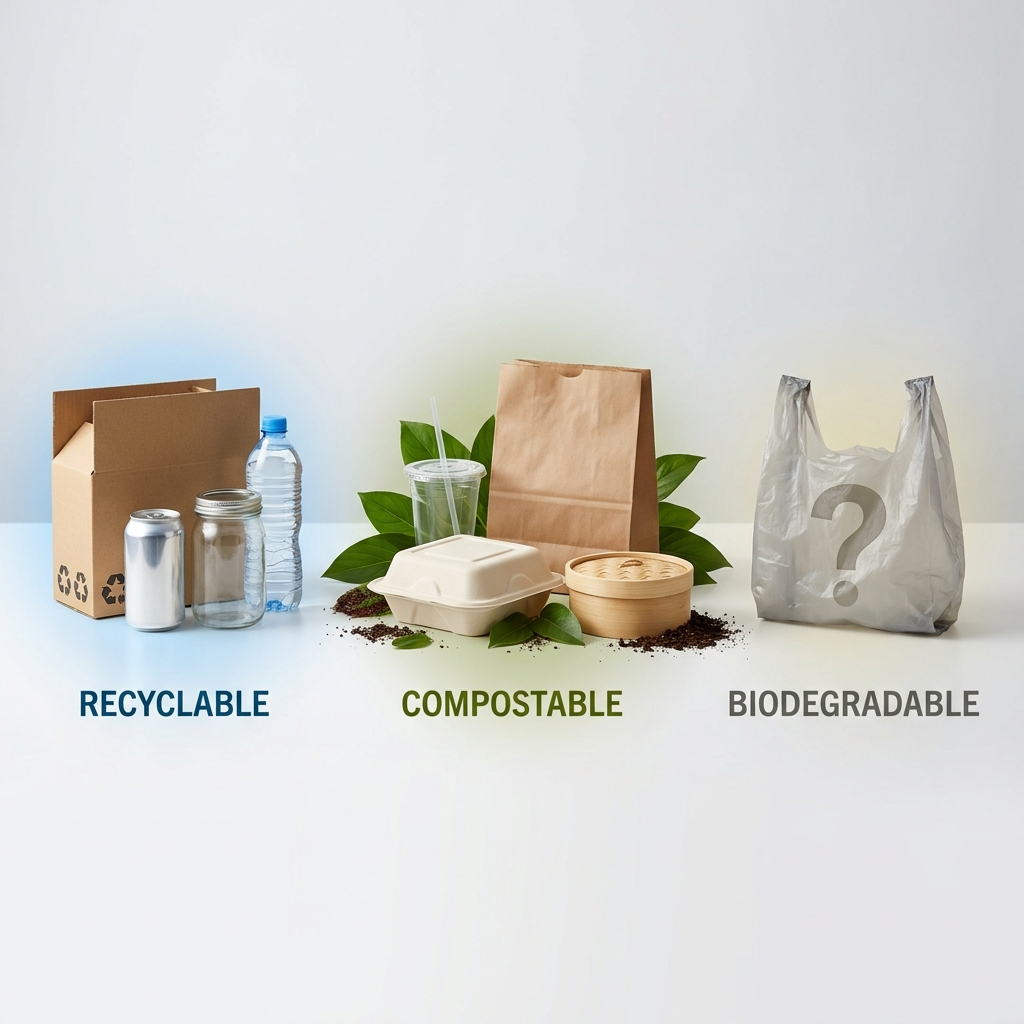
Compostable vs Recyclable vs Biodegradable: What's the Difference?
These three terms are often confused, but they describe fundamentally different end-of-life pathways for packaging. Choosing the right one affects your environmental impact, cost, certifications, and marketing claims.
Quick answer: Recyclable = reprocessed into new products (cheapest, most scalable). Compostable = breaks down into soil nutrients in 90 days at a composting facility (strictest standard). Biodegradable = will eventually decompose, with no guaranteed timeline (least meaningful claim).
Recyclable Packaging
Definition: Can be collected, sorted, and reprocessed into new raw materials through existing municipal or commercial recycling infrastructure.
How It Works
- Consumer places package in recycling bin
- Material is collected, sorted by type (paper, plastic #1-7, metal, glass)
- Material is cleaned, shredded, and melted/pulped
- Reprocessed into new packaging or products
Key Facts
- Timeline: Infinite loop (paper can be recycled 5-7 times, aluminum infinitely)
- Infrastructure: Widely available — 94% of US has curbside recycling
- Certification: How2Recycle label for consumer clarity
- Cost premium: 0–10% (recycled corrugated costs the same as virgin)
- Best materials: Cardboard (93% recycling rate), aluminum, glass, PET #1, HDPE #2
Limitations
- Not all recyclable materials ARE recycled (PET bottles: 29% recycling rate in US)
- Multi-material packaging (paper + plastic lamination) is NOT recyclable
- Contaminated packaging goes to landfill
Best for: Any brand wanting the lowest-cost, most scalable sustainability option. Start by making existing packaging actually recyclable (remove lamination, use mono-materials).
Compostable Packaging
Definition: Breaks down into carbon dioxide, water, and nutrient-rich compost within 90 days in a commercial composting facility at 140°F+ temperatures.
How It Works
- Consumer places package in commercial compost bin (NOT home trash)
- Material is collected and taken to a composting facility
- Under controlled heat (140°F+), moisture, and microbial activity, the material decomposes
- Result: Nutrient-rich compost used for agriculture and landscaping
Key Facts
- Timeline: 90 days in commercial facility, 180 days for home compostable
- Infrastructure: Limited — only 4,700 composting facilities in the US
- Certification: ASTM D6400 (US), EN 13432 (EU), BPI, OK Compost
- Cost premium: 25–50% over conventional
- Best materials: PLA (corn-based), PBAT films, bagasse (sugarcane), bamboo fiber
Limitations
- Requires access to commercial composting (not available everywhere)
- Will NOT decompose in a landfill (no oxygen or heat)
- Often confused with "biodegradable" — they are NOT the same
- Cannot be recycled in standard recycling streams (contaminates the stream)
Best for: Food packaging, food service, and brands serving eco-conscious consumers in cities with commercial composting programs.
Biodegradable Packaging
Definition: Will eventually break down through natural biological processes. No guaranteed timeline, no specific conditions, and no certification standard.
Key Facts
- Timeline: Months to decades depending on conditions
- Infrastructure: None required (but landfill conditions slow decomposition)
- Certification: None standardized (claims are often unverified)
- Cost premium: Variable (10–30%)
- Marketing risk: FTC Green Guides warn against unqualified "biodegradable" claims
Why "Biodegradable" Is the Weakest Claim
Technically, everything is biodegradable given enough time — even a plastic bag will decompose in 500 years. The term has no legal timeline, no certification, and is frequently used in greenwashing. The FTC requires brands to specify conditions and timeline if making biodegradable claims.
Recommendation: Avoid "biodegradable" as a primary sustainability claim. Use "compostable" (with ASTM D6400 certification) or "recyclable" (with How2Recycle label) instead.
Side-by-Side Comparison
| Feature | Recyclable | Compostable | Biodegradable |
|---|---|---|---|
| Timeline | Instant (reprocessed) | 90 days | Months to centuries |
| End result | New raw material | Soil nutrients | CO₂ + fragments |
| Infrastructure | 94% US coverage | 4,700 facilities | None needed |
| Certification | How2Recycle | ASTM D6400, BPI | None standard |
| Cost premium | 0–10% | 25–50% | 10–30% |
| Consumer trust | High | Very high | Low (greenwashing risk) |
| Best option when | Maximum scale | Food contact, eco cities | Avoid this claim |
Which Should Your Brand Choose?
Choose Recyclable When:
- You want the lowest-cost sustainability upgrade
- Your packaging is paper/cardboard-based
- You serve a broad consumer base
- Scalability matters more than "cutting edge" eco claims
Choose Compostable When:
- You sell food or food-adjacent products
- Your customers have access to commercial composting
- You want the strongest environmental claim
- You can absorb the 25–50% cost premium
Choose Both:
- Many brands use recyclable paperboard boxes with compostable inner materials (best of both worlds)
Need help choosing the right sustainable packaging? Get a free quote or ask our AI consultant. Browse our eco-friendly collection.
Order custom packaging for your brand. Custom Mailer Boxes → | Custom Folding Cartons → | Custom Labels → — full-color printing, premium materials. From 500 units. Get a free quote →